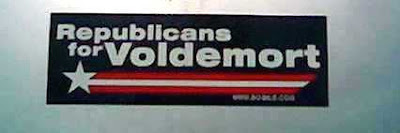
During the 2008 presidential election, I spotted this gem.
This one turned up on Facebook on a friend’s timeline.
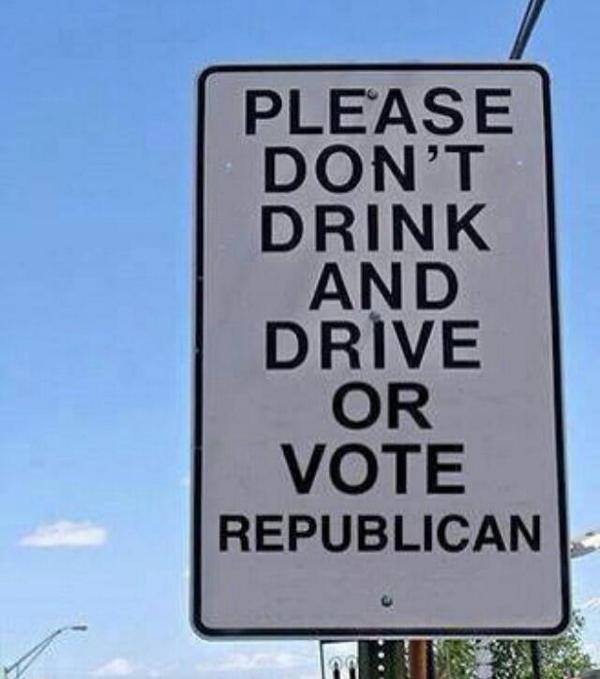
I couldn’t say it better myself.

During the 2008 presidential election, I spotted this gem.
This one turned up on Facebook on a friend’s timeline.
I couldn’t say it better myself.

In the last election cycle, I mentioned that lacking money to donate, I would donate time to help elect my chosen candidates. Five days before election day, I found myself in the Emergency room of the nearest hospital, hooked up to many machines, unable to move or control my left side. I thought to myself, “Thank goodness I voted early!”
My episode resembling a stroke kept me from volunteering during the weekend of action, a big one. I’d already given many hours of time to prepare volunteer packets for the day. I managed to stop by the office downtown and donate chocolate to keep people happy during their full day.
I have regained control over the left side of my body, but I’ve had other problems since fall of 2012. With all of that in mind, I need to set myself some definite boundaries for this fall election cycle.
To maintain my physical and mental health, I will NOT:
To further maintain my physical and mental health, I WILL:
Intellectually Vulnerable — I saw the term on Facebook, of all places. The complete phrase read, “…trying to sell his snake oil to the intellectually vulnerable.” Intellectual snake oil — that’s another interesting term, combining the two in the sentence.
Snake oil, according to Merriam-Webster, is “any of various substances or mixtures sold as medicine usually without regard to their medical worth or properties.” A vulnerable buyer might pay for this snake oil and get stuck with a worthless product.
The snake oil on the market today doesn’t come in a bottle. Today’s snake oil is more a collection of misinformation, often talk with no action or talk that has no basis in fact.
Back to Merriam-Webster. Intellectual snake oil, ideas without merit, sound wonderful because they sound simple. The vulnerable might think, “Yeah! I like this! It’ll solve all the world’s ills in one shot!” But no. Nothing is ever that simple. And those that are vulnerable might also be those that are hurt by the simplistic faux solution.
Where is this heading? Tuesday, it’s headed to the polls – at least I am. We have a school board to elect and a new City Council member for our ward, too. I can’t quite bring myself to use the term “alderperson.” It sounds so impersonal.
I think I’ll make a bumper sticker that says, “I’m NOT intellectually vulnerable; and I vote!”
It got into my head during BridgeGate. You might remember New Jersey Governor Chris Christie and his staff dealing with the aftermath of an episode that could also be called Traffic Troubles and Retribution.
Closer to home, Wisconsin Governor Scott Walker is refusing to answer questions about an alleged ongoing violations of campaign laws when he was Milwaukee County Executive and running for governor. He had his campaign staff set up an alternate email system using laptops so that the emails would not be public record and so that his office staff could work on his campaign during their office hours, essentially working on his campaign while on the public dime – a violation of Wisconsin law.
Even closer to home, a local school district had a heartbreaker of a case where a teacher was mistreating students. A paraprofessional (teacher aide) in the class felt intimidated and feared she would lose her job if she reported the problems.
In all three cases, the workplace climate is key. In both governor’s offices, the philosophy seems to be “Do it; we’re above the law.” Both governors are still fighting the battle of “what they knew and when they knew it” and both have watched staffers take the fall for the events that broke the law. In the third case, the worried witness felt unsafe, intimidated, and basically bullied into submission.
Above the law.
Do it.
Don’t question anything.
Don’t rock the boat.
Don’t even consider making waves.
Whether Gov. Christie knew of the bridge closing traffic-disrupting action, his workplace climate obviously encouraged retribution and demonstration of power.
Gov. Walker’s staff did as they were told. Whether he was the puppet or the one holding the strings, his office was another one with an inner circle that promoted and enjoyed the privilege of breaking laws without fearing consequences.
In the school district’s case, a follow up investigation seemed to say that the working climate was safe, open, and unintimidating. I have my doubts. This kind of office philosophy is harder to uncover than the Powers That Be might think. Fear runs deep.
And as we enter another election cycle and my phone starts ringing with volunteer opportunities, I have to ask myself: where do I stand? How far am I willing to go in order to expose this kind of workplace climate and participate in changing it for the better?
That’s a climate change I could handle.
Remember Wisconsin Act 10? It started as a budget “repair” bill, and when our governor’s followers couldn’t pull together a quorum, they changed the bill enough to pass it — oh, I’m sorry, I can’t summarize this quickly. It’s the law commonly known as the Union Buster. It’s featured along with a few other political topics on my Voter’s Voice page. That’s Voter, as in singular, as in me. One voter’s voice. Recently, a different sort of vote surfaced, one that requires voters, plural, to raise their voices.
According to Good Ole Act Ten, public sector unions like the one to which I belong must vote to recertify their associations in order to bargain what little they still can. Our local met last night to vote on whether or not to pursue the recertification process. Why not? Well, the whole process is still tied up in court and may be unnecessary if the related part of the law is found to be unconstitutional. Get it? Uh-huh. I hear you.
Meanwhile, all potential eligible possible members must be part of the recertification. To keep on as a bargaining entity, my local needs to get 51% of all the actual members AND the call-me-maybes. We set goals last night at our meeting; each member present at the meeting was to recruit and be personally responsible for three votes in addition to our own. If that happens, we will successfully get at least the 51% that we need.
The phone call vote is not easy, though. The Powers That Be designed the automated call process to make callers jump through a few hoops. If a caller hangs up one hoop shy of completion, the vote gets recorded as NO.
The Powers That Be underestimated us. Seriously, most definitely underestimated us. We are teachers! Giving complete directions is what we do! The leaders of our local made up a handout with two sides: One with written directions for the verbal linguistic word-person types, and one with a flow chart for the more visual learners.
Wait! I forgot a detail about the automated voting system. Anyone who doesn’t call at all is recorded as a NO. That’s right, folks, no vote at all counts as a vote towards the Governor’s union busters. All potential members who fail to call are counted in the negative column just as though they had thumbed their collective noses at collective bargaining.
Well, readers, I recruited two on my own and checked on a third potential voter. I do plan to quietly chat with a couple of my nonmember colleagues and ask them to do the democratic thing and be counted. Yes or no, pro or con, our nonmembers need to make their preferences known.
When it’s over, maybe I’ll jump back into the future and ask Grandma Daisy to reminisce a little. I’ll get back to you, folks.
Readers, if you haven’t been around long enough to recognize the Daisy Reality Show, here’s a brief introduction.
Daisy (yours truly) hosts a reality show at the O.K. Chorale. The director and her bumbling assistant keep the show on track and provide a running commentary off-screen.
Daisy: I’m baking cookies this afternoon. We have no snack foods worth eating. Well, few snack foods in the house. Peanuts, cashews, the makings for trail mix – that’s it.
Assistant: I see chips. What’s wrong with potato chips?
He had to ask, didn’t he?
Daisy: It’s like Michael Pollan says in his Food Rules: Eat food, not too much, mostly plants. In this case, I’m following his advice that whole foods are better than processed foods and junk food is okay in moderation when I make it myself.
Assistant (pretending to understand): Oh.
Daisy’s cell phone chirps, indicating a text message.
Daisy: Oh, it’s my daughter. She says:
So we were sitting at the fair eating ice cream and I spotted something terrifying — Paul Ryan.
Daisy (Laughing): That’s my daughter, a good progressive young woman! I’ll respond and tell her to run, run fast, run far in the other direction.
Director: Oh, I remember you were a volunteer for Obama last year. Was it really only a year ago?
Daisy (texting): It’s been a very full year. La Petite lives in Paul Ryan’s congressional district, and she took great pleasure in voting against him twice last November.
Assistant: She voted twice? Daisy’s phone chirps again.
Daisy: Here’s the next one!
I was walking towards him to document this with my camera and Audreykins followed. Her mom was all like, “No, nooooo! Don’t get too close!”
And then, after Daisy responds with “He didn’t try to talk to her, did he? Scary.”
No, I didn’t want to talk to him either, so I stayed my distance. Took a photo of people in line to greet him.
Assistant: Twice? Is that legal?
Daisy: She voted for his opposition in two different races — Congress and Vice President.
Assistant: Oh. Um — never mind. Oh.
Daisy: Back to cookies! Real food for snacks at the O.K. Chorale.
Director: Camera One, zoom in on the cookbook.
Daisy: The recipe is on my blog.
Director: Camera One, zoom in on the laptop on the kitchen counter.
Readers, with the exception of the reality show, this post is entirely true. Cookies can be a good snack, I looked up the recipe on a previous post of Compost Happens, and La Petite really did text me the conversation above. She was mixing work with pleasure by photographing the county fair and spending time there with her adorable cousin and family.
Readers; do you remember Grandma Daisy? She contributed to the blog as part of the Voter’s Voice series. Grandma Daisy’s voice gave Compost Happens a different perspective: the perspective of looking back in time, viewing events with the advantage of 20/20 hindsight. Well, folks, take yourselves back to the future and look at the creativity of Wisconsin citizens and the reaction from the top.
Oh, grandkiddos, you might remember that in the recall election of 2012, Governor Walker’s supporters weren’t exactly showing their best sides. Campaign signs spelled governor with an -er, as if the voters either didn’t know the difference or didn’t care.
You might also remember the Overpass Light Brigade and the Solidarity Singers. Walker had money on his side, so his opponents invested in creativity and time. Both the OLB and the Singers continued their activity after the election. They publicized issues in non-violent methods designed to get attention rather than cause trouble.
The Governor and his security detail didn’t see it that way. The Solidarity Singers sang protest songs in the Capitol rotunda every weekday at noon. The Capitol Police, acting on a hastily-made policy requiring permits for any public gathering, began making arrests and issuing tickets. For singing, you say? I hear you, children. Singing in the rotunda was now a crime.
The tactic backfired, of course. Instead of discouraging protesters, the aggressive action encouraged more people to show up and make noise, er, music. The Solidarity Singers stood up for their first amendment rights to free speech and the peaceably assemble. They knew that the greater number of arrests simply meant more PR for their actions and their issues.
As you might expect, young ‘uns, there were naysayers. There were folks who showed up just to watch the handcuffs go on and to poke fun at the so-called musical mayhem. You might not be surprised, I dare say, that some of the naysayers were in the same category as those who displayed error-filled yard signs.
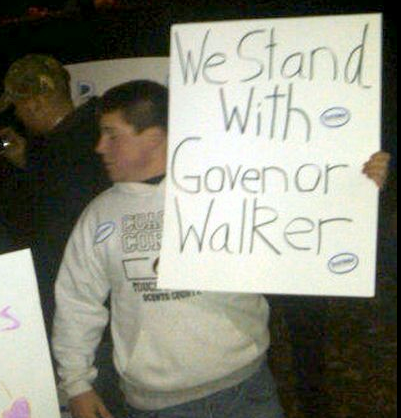
Who?
I began my Voter’s Voice series during the Wisconsin Governor’s recall effort in early 2012. Some new readers have expressed curiosity and a wish to read earlier posts. To make that easier, I posted a list of those posts, complete with links and excerpts, on the page titled Voter’s Voice. I planned for this series to run until the first Tuesday following the second Monday in November, 2012. Once in a while, though, the ever-opinionated Grandma Daisy character returns to share new insights.
The most recent posts are on top. If you want to read posts chronologically, start from the bottom and work your way up.
Teachers in brick and mortar schools, the standard classrooms with four walls and a ceiling, decorate for their students. Posters, bulletin boards, themes, student work – you name it, it’s on the walls. A classroom becomes by design a very welcoming place.
I teach from a cubicle. Decorating the cube is a little different. First, I organize my electronics for easiest access and maximum comfort. If I can reach the phone and the computer with ease, I’m ready to work. Next, I arrange basic teaching files, both electronic and paper, so I can reach both copies of my lessons without leaving my chair.
But welcoming – I do need to come into my cube and have the comforts of a home-away-from home around me. Chuck would call this a Cubicle Survival Kit. You’ve seen the fingerless gloves I keep in one drawer. Here are a few other components in the survival kit.
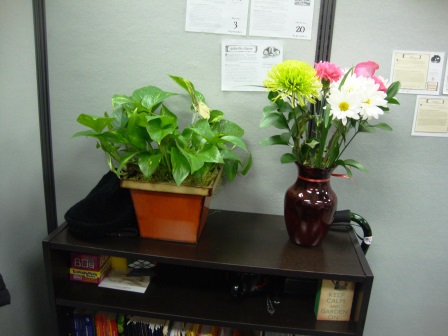
Plant life and flowers
The flowers were from Chuck on Valentine’s Day. They beautified my bookshelf for almost two weeks. The plant on the left was a gift from a family grateful for my extra time and efforts.
On the top shelf, you can catch a glimpse of a few other survival tools: a Rubic’s cube, a cube-shaped trivia game, and on the right, my mantra of “Keep Calm and Garden On.”
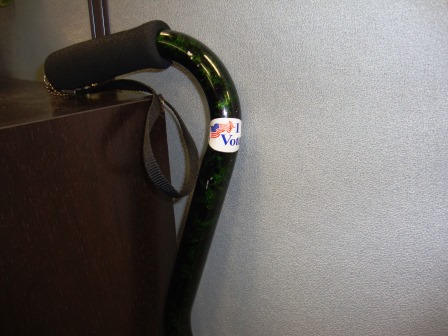
I voted!
My cane graces the cubicle with its lovely green color and the sticker from last month’s primary election.
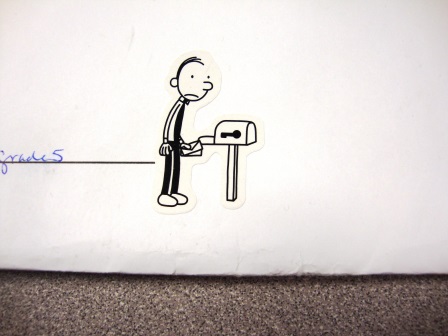
Mail for me?
And finally, how can a cubicle be less than happy when the mail regularly arrives sporting stickers?