Like-minded People

Imagine a busload of people who like Car Talk, get the jokes on Wait, Wait, Don’t Tell Me, and know the difference between Michael Feldman and Michael Perry.* This is a bus trip of people who are polite to each other, make friends readily, and enjoy intelligent conversation about issues that matter to you, er, them. Amigo and I took just such a trip last summer and the previous summer. Sponsored by Wisconsin Public Radio, the trip goes to tiny Bayfield, WI, where the group takes in a show at the Big Top Chautauqua.

The most recent City Council meeting seemed like it was ripe for conflict. People attended to speak for the trees, speak for the right to raise urban chickens, and support an up and coming project that will turn a former country club and golf course into a large community garden. Despite the differing opinions, all in attendance had something in common.

Last, but never least, I attended two meetings at the local Organizing for America office. One was simply a monthly update of the citywide group, and the second a training in canvassing techniques for the upcoming campaign kick-off weekend.

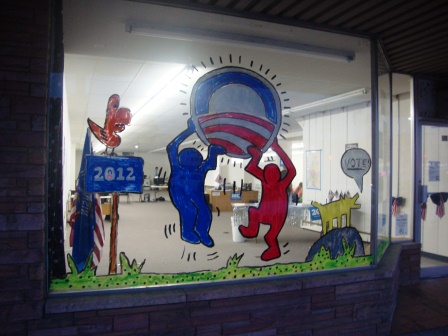
What do these three have in common? I’ll give you a moment to think. Take a look at the OFA office windows while you’re contemplating.
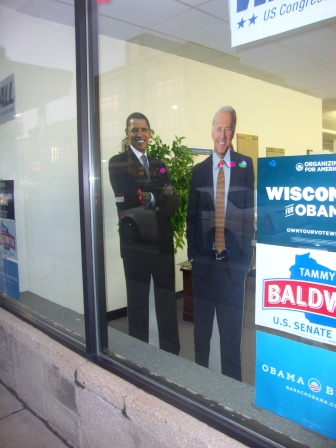
 

Come on in and pose with the cardboard cut-outs!

Remember the question? I asked you to consider what these three examples might share in common. It’s the people.

In each example, you’ll see a group of like-minded people. The Public Radio bus trip was thoroughly enjoyable because of the camaraderie. In the second example, all three issues had to do with sustainability and the city environment. In the third, all of the meeting attendees were motivated to help re-elect the President of the United States to a second term.

Seeking out like-minded people is one way to stay calm and focused during difficult times. We share experiences, we share attitudes, and we share priorities. These groups will meet again, I’m sure. Trees, chickens, Public Radio, and elections are topics that inspire passion. Finding focus for a passion can lead to making a difference in the world.

Go ahead, readers. Find like-minded people. Talk. Then come back here and tell me: what will you do to make a difference?

Michael Feldman hosts a Saturday morning show on WPR called Whadya Know?. Michael Perry hosts Big Tent Radio on Saturday nights. Good enough?They’re both comics, hosts, and fascinating people. 
Share and Enjoy !

Shares

Battle Fatigue and Injustice

There may be times when we are powerless to prevent injustice, but there must never be a time when we fail to protest. 

~ Elie Wiesel ~

The wild and woolly recall election was over a month ago. The scars are fading, but they’re still visible. I have three meetings on this week’s calendar, all in some way political. I keep plugging away, but some days it just seems pointless.

Why do I bother? Does one person’s effort really matter? The big money sources are working to make sure their own puppet legislators are in power. Those on “my” side keep begging for donations, and I can afford only to give them time. Does volunteerism count for anything in the long run? On June 6, my efforts and energy seemed – oh, I give in, it seemed wasted. Totally wasted.

Then I ran into the above quote from Elie Wiesel.  Holocaust survivor, journalist, writer, teacher, leader in human rights causes, Elie Wiesel’s quote reminds me to keep active. I may not have the money, but I have words and I will make the time. Tonight, messaging workshop at the OFA office. Tomorrow night, City Council. After that, a couple of days off to rest and reconnect with my family.

And then, after that, despite that occasional powerless feeling, I’ll keep protesting injustice and helping others fight the good fight leading to the Tuesday after the first Monday in November.

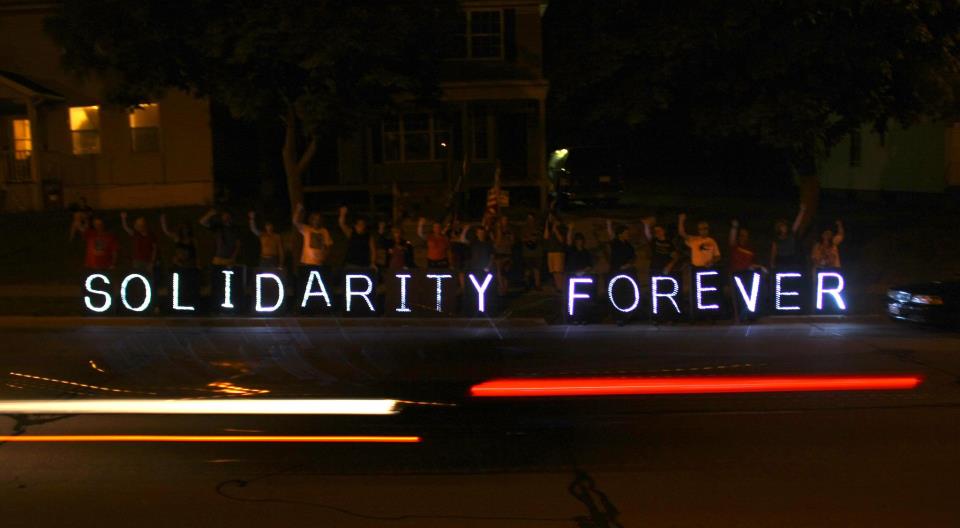
The Overpass Light Brigade, a creative tactic born in Milwaukee

Share and Enjoy !

Shares

Thinking in Broad Terms: The Broad Side

In my circle of acquaintances, online or In Real Life (IRL), it would be hard to find anyone who doesn’t read or hasn’t heard of The Huffington Post. HuffPo, for short, provides commentary on many current and fascinating topics. HuffPo, however, isn’t the only sheet of value out there on the Interwebs. Since last autumn, a new face is gracing cyberspace: The Broad Side.

Recent Broad Side articles dealt with the Supreme Court decision on the Affordable  Health Care Act, sometimes called Obamacare. Here, have a taste.

A guest commentary by Nancy Gruver states:

“The fact is that healthcare is a product like virtually none other in a capitalist economy. It isn’t governed by rational consumer decision-making. And it never will be.”

Angie Lynch talks about being fortunate enough to have good health coverage and adds:

“Before today, we were one of the lucky ones. From today forward, we are among the millions of U.S. citizens who do not have to worry about being lucky.”

Is Chief Justice Roberts a political mastermind or the destroyer of conservative hope? Find out one opinion here.

And finally, but not the last word I’m sure, one of my favorite pundits, Joanne Bamberger, weighs in here. A few sound bites? Of course I’ll share, with a Daisy reaction, of course.

“According to news reports, Republicans who were in the courtroom as the justices read their opinions had their jaws drop and their eyes rolled back in their heads. They did NOT expect this.” Oh, I wish I could have been there to hear the *thunk* as those jaws hit the floor.


“…this is amazing news for families who have been cut off from insurance because of pre-existing conditions, lifetime limits on insurance coverage and who couldn’t come up with out-of-pocket payments for preventative services, like mammograms, that some policies wouldn’t cover.” Yes, readers, Daisy and family resemble this remark. With two disabled family members, a history of depression for one, family history of cancer, and a young one approaching the magic age of 26, this ruling is a relief. 


Looks like they need a Plan B (no, not that Plan B!) for attacking the President.  Exactly. I couldn’t say it better. 


 The Broad Side: see for yourself. Real women, real opinions.

Share and Enjoy !

Shares

I teach, and I pay taxes – a still-timely encore

This was originally posted in February of 2011 when the wild rumpus in Madison had just begun. I was on medical leave recovering from a severe depression when Gov. Walker’s, er, proposal broke open. The post, unfortunately, is still relevant. The phrase “My Tax Dollars!” is so hurtful when it’s misused, and it’s getting misused daily. 

I teach, and I pay taxes. Or should I say “I pay taxes and I teach”?

Folks who’ve seen the Wisconsin budget drama on CNN or Fox News or CSNBC probably wonder. “Daisy, you’re a teacher! You live in Wisconsin! You’re a progressive thinker and you’re active in politics! Why have you said nothing about the demonstrations? Or the disappearance of the Senate Democrats? Or Governor Walker’s bad hair and desire for make-up any time a camera is near? Never mind that last one.
I haven’t posted yet because it’s so upsetting. Today I’m checking in periodically, but I’m minimizing my TV news time. My news junkie self is not compatible with the depressive self, and I’m in a pretty bad state right now – pun intended.
Instead, I’d like to share a few facts about union history. Consider it a history lesson featuring the American worker.
Early railroad worker unions were primarily insurance providers. The workers could not get standard insurance because their work was considered too hazardous, the workers too risky to insure. From Railroad Labor and its History
The first organization of working women to organize was the Lowell Female Labor Reform Association, a group of young women working in textile mills. For a descriptive piece on the Lowell Mills Girls, look to this piece, an overview of women’s labor rights at the time. From Women and Unions, early efforts
Unions helped outlaw child labor and protect worker safety. The horrible Triangle Shirtwaist Factory fire spurred further movements to keep workers safe at work. Work also means outdoor work. Remember Cesar Chavez? The United Farm Workers are glad he took the lead to improve their treatment.
Unions are about people: working people. Unions help regulate working conditions, wages, and employee rights. Benefits in union contracts include paid sick days, working conditions, grievance procedures, opportunities for advancement or changing positions, length of workday, and more. My current contract has 182 pages, single spaced. It’s a complex, thoughtful agreement between the school board and the association that represents the district’s teachers.
Every paycheck I receive has taxes taken out. Yes, I teach. Yes, I pay taxes. Yes, I’m a union member. I’m proud of all three.

Share and Enjoy !

Shares

The trees! Save the trees! Or… or… not.

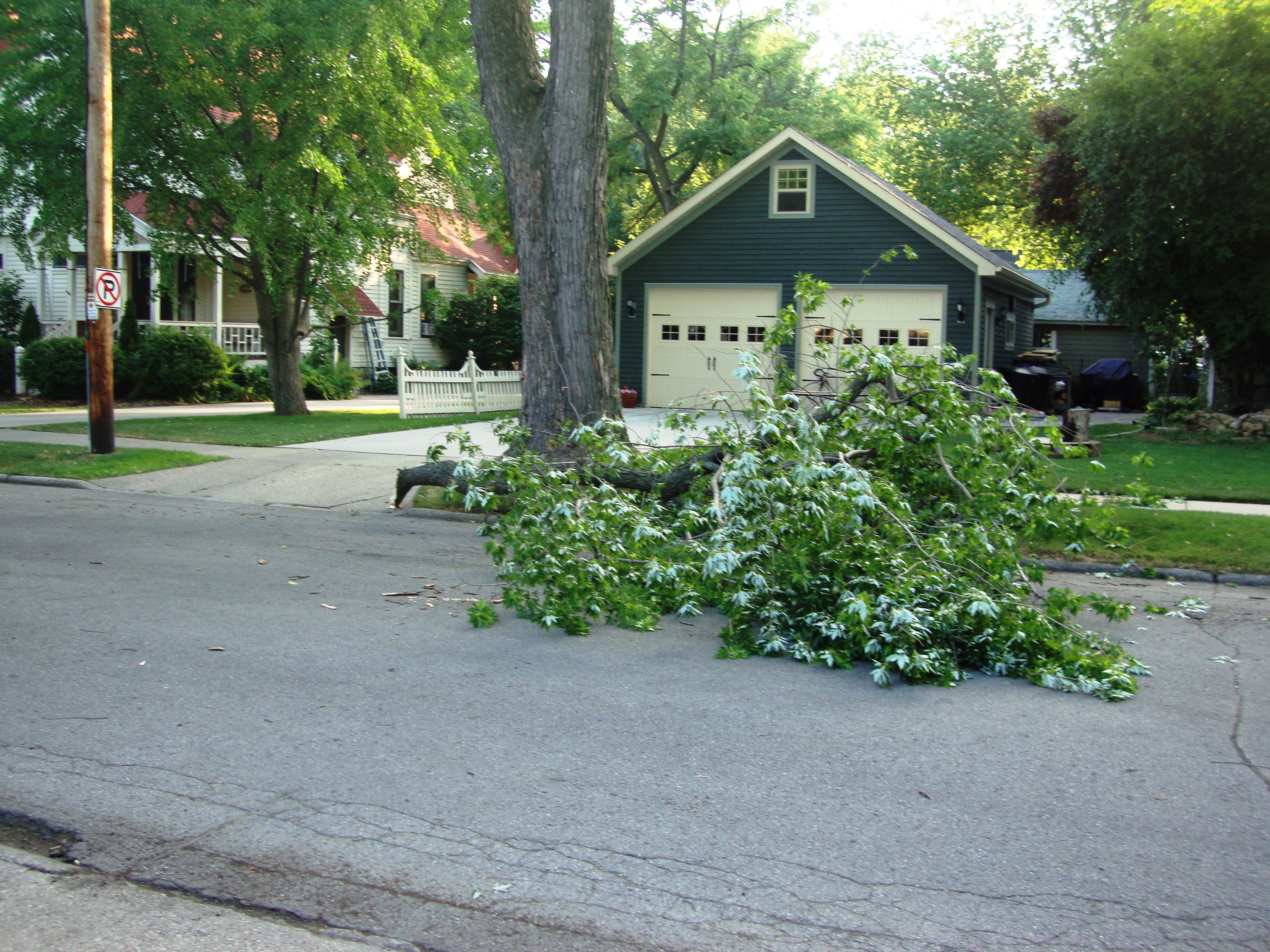
Observe: one of the trees that our neighbor wants to save. She circulated petitions and called our alderman and forced a review of the situation. Unfortunately, she’s not thinking logically. 

A blustery day in the neighborhood

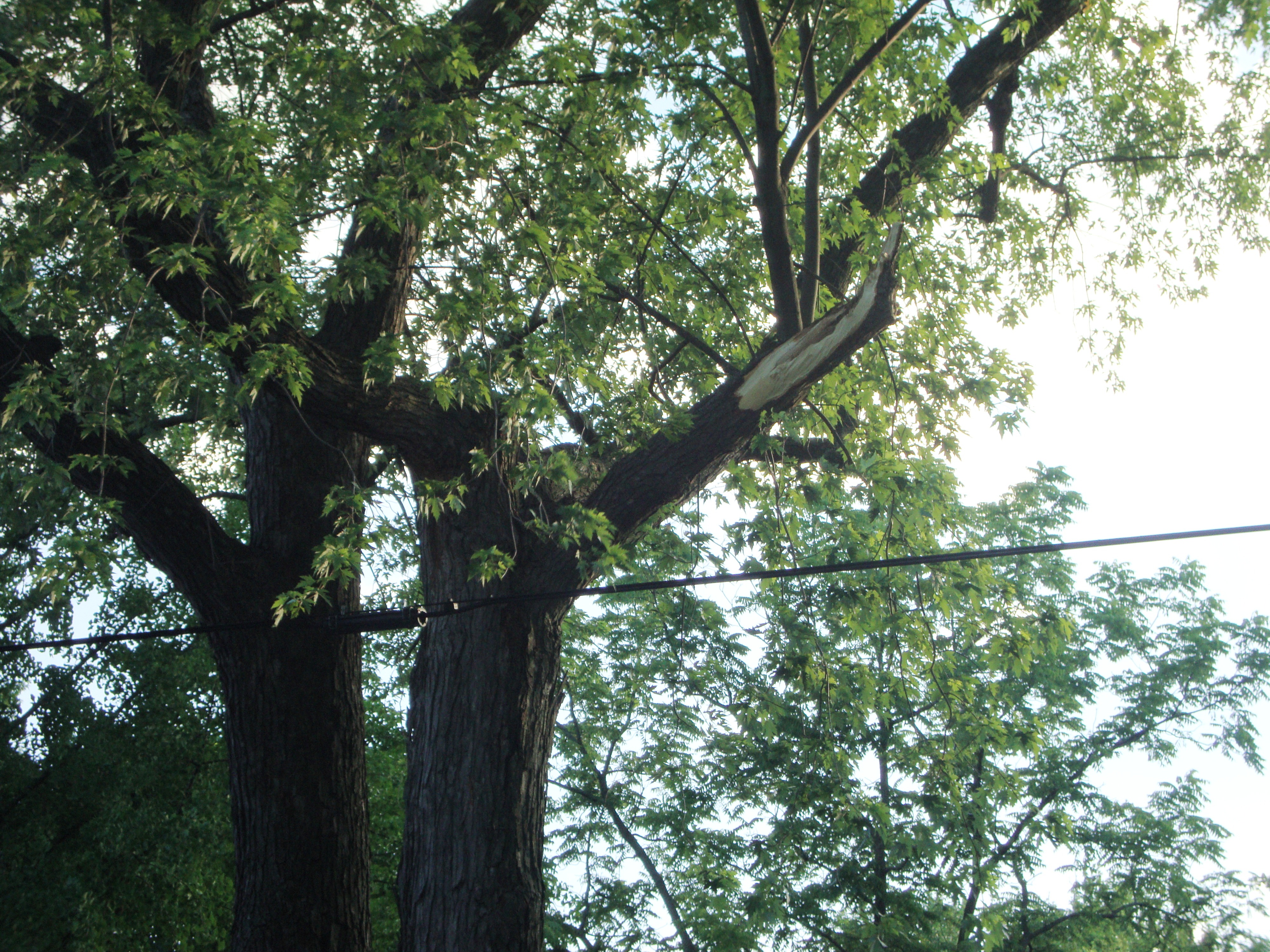
It’s a big one. The branch cracked and fell due to a wind gust – just a gust of wind on a clear but windy day.

Big tree, big branch.

In conclusion, the trees are lovely, and they’re lived good lives. Saving these trees (and tearing up the roots with the road construction) isn’t a logical decision.

Remaining limb – and proximity to wire


Share and Enjoy !

Shares

Non-Consumption – guidelines to make it possible

I enjoy Mother Nature Network. I scan the articles, peruse the photo collections, compare the graphics, and more. Sometimes I see inspiration for changes in my own life. My family and I tend more toward the locavore than the globavore, as illustrated in this graphic. I do buy organic and free trade coffee from outside the local range – it doesn’t grow here – but I like to buy it from small grocers or local delis whenever I can. We grow quite a few vegetables in the backyard, and we buy a lot of produce from the downtown farmers’ markets. All of this improves the quality of our diet and our carbon footprint.

 The piece I saw this week was a list of questions to help make purchasing decisions. Instead of mindless consumerism and buy-buy-buy, asking these questions can point a consumer in a different direction. My friend Green Girl commented that “No one leaves the Farmers’ Market with buyer’s remorse,” and I agree. But regular stores? That kind of remorse is more likely. Check out the list below.

1. Is this purchase something I need? Need, not want. There’s a difference.

2. Do I already own something that will serve the same purpose? Example: clothing. I don’t need a new pair of jeans. I need to wear out the jeans I already own. I’ll let you go on, readers, without my interjections. 

3. Can I borrow one instead of buying new?
4. Can I make something that will serve the same purpose?
5. Can I buy a used one?
6. Would someone be willing to split the cost and share this with me?
7. Can I buy or commission one made locally?
8. Can I buy one that was made with environmentally responsible materials?
9. Can I buy one that serves more than one purpose?
10. Can I get something human powered instead of gas or electric?
11. Can I compost or recycle it when I’m done with it?
12. What is the impact on the environment of the full life cycle of it?
13. Does the manufacture or disposal of it damage the environment?
If the answers to these questions still suggest making a purchase, the buyers will know that their money will go toward valuing our environment rather than spoiling or damaging the natural world. I wonder – if I copied this list into my tiny purse notebook, could I avoid spending money unnecessarily? Probably. Could I make a more positive impact or at least a lesser impact on my home planet? Likely. I tell myself that I limit my consumption in a lot of ways. This list reminds me that I can do better.
Readers, which question is the hardest to answer? For me it’s number 13. I find it difficult to do the research involved in answering questions about the manufacture or disposal of commercial items. How about you?

Share and Enjoy !

Shares

War Imagery in Politics

Readers, remember this conversation?

Daisy: I’m going downtown to volunteer for a few more hours.

Chuck: You know, honey, the recall election is over.

Daisy: Dear, we lost the battle, but not the war. There are primaries in August and the Big Match-up in November. 

I know; Governor Walker won his recall election. He won it by a small margin, despite the millions spent on his campaign. I hope the governor is taking into consideration that he did not win easily. His side may have won one battle, but the troops on the ground are still fighting the war.

Fighting the war. The battle imagery implies fighting, attacking, attempting a take-over or worse, aiming to kill. Collateral damage will occur; people will suffer. Is that really what we want in Wisconsin?

Back in the 1970s and 1980s, the language of war and the language of sports were highly recommended study topics for college graduates going into business. If young men and (especially) women didn’t know the terminology, they were perceived as outsiders and began their careers with a linguistic disadvantage. In today’s world, management language still exists, but it varies more according to workplace climate than a gender or age difference. In a working climate defined by conflict, war words might seem appropriate. Wisconsin’s current political climate is not physically violent, but it is full of pain, aggression, vitriol and rancor. Conflict is the norm and cooperation is the exception. Passing laws becomes a matter of a battle won or lost, with wounded citizens on both sides.

If instead a sports analogy came into play, the teamwork aspect could appear stronger. When team works together, they score. When players go to bat and hit grand slam home runs, their entire team benefits. In this model, legislators can train for marathon sessions or bulk up for raising heavy issues, Unruly managers and players can be removed from the game. Good sportsmanship, playing by the rules, and clean competition all become important.  In a sports metaphor, opposite sides still compete, but they do it within a structure. They compete in public, with an audience watching, cheering, applauding, and respecting the participants. Eventually the game ends with a winner and, unfortunately, a loser. A sportsmanlike competition allows the loser to graciously concede without losing status.

I don’t even want to start thinking about battle fatigue. That’ll be a whole different set of images. Readers, what kind of language do you suggest? The metaphors and analogies we use can set the scene for success or failure.

Share and Enjoy !

Shares

Actual conversations

Daisy: I’m going downtown to volunteer for a few more hours.

Chuck: You know, honey, the recall election is over.

Daisy: We’re looking ahead: focusing on August and November. Senate, Congress, and state assembly, and of course, re-electing President Obama.

Later conversation:

Chuck: I’m not hearing any buzz for the Democratic candidates.

Daisy: You will. We’re out there. We Dems don’t have the billionaires and their Super PACs on our side.

Chuck: So the appearance is that the Democrats don’t have any money, and therefore don’t have broad based support.

Daisy: That’s not it. Our backers don’t have the billions to spare. We’re supported by others, those who have fewer bucks to donate. Our candidates don’t have as many television commercials because they’re expensive. We concentrate on grass-roots, people to people campaign tactics.

Chuck: But with less money, it appears that the Democrats have less support. That may not be true, but money does buy a lot of exposure.

Daisy: Well, we already know from our recall experience that money can buy an election. Sigh. 

In summary, people, I still volunteer. I will continue to offer my time and knowledge and expertise to the less-wealthy candidates that seem to understand and support the issues that matter to me. We public servants lost one battle, but we’re still fighting the good fight..

Share and Enjoy !

Shares

Thoughts and Questions post-election

The atmosphere is settling a little now, two weeks past the recall vote. Make no mistake, however. The grassroots organizers are determined to keep our state on a progressive path, despite the results at the polls. I share with you thoughts and observations (For what its worth) from family and friends and coworkers (and Daisy’s reactions, of course):

The Journal Company endorsed Walker and they own WTMJ, an NBC affiliate—

  • NBC was 1st to come out with calling the race in favor of Walker.
  • WTMJ was extremely invested in their coverage at the Walker site. They spent most of their live time there with multiple crews and cameras while Barrett coverage was one crew that was on the air a little.  If Walker had lost, then WTMJ would have covered that angle, not the Barrett win. Hmmm…
  • Do I sense a bias in the Milwaukee media? The J-S editorial panel endorsed Walker, despite their news reporters’ investigations into the governor’s illegal activities. The right hand at the JS doesn’t seem to know what the left is doing. Their credibility took a hit, that’s for certain.

Did the number of votes not for Walker (Barrett and Trevoli sp? combined) at least equal the number of people that signed the recall petition? No; this was a grave disappointment. There were rumors of phone calls claiming incorrectly “If you signed, you don’t have to vote.” I hope no one believed it. 

If it is less then you have to ask what happened…Were there people who signed the petition that didn’t vote?  See above; there were voter suppression efforts that may have knocked off a few votes. Were there people who signed the original petition that voted for Walker in the end? Unfortunately, yes. Our canvassers spoke to people who had felt coerced into signing petitions at their workplaces or in their neighborhoods. They even talked to a few women who said they “had to” vote the way their husbands did. WTH?!? 

Will there be legal wrangling regarding the vote suppression campaigns and the media contacts with voters standing in line? I hope there will be an investigation, if only to stop any interference from happening in future elections.

Is Wisconsin now a regressive state? Action in Madison certainly doesn’t look progressive. Frightening thought. There’s more truth in that quick statement than I care to admit. 

The Walker win must at least be telling the national parties that Wisconsin is no longer a lock for the Democrats and that the state is up for grabs.  Will we see an endless parade of Obama and Romney visits to our state between now and November? Sure. Wisconsin is known on the national scene as a “purple” state: neither fully blue nor fully red. Exit polls imply that many who voted for Walker plan to support Obama in November. Now if Rep. Paul Ryan gets the nod to be Romney’s running mate, Wisconsin citizens might as well turn off their TVs and unplug their phones. 

And why does Spell Check recognize “Romney” as a valid word? (My computer doesn’t flag it as a misspelling like it does with other proper names.) Now that’s just plain scary. 

Share and Enjoy !

Shares