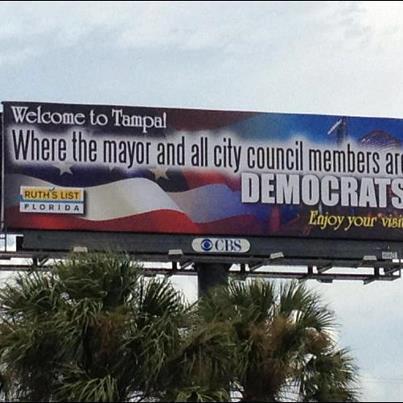
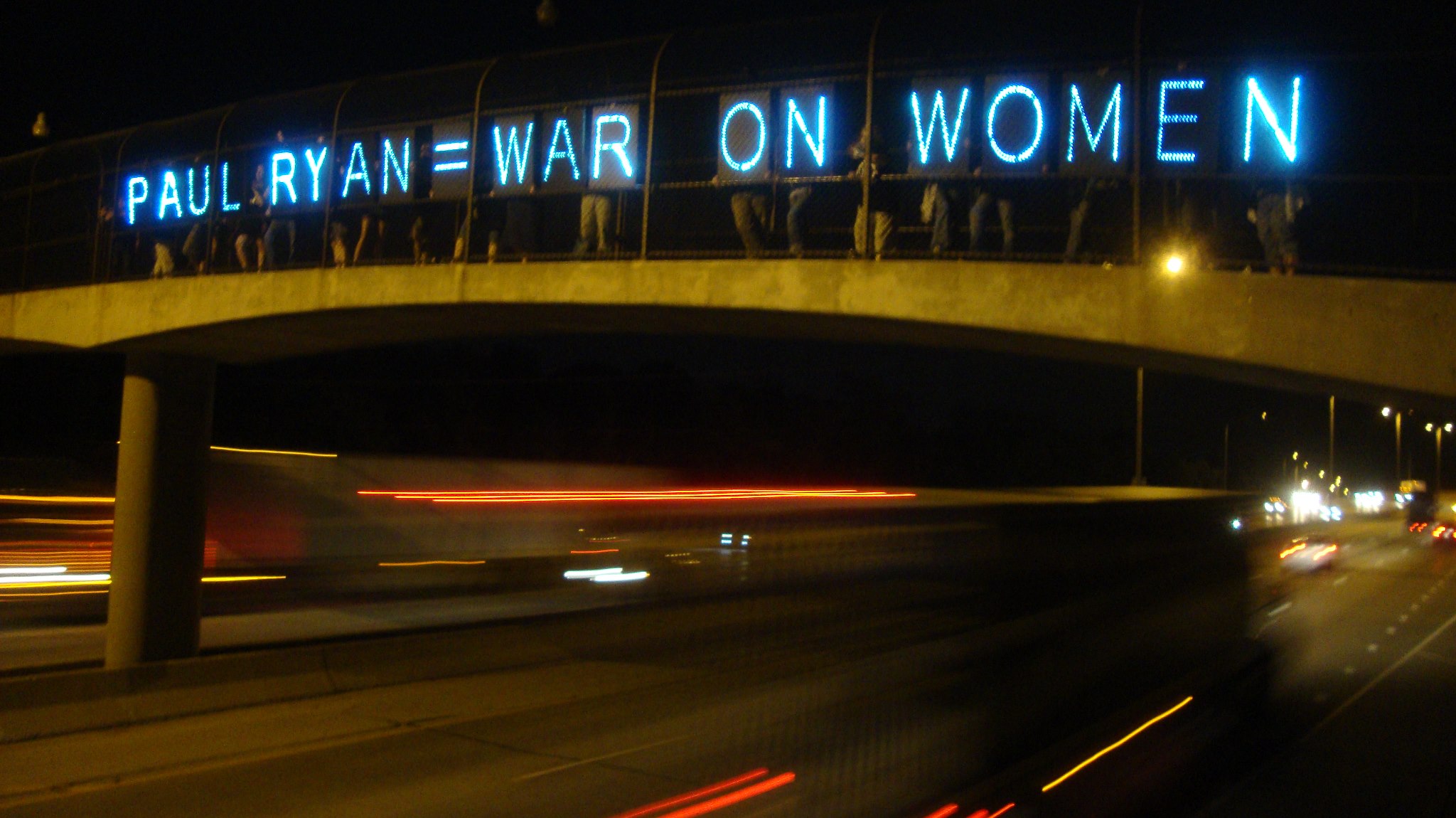
In my travels, both real and virtual, I see many visual messages. From the Southeast to Midwest, join me on my journey.
From a nearby parking lot, on the bumper of an original VW Beetle:

I couldn’t have said it better myself.
In my travels, both real and virtual, I see many visual messages. From the Southeast to Midwest, join me on my journey.
From a nearby parking lot, on the bumper of an original VW Beetle:

I couldn’t have said it better myself.
I couldn’t believe the baby aspirin between the knees method of birth control made headlines last year.
Now I can’t believe the idiocy of Representative Tod Akin, Republican from Missouri and candidate for Senate. He claimed the following:
First of all, from what I understand from doctors, (pregnancy from rape) is really rare. If it’s a legitimate rape, the female body has ways to try to shut that whole thing down.
What the hell??!!
Does this man talk to real doctors, MDs, professionals who really know how a woman’s body works? Did this man talk to sexual assault counselors? Does he know what rape means? Did he pay attention in middle school when the science and health teacher taught how fertilization occurs?
I’m appalled that Mr. Akin would believe such a falsehood, much less attribute it to medical professionals and state it as truth.
I’m even more appalled that people might trust him and agree with this woefully inadequate piece of playground gossip.
I’m still more appalled that ignorant voters might decide to vote for lawmakers who believe that a woman can “shut down” her reproductive organs and somehow resist pregnancy when she is being attacked.
Republican leaders are distancing themselves from this horrific statement and the man who made it. But listen up, women: VP Paul Ryan was one of 200 cosponsors of the “personhood” bill that would outlaw birth control pills and narrowly define the term “rape.” Mitt Romney wants to completely eliminate federal funding for Planned Parenthood. These two candidates are dangerous.
I want my health to be a discussion between my doctor and me. No one in Congress need get in the middle. If Tod Akin is any example, many in the Republican Party didn’t pay enough attention in school to understand how pregnancy occurs, and they certainly can’t comprehend or define the term “rape.”
Women, we can’t stay silent. Speak up, educate, and above all, vote. A woman’s vote still counts the same as a man’s.
You heard the news, folks. Wisconsin’s Paul Ryan is now Mitt Romney’s running mate. But who is this guy? What’s his vision? What is Paul Ryan really like?
Paul Ryan represents a district in southern Wisconsin in Congress. He is 42 years old, the fourth youngest candidate on a major party ticket. His relative youth may be a factor if it strengthens his appeal to Generation X, Generation Y, and even a few Millennials. Baby Boomers are not so sure; we’ll get to that another day.
Paul Ryan is an economist by trade. He graduated from college with a double major in economics and political science. On the surface, this could be a plus on his balance sheet. He is articulate and intelligent, and he can expound upon economic theories at length.
A CNN morning anchor (we’ll call her “Ash”), was gushing about Paul Ryan on Monday morning. Yes, gushing. Let’s see if I can remember. His eyes, his hairstyle, his smile, and then his past. She was excited that he’d been a bartender – she also worked her way through college tending bar and cocktail waitressing! She was thrilled to hear that he’d worked for Oscar Mayer because he’d driven (are you ready for this?) the Weinermobile. Just what she wanted to see in a Vice President: good looks, experience behind the bar, and a Weinermobile on his resume.
But let’s look more deeply than our giddy blonde anchor did, more deeply into this economist’s vision for the country. His budget plan, nicknamed the “Path to Prosperity,” didn’t really propose to increase prosperity for the average middle class American. His plan as introduced last fall included major changes in the programs known as entitlements, most notably replacing Medicare with a voucher program. His overall plan also relied on severe spending cuts. These cuts, and the austerity policies that would result, promised to be extreme and far-reaching.
The Ryan Budget bill did not become law. It passed the House, but the Senate voted it down.
What’s next, moving forward? Well, blog readers, that’s where the problem sits. Paul Ryan’s plans would move our country in reverse, back to the archaic values of the 1950s. His plans are extreme, severe, and austere in all the wrong places.
Ryan describes himself as being “…as pro-life as a person can be.” Unfortunately, that doesn’t include pro-women who need birth control, empathetic toward women who become pregnant by rape or incest, or supportive of women who have a legitimate need to terminate a pregnancy. He doesn’t value their lives at all.
Rep. Ryan’s budget proposals favor privatizing public education and using public funding in order to do it. His austerity measures and cuts will harm public schools – schools that are suffering financially already. A full generation of students are at risk. These students, unfortunately, are too young to vote.
Rep. Ryan likes the idea of for-profit colleges. He ignores the years of evidence that show for-profit colleges’ students’ poor payback record for federal student loans. Defaults on loans like this – well, where does the money come from to make up the missing dough? Ryan hasn’t answered that question. He has a history of voting against increasing amounts or availability of Pell Grants, grants that target low-income students pay for college. In general, his policies show that he views education as a privilege for the wealthy rather than an opportunity and a right for all.
Look beneath the surface, voters. How will a Ryan extreme budget affect you and your family? Make your judgment based on the real and detailed policies and philosophies, not on the thirty second sound bites on television.
And beware of gushing anchors. Bright eyes, a head full of hair that hasn’t grayed (yet), and a Weinermobile drivers’ license aren’t enough for this voter.

STEM is an acronym for Science, Technology, Engineering, and Math in education. There are STEM conferences, STEM career fairs, and STEM grants. Science in general, though, doesn’t seem to be an election issue. Readers, you know I support re-electing President Obama. No matter if you live in a blue or red state, science is a reality in our lives. National Public Radio recognizes this with their Science Friday. Some of my favorite blogs, like the new Maker Mom, recognize the importance of science every day. Mother Nature Network, another of my favorites, suggests several topics for questioning any and all candidates.
Economics: how does science fit in with innovation and entrepreneurship?
Pandemics; Can the nation protect its residents from bio-terrorism or pandemic illness? Are there enough health care providers and other trained professionals to handle a pandemic flu or other illness?
Food and Farming: What steps would you take to ensure the safety of the country’s food supply?
Space: What are the nation’s goals in space exploration?
Science in public policy and law: How are scientists and other experts involved in the decisions and lawmaking regarding scientific information? How can the public feel assured that laws and policies include relevant and accurate scientific input?
Education: Where does the perception come from that U.S. students are behind other countries in science and math achievement? Is this perception correct? If so, where does education need to change in order to teach students the curiosity and thought skills they need in order to change? What kind of funding is available? Where will the money originate?
I admit it. Education is a high priority because I am an educator and I love teaching science. I enjoy getting my hands dirty, setting up situations that encourage students to question and think, and seeing the “A-ha!” moments when the light goes on. Now that the federal government is waiving some of the extensive (excessive) testing, maybe we can devote more time and energy to teaching STEM skills. I’m in. Are you?
Imagine a busload of people who like Car Talk, get the jokes on Wait, Wait, Don’t Tell Me, and know the difference between Michael Feldman and Michael Perry.* This is a bus trip of people who are polite to each other, make friends readily, and enjoy intelligent conversation about issues that matter to you, er, them. Amigo and I took just such a trip last summer and the previous summer. Sponsored by Wisconsin Public Radio, the trip goes to tiny Bayfield, WI, where the group takes in a show at the Big Top Chautauqua.
The most recent City Council meeting seemed like it was ripe for conflict. People attended to speak for the trees, speak for the right to raise urban chickens, and support an up and coming project that will turn a former country club and golf course into a large community garden. Despite the differing opinions, all in attendance had something in common.
Last, but never least, I attended two meetings at the local Organizing for America office. One was simply a monthly update of the citywide group, and the second a training in canvassing techniques for the upcoming campaign kick-off weekend.
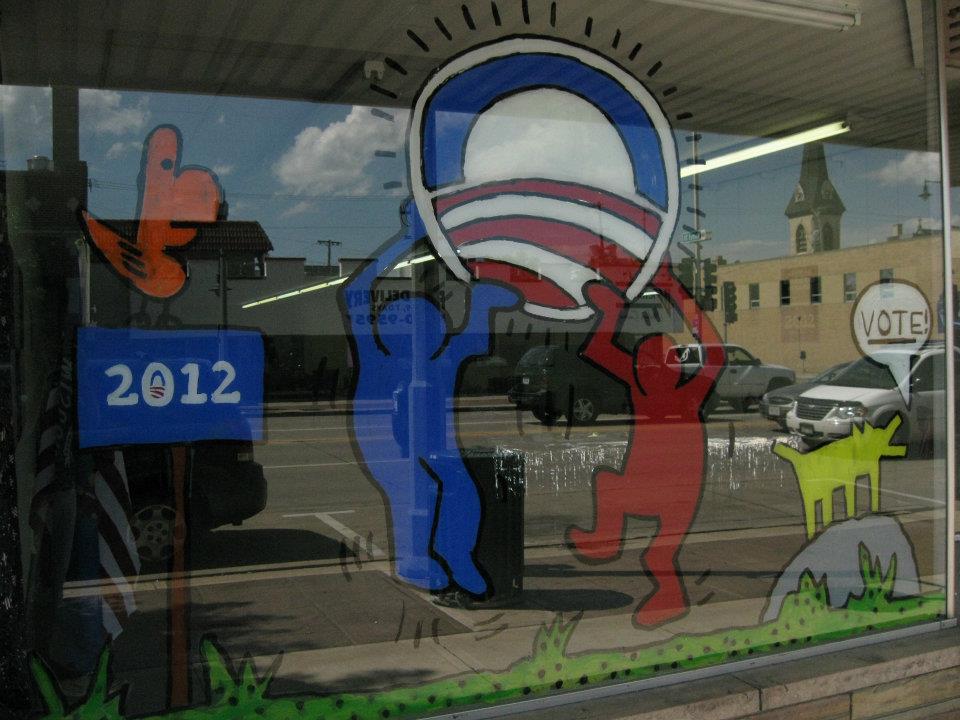
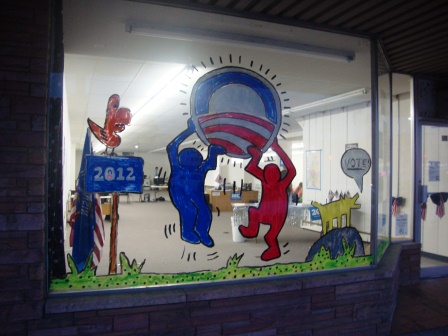
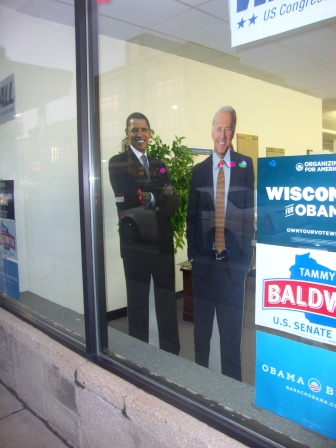
What do these three have in common? I’ll give you a moment to think. Take a look at the OFA office windows while you’re contemplating.
Remember the question? I asked you to consider what these three examples might share in common. It’s the people.
In each example, you’ll see a group of like-minded people. The Public Radio bus trip was thoroughly enjoyable because of the camaraderie. In the second example, all three issues had to do with sustainability and the city environment. In the third, all of the meeting attendees were motivated to help re-elect the President of the United States to a second term.
Seeking out like-minded people is one way to stay calm and focused during difficult times. We share experiences, we share attitudes, and we share priorities. These groups will meet again, I’m sure. Trees, chickens, Public Radio, and elections are topics that inspire passion. Finding focus for a passion can lead to making a difference in the world.
Go ahead, readers. Find like-minded people. Talk. Then come back here and tell me: what will you do to make a difference?
Michael Feldman hosts a Saturday morning show on WPR called Whadya Know?. Michael Perry hosts Big Tent Radio on Saturday nights. Good enough?They’re both comics, hosts, and fascinating people.
There may be times when we are powerless to prevent injustice, but there must never be a time when we fail to protest.
~ Elie Wiesel ~
The wild and woolly recall election was over a month ago. The scars are fading, but they’re still visible. I have three meetings on this week’s calendar, all in some way political. I keep plugging away, but some days it just seems pointless.
Why do I bother? Does one person’s effort really matter? The big money sources are working to make sure their own puppet legislators are in power. Those on “my” side keep begging for donations, and I can afford only to give them time. Does volunteerism count for anything in the long run? On June 6, my efforts and energy seemed – oh, I give in, it seemed wasted. Totally wasted.
Then I ran into the above quote from Elie Wiesel. Holocaust survivor, journalist, writer, teacher, leader in human rights causes, Elie Wiesel’s quote reminds me to keep active. I may not have the money, but I have words and I will make the time. Tonight, messaging workshop at the OFA office. Tomorrow night, City Council. After that, a couple of days off to rest and reconnect with my family.
And then, after that, despite that occasional powerless feeling, I’ll keep protesting injustice and helping others fight the good fight leading to the Tuesday after the first Monday in November.
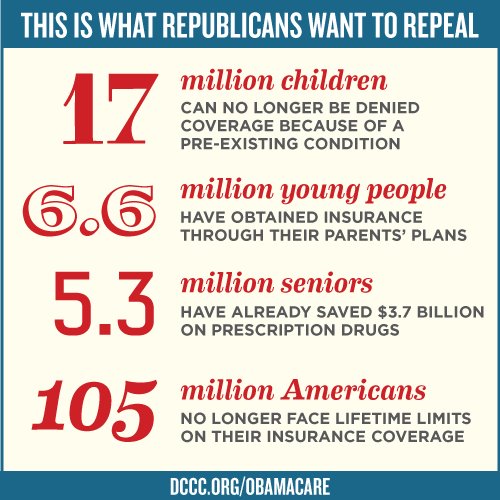
I’d posted, shared, a short graphic about the Affordable Care Act. It contained examples of people who benefit from the law. I usually post items like this on my blog page in Facebook, rather than my personal page, but this one needed to reach a wider audience – or so I thought.
An acquaintance from my undergraduate days – dare I call him a friend? – commented “Single Entry Accounting…”
Background: This acquaintance was someone I liked and respected. He was and I’m sure still is a very intelligent and multi-talented man. He fell into the category of people we called book smart, but not people smart. Thirty years ago on our small college campus, he was known as very, very intelligent, but not very wise.
So this slam, and yes it’s a slam, still hurt. It stung more than a little to hear this former friend, now a business owner in the financial field, thought I had posted something misleading. .
I have strong feelings about the Affordable Care Act. Biased? Absolutely, I am. I can go down the posted list and find family members and friends affected in each and every category.
Pre-existing conditions:
Retain coverage through parents’ plans:
Seniors: I’m not there yet, but my day will come. In the meantime, this affects:
Lifetime limits: what if you, your family, or your friends have —
Now that I’ve shared my reasoning and rationale for sharing the graphic in the first place, I’ll address the criticism.
Hey, old “friend,” I know you’re in a different position professionally than I am. I know you’re a successful business leader in the private sector, and you look at taxes from that angle. Since you’re in the financial field, I respect your knowledge of standard accounting practices. When I posted the chart, I made no secret of my bias. I did not claim to share both sides of the issue, including the overall cost of implementing the law. Your comment was an obvious put-down. In fact, you may have hoped that I didn’t know the meaning of the term “single entry accounting” and meant to imply my ignorance.
Old “friend,” I hope you always have the health coverage that your family needs and you never have to worry about being dropped or excluded. If you or your family need care, I hope you have no trouble finding medical specialists and paying their fees. I wish you and yours good health now and as you age. As for the Facebook bit, I don’t plan to unfriend you. The divisiveness in our nation is severe and widespread already, and I’d rather not add more. Indeed, you may have already taken me off your news feed or friends list. If you don’t want to read my updates any more, I’ll understand.
Sincerely, your old college pal, Daisy
In conclusion, a Note to Self: Attend the messaging workshop at the local OFA office. Learn the best ways to make a point. Thicken skin and prepare for more attacks. Don’t stop believing, though. Health care for all is far too important to lose.
In my circle of acquaintances, online or In Real Life (IRL), it would be hard to find anyone who doesn’t read or hasn’t heard of The Huffington Post. HuffPo, for short, provides commentary on many current and fascinating topics. HuffPo, however, isn’t the only sheet of value out there on the Interwebs. Since last autumn, a new face is gracing cyberspace: The Broad Side.
Recent Broad Side articles dealt with the Supreme Court decision on the Affordable Health Care Act, sometimes called Obamacare. Here, have a taste.
A guest commentary by Nancy Gruver states:
“The fact is that healthcare is a product like virtually none other in a capitalist economy. It isn’t governed by rational consumer decision-making. And it never will be.”
Angie Lynch talks about being fortunate enough to have good health coverage and adds:
“Before today, we were one of the lucky ones. From today forward, we are among the millions of U.S. citizens who do not have to worry about being lucky.”
Is Chief Justice Roberts a political mastermind or the destroyer of conservative hope? Find out one opinion here.
And finally, but not the last word I’m sure, one of my favorite pundits, Joanne Bamberger, weighs in here. A few sound bites? Of course I’ll share, with a Daisy reaction, of course.
“According to news reports, Republicans who were in the courtroom as the justices read their opinions had their jaws drop and their eyes rolled back in their heads. They did NOT expect this.” Oh, I wish I could have been there to hear the *thunk* as those jaws hit the floor.
“…this is amazing news for families who have been cut off from insurance because of pre-existing conditions, lifetime limits on insurance coverage and who couldn’t come up with out-of-pocket payments for preventative services, like mammograms, that some policies wouldn’t cover.” Yes, readers, Daisy and family resemble this remark. With two disabled family members, a history of depression for one, family history of cancer, and a young one approaching the magic age of 26, this ruling is a relief.
Looks like they need a Plan B (no, not that Plan B!) for attacking the President. Exactly. I couldn’t say it better.
The Broad Side: see for yourself. Real women, real opinions.
This was originally posted in February of 2011 when the wild rumpus in Madison had just begun. I was on medical leave recovering from a severe depression when Gov. Walker’s, er, proposal broke open. The post, unfortunately, is still relevant. The phrase “My Tax Dollars!” is so hurtful when it’s misused, and it’s getting misused daily.
I teach, and I pay taxes. Or should I say “I pay taxes and I teach”?
Readers, remember this conversation?
Daisy: I’m going downtown to volunteer for a few more hours.
Chuck: You know, honey, the recall election is over.
Daisy: Dear, we lost the battle, but not the war. There are primaries in August and the Big Match-up in November.
I know; Governor Walker won his recall election. He won it by a small margin, despite the millions spent on his campaign. I hope the governor is taking into consideration that he did not win easily. His side may have won one battle, but the troops on the ground are still fighting the war.
Fighting the war. The battle imagery implies fighting, attacking, attempting a take-over or worse, aiming to kill. Collateral damage will occur; people will suffer. Is that really what we want in Wisconsin?
Back in the 1970s and 1980s, the language of war and the language of sports were highly recommended study topics for college graduates going into business. If young men and (especially) women didn’t know the terminology, they were perceived as outsiders and began their careers with a linguistic disadvantage. In today’s world, management language still exists, but it varies more according to workplace climate than a gender or age difference. In a working climate defined by conflict, war words might seem appropriate. Wisconsin’s current political climate is not physically violent, but it is full of pain, aggression, vitriol and rancor. Conflict is the norm and cooperation is the exception. Passing laws becomes a matter of a battle won or lost, with wounded citizens on both sides.
If instead a sports analogy came into play, the teamwork aspect could appear stronger. When team works together, they score. When players go to bat and hit grand slam home runs, their entire team benefits. In this model, legislators can train for marathon sessions or bulk up for raising heavy issues, Unruly managers and players can be removed from the game. Good sportsmanship, playing by the rules, and clean competition all become important. In a sports metaphor, opposite sides still compete, but they do it within a structure. They compete in public, with an audience watching, cheering, applauding, and respecting the participants. Eventually the game ends with a winner and, unfortunately, a loser. A sportsmanlike competition allows the loser to graciously concede without losing status.
I don’t even want to start thinking about battle fatigue. That’ll be a whole different set of images. Readers, what kind of language do you suggest? The metaphors and analogies we use can set the scene for success or failure.