>How much garden still grows?

>

Call it leftovers, call it a fall crop, call it the end of summer. Call it whatever you wish; to me it means that school has started and summer gardening is nearly done.
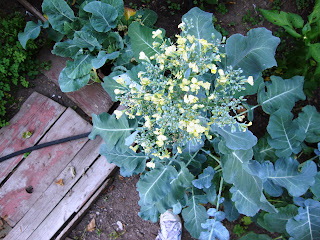
I neglected the broccoli and it flowered.

The beans are hanging on, producing a few more handfuls for the steamer, and even putting out a few small buds that might ripen if the warm weather holds.

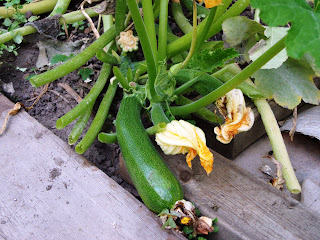
And of course the zucchini continues, even after I cut back the vines to prevent the powder mildew from spreading even farther.


The kitchen has green tomatoes ripening on every windowsill. If you’ve ever seen my kitchen, you know that means on both (small) windowsills and probably beside the sink. I’m going to keep visiting the farmers’ market until it’s over; when the fresh vegetables and fruits are gone, I know I’ll mourn.

Share and Enjoy !

Shares

>Compost: How far can I go?

>

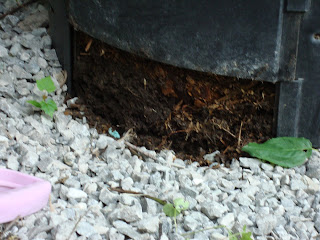
Compost: how far can I go? How much waxy paper, how many pizza boxes, will actually decompose in the bin with the kitchen waste? Only time (lots of it) will tell.

Last spring I set a few composting goals in a 3-2-1 Summary style. I’d noticed that the litter from the bunny boxes didn’t decompose completely. I still compost the contents of the bunny boxes, but this time I’m planning on leaving the bin for a full year. The time and the heat of a second summer season, I hope, will help the pine and red cedar bits decompose all the way.

Popsicle sticks didn’t decompose very well, either. To hasten the process, I broke the sticky sticks into smaller pieces. If the additional time and the breaking down of fibers doesn’t make a difference, I’ll know they’re just not suffiently biodegradable for a backyard bin.

My main goal was to add in papers of many kinds – papers and cardboards that are food-tainted or otherwise unsuitable for recycling. Take pizza boxes, for example. The lids are usually contaminated with bits of pizza sauce and spices. Advice from the Interwebs said this: tear these lids in strips, soak them to further break down the fibers, and then bury them in the compost. The cardboard circles from the frozen Tombstone can go this route, too. Further experiments: the wrappers from butter/margarine sticks (hoping such small amounts of dairy won’t cause a problem), waxy wrappers from orange dreamsicles, an occasional paper towel.

That paragraph makes it sound like we eat a lot of junk food. We do consume a fair share, (blush) I admit it. Pizza or drive-through foods are the exception, though, not the rule. I’d rather use my crockpot than bring in a Big Mac, and the family knows it.

There won’t be many paper towels, either; we’ve eliminated paper napkins and paper towels almost entirely.

But ultimately, this experiment will depend on time. I have the new composter, and I’ll use that one exclusively next season while the big black one sits and does its thing: lets the compost happen.

Share and Enjoy !

Shares

>On being self-sufficient

>A city family, even in a small city, will be dependent on the grocery store and the basic utilities. The question nagging in the back of my head is this: How much of that is really necessary?

It’s a small city lot that makes room for my garden behind the garage, a plot that has gotten a little larger over the years we’ve lived here. We grow a small amount of our food here, more a supplement than a significant amount of the family food supply.

I haven’ t learned to can — yet. I bought some of the supplies I need, and decided that next summer my project will be jam. The raspberries in the backyard yield almost nothing, and what little ripens goes to the birds before we even know it’s there. But I do have rhubarb, and we have the farmers’ market. Market strawberries, backyard rhubarb, and maybe raspberries and blueberries will make some J for our PBJs next summer.

I blanched and froze beans this year, both green and yellow, and a little bit of sweet corn, too. I have cartons of frozen rhubarb and grated zucchini frozen for winter baking. Soup stocks, turkey and chicken and beef, share the freezer space with the vegetables. When it’s time to cook, I’ll reach in the freezer instead of adding a commercially made mix to the crockpot.

The freezer is small, though. When Chuck picked it out, he wasn’t thinking of putting up enough food for the winter. He and I both thought it would just be a convenience. Now, a few years later, I wonder if we need a larger one. But do we? What am I really planning?

If we grew or bought from the farmers’ market more of our produce, we wouldn’t need to buy it from the grocery store. It would cost less purchased in season, and taste great when we cook it. It would be mainly organic, introducing fewer chemicals into our systems.

We could look into getting a dehydrator, something I’ve only read about. We have the storage space in the basement, but it’s a bit damp in fall and spring. Is it suitable for dried food? Need more research before I go farther with that angle.

Back to canning. Many vegetables and fruits become ripe just when I’m starting school, and it’s just about impossible to spend the prep time in the kitchen that’s really necessary. Or is it? Could I do enough of the work in July and early August to make this happen? I don’t know.

My kitchen is so small it’ll be hard to make room for a major process. Blanching the beans took up (I am not kidding) close to half the counter space.

But really, if we picked up another medium sized freezer, an upright perhaps, we wouldn’t need to go shopping every week. We’d be able to pick up milk and orange juice and bunny food, buy meat in bulk on sale, but the veggies and fruits would be in the house already.

I’m dreaming, but it’s a dream that could work out in the end. We’re city people, so we’re not going to put up a chicken house in the backyard. We’ll just have to keep buying eggs from Chuck’s coworker who does raise chickens. But learning to make our own jams, freeze our own tomatoes and peppers and herbs, can do more than just season our foods.
Share and Enjoy !

Shares

>Broccoli — flower-ettes?

>Dear gardener friends;
Is this supposed to happen? Is my broccoli supposed to flower, or did I do something wrong?

Leave a comment, please. In the meantime, I’ll try for a clearer picture and I’ll hope for rain – for the entire garden.

Share and Enjoy !

Shares

>Rhubarb Nut Bread

>Warning: make a double batch for sharing. The batch I set out in the staff lounge on treat day was gone by morning recess.

Ingredients
1 1/2 cups firmly packed brown sugar
2/3 cup vegetable oil
1 egg or 1/4 cup egg substitute
1 cup buttermilk or sour milk
1 teaspoon baking soda
1 teaspoon salt
1 teaspoon vanilla
2 1/2 cups flour
1 1/2 cups raw rhubarb, chopped
1/2 cup pecans or walnuts
1/3 cup white sugar
1 tablespoon melted butter

Directions
Heat oven to 325F, lightly butter and flour two 8″x4″x3″ loaf pans.
Combine the brown sugar, veggie oil and the egg.
Combine the buttermilk (sour milk), baking soda, salt & vanilla. I mixed it up; added the vanilla to the brown sugar/ egg mixture. It worked.
Add the milk mixture to the sugar mixture alternately with the flour, beating well after each addition.
Fold in the rhubarb& the nuts.
Turn batter into the two loaf pans.
Sprinkle with the melted butter and sugar.
Bake for 45 minutes or until done.
Turn out on a wire rack to cool.

From Recipezaar – a plurk buddy recommended this, and I’m glad she did! I look forward to making it in January with some of the rhubarb in the freezer. I wonder if this would make good muffins?

Share and Enjoy !

Shares

>Conserving Resources: It’s as simple as a barrel.

>Green Moms Carnival is hosted by Mindful Momma this month, and they’re posting on the topic of Conserving Resources. I didn’t post far enough ahead to actively participate, but I can still contribute.

One of my favorite ways to conserve a finite resource is by using a rain barrel. In fact, I liked the rain barrel so much I bought a second one in August! Here’s a quick 3-2-1 summary of the highlights of my special water-conserving tool.

Three reasons to use a rain barrel instead of a conventional sprinkler:

1. Set it up correctly, and it’ll water the roots, not the leaves, of the plants.
2. The water goes directly into the soil; very little evaporated.
3. It’s rain water. It doesn’t have to go through the treatment plant before it waters my garden.

Two changes in thinking with the rain barrel:

1. I’m careful with the water. After all, I “harvested” this myself!
2. I use this water to rinse litter boxes and compost buckets, too.

One final thought in favor of rain barrels:

1. It saves the potable (drinkable) water for its intended purpose: human consumption.

Share and Enjoy !

Shares

>The first week of teaching — for a gardener

>A week of teaching means little or no time in the garden. My poor tomatoes are gasping for breath, craving water. My beans are doing fine at the end of their growing season. Parsley looks good, and the bunnies are happy with that news. But the squash, you ask, the squash…


How did I miss these huge zucchini? Where did they come from? How did they get so, well, huge??


I didn’t plant any yellow squash this year. Who snuck in and cross- pollinated my greens with yellow? There are two more on this vine, even tinier than the two you see with the blossoms still on.

And last, but surely not least, the white pumpkins (if that’s indeed what they are) have been joined by what might be one of their orange counterparts. Maybe. Perhaps. I didn’t plant this, either.
Did someone or some thing sneak into my garden recently? It’s a mystery, all right.

Share and Enjoy !

Shares

>Ah, Zorba, your Summer Veggie-Corn Chowder is delicious.

>An open letter to Zorba Paster of Public Radio fame:

Dear Dr. Paster (May I call you Zorba?); I enjoy your heart-healthy recipes. I find most of them delicious and practical. I often print out the good ones on Saturday morning as I’m making my list for the Farmers’ Market. When I heard Summer Vegetable-Corn Chowder, my reaction was “MMmmmm! Must make this!”

But Zorba, there were a few weak spots in this one. I present it here to share with my readers, complete with my own Daisy-style commentary.

2 potatoes, peeled and diced (What kind of potato? Russet? Red? Yukon gold? Blue?)
1/4 cup leeks, sliced thinly (I’ve never cooked with leeks before. This will be fun.)
1/4 cup red onion, diced
1/4 cup celery (feed the leftovers to the rabbits, of course)
2 cloves garlic, minced
1 Tablespoon margarine
2 cups low-sodium broth (my homemade broth is low sodium, but somewhat higher in fat)
2 Tablespoons cornstarch
4 cups skim milk
2 16 oz. cans Corn (Cans? Zorba, it’s harvest season! Get fresh corn! Cans? No way.)
1 cup evaporated skim milk
1/2 teaspoon salt
1 teaspoon hot pepper sauce
1/4 cup parsley, minced (this came from the garden, and the bunnies got the leftovers)
1 Tablespoon Dill Weed (I skipped this)

But wait – before we even start. Dr. Zorba, this recipe aired in late August. Really. Think about it. What do gardeners and farmers’ markets have in abundance in late August? Zucchini!! Where’s the zucchini in this recipe? And how about herbs? They’re all over, fresh as can be.
I added 1/2 cup grated zucchini and at least a Tablespoon each of thyme and oregano and rosemary. The house (and my hands while cooking) smelled wonderful.

Back to business. In a large soup pot over medium heat, add chicken broth, potatoes, leek, onion, and celery. Add in margarine and garlic. Cover and simmer 25 minutes, stirring frequently.
In a saucepan, dissolve cornstarch in cold skim milk. Whisk over medium high heat until thickened, and then whisk into soup pot. Add corn (cans? Hmph, I used fresh corn), evaporated skim milk, salt, and hot pepper sauce to pot. Simmer uncovered for 15 minutes. Stir occasionally to thicken the chowder. Don’t allow to boil! Serve warm in bowls, topped with parsley and dill.

I had fairly good luck with this recipe. I wish I had cut it in half. It says “serves 6” and they mean it. I was feeding three, and I could have halved the recipe and still haved, er, had plenty.
It wasn’t thick enough for my taste – I like my chowders thick and creamy – but I think that was my fault. I was feeling impatient and hungry and the teenager was too, so I rushed the cornstarch and milk step. Had I given it more time, the chowder might have been thicker. As it was, the soup was still delicious and the house smelled heavenly.

Really, Zorba, I like going to your web site and finding full nutritional details for the recipe along with many other heart healthy selections. Right now I’m searching for recipes with fresh vegetables, and this one fit the bill.


But really. Canned corn? Bleh.

Share and Enjoy !

Shares

>Blanching and Freezing Beans: Yes, I Can!

>According to my Twitter friend City Slipper, blanching is easy. I just need a colander and a big
stockpot for boiling water. But wait – my colanders are too big, or my stockpots are too small!


Okay, the steamer basket fits. I can do this.

Step one: bring water to a boil. Lower beans into water. Bring water back to a boil, and boil for three minutes. I can do that. Yes, if you’re wondering, those are indeed Daisy’ Famous Green Bay Packer beans.

After the three minutes, put the beans in ice water for three minutes to cool.

Remove from ice water, and then dry. I had all three steps going at once in my tiny kitchen. Packer beans boiling, green beans cooling, and yellow wax beans drying.


Since the drying step takes the longest, I eventually had all the beans spread out on the counter at once. I froze them in quart-size Ziploc vaccuum bags. Some time in December or January, we’ll have really good beans, better than anything on the grocery store shelves.

The best part of cooking these will be knowing they were grown locally. About a third of this batch grew in my garden; the rest came from the farmers’ market. It took a little research and a little time, but this action was worth it.

Share and Enjoy !

Shares

>More garden mysteries

>What is this? Is it an herb finally coming up or a weed that flew in on the wind?

It’s small; it sneaks in between the basil and the thyme plants. Does anyone recognize it? I’m a relative beginner with herbs, so go ahead. I can handle the truth.

Then there are these orbs, the not-zucchini squash. They look more pumpkin-like each day, but they’re white. I didn’t plant white pumpkins. In fact, I didn’t plant pumpkins at all! Ideas? The stems resemble pumpkins more than any other squash.

And finally, last but never least, how does the zucchini sneak up on me like this? I thought I was done harvesting in this corner. More zucchini bread on the way!

Share and Enjoy !

Shares