>
My backyard may look like this:

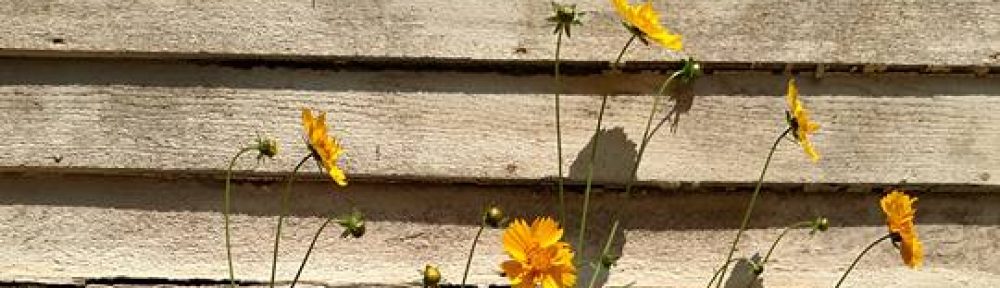
But inside, I’m thinking of this:

Seeds! Spring training! Brewers baseball, beans, and basil.
>
>The grass that’s peeking out of the melting snowbanks is brown, not green. If you’re looking for green, try these sites.
Eco-Women, Protectors of the Planet, are celebrating a birthday and hosting giveaways. Go enter! But not too many times, please – I’d like a chance at winning the tote bag.
Mother Nature Network talks about natural, non-chemical cleansers. Do they really work?
Green Girl, rather than echoing my sentiments on health care, speaks clearly and carries a walking stick.
At the Green Phone Booth, Jenn the Green Mom is planning her garden while she waits for the snow to melt.
Judy from Royal Ranch continues to introduce members of her “royalty” every Sunday.
>Most New Year’s Resolutions fail. People get unrealistic or take on too much at once, setting themselves up with impossible expectations. Instead, I offer the following: twelve recommendations, one per month, for a person who wants to become more eco-conscious but can only handle one change a month. Here’s my list: one action per month, meant to be additive so that after a year’s time green behavior feels natural.
January: Read and learn. Join Paperbackswap.com for trading books. Don’t stop buying books, but instead of hoarding them, pass them on to another reader through the swap network. I just finished The $64 Tomato (reviewed yesterday – just scroll down) and I’m reading Suddenly Frugal, a book with practical tips as green as they are frugal.
February: Switch to cloth napkins. This was so easy I wondered what took me so long to try it. I buy them on sale, so the investment is minimal. They go in with the rest of the wash, so there’s no additional expense for laundry.
March: Dig a garden plot. If you live in the north country like I do, March might be too early. If your ground is still frozen, plant and nurture a few seeds. Herbs grow quickly; try basil and oregano.
April: Start backyard composting. Really. It’s simple. Buy an inexpensive compost bin or build one yourself. There’s no need for the fancy ones – unless you want something really cute like my new bin!
May: Plant a garden. Vegetables for eating, flowers for pleasure, but keep them local. No imports, please. Vegetables can be so satisfying. There’s not much on Earth that can compare to a fresh tomato right off the vine.
June: Shop at a Farm Market or join a CSA. When you pass by the street musicians, drop some spare change in their cases. They offer so much enjoyment when they share their talents.
July: Use your own shopping bag. Keep a small one in your purse or the car’s glove box. It’s an easy routine to build if you keep the bags handy. As the habit grows, you’ll collect fewer and fewer plastic bags. It’s worth the (small) effort.
August: Before hitting the school supply sales, check your home. Buy only what you need. This is both economical and eco-conscious.
September: Use a reusable lunch box, including containers and flatware. Build this habit early, and the brown bag will never feel the same.
October: Rake your leaves into a pile over the garden or compost them. I said rake; the leafblower is overrated. Resist!
November: Cook local or regional specialties for Thanksgiving. That’s easy for me to say: cranberries grow in my state! Seriously, however, localizing your food supply one step at a time is important. You don’t need fresh pineapple if you live in Wisconsin. Cranberries will do.
December: Give up commercial wrapping paper. It’s not recyclable, it’s rarely reusable, it contains too many chemicals to be burned in a fireplace. Re-use gift bags or get creative with your wrapping. It’ll save money while you save natural resources.
I saw the original inspiration for this post on Over Coffee: the Green Edition. She suggested twelve recommendations, one per month, for a person who wanted to become more eco-conscious but could only handle one change a month. Imitation being the most sincere form of flattery, I stole the idea. Here’s my list: one action per month, meant to be additive so that after a year’s time green behavior feels natural.
Previously posted here: updated today.
>
This memoir chronicles William Alexander’s journey to create the perfect country kitchen garden, lessons in planting and cultivating, humor, and life lessons as well. Of course there are life lessons; what would a memoir be without them?
I can’t consider myself a genteel gardener in Alexander’s league. For one thing, my small city yard is nowhere near the size of his plot, the one he called a baseball field. Read “small city yard” any way you wish: small city or small yard, either works to describe the piece of land that holds my home, garage, and garden.
We haven’t hired people to do any of the garden work, which means my garden history pales in comparison to Alexander’s. From Lars the young guy who drives the tractor too fast to Lou the plumber/excavator that leaves his backhoe stuck in the Alexanders’ clay soil backyard all winter, the hired help provide many stories so funny they must be true.
Size and perspective make a difference, too. Weeding is a small job in my garden due to its smaller size and the application of square-foot gardening principles. Poor guy, Bill Alexander got roped into a design of rows, rows, and more rows, which meant weeding, weeding, and more weeding. He attempts to minimize the feeling of labor by calling it “cultivating.” He describes his tools with such awe that I want to buy a shuffle hoe now, not wait until spring. By spring I’ll remember that I have a fairly small vegetable plot, and I won’t spend a bundle on a limited-use tool. My regular hoe will do.
In The $64 Tomato, Bill waxes poetic in an attempt to rationalize the size and design of his beds to minimize the huge job of weeding. He doesn’t put the same poetic response toward his failure to remain organic. Good intentions were the road to chemical intervention in his garden as the pests got tougher and tougher – and bigger: Superchuck the woodchuck! My woodchuck visitor last year didn’t come back, and didn’t provide me with the same level of entertainment as Superchuck did the Alexanders, thank goodness.
I mentioned life lessons. To keep this post short and sweet, I’ll let you read the book to find them. Is it worth the marital trauma to spend nights canning peaches? Does the time and financial investment necessary for a kitchen garden truly pay back in quality? Can this family be considered (gasp) normal?
If you’re looking for a gardening book with straightforward advice, this isn’t it. If you’re looking for a good read with a fun take on the entire gardening experience, this is just right.
 Disclosure: I found my copy of The $64 Tomato on Paperbackswap.com. This is not in any way a compensated post.
>I was falling asleep on the couch as the Chicago Bears and the Minnesota Vikings headed into overtime. That’s how sick I was; I couldn’t stay awake to watch the end of Monday Night Football! As I dragged myself up to bed, it occurred to me that I hadn’t posted my weekly recipe yet. Well, folks, sometimes illness gets in the way of regular blogging, but here’s a taste of yesterday.
Chicken Soup with Rice
It’s the ultimate comfort food; keep chicken stock and chicken scraps in the freezer for soups or stews, and it’ll be easy to put together a soup when you’re not feeling well. Here are the ingredients that went into mine.
6 cups chicken stock
2 cups chicken scraps (from freezer, labelled “chicken for soup”)
1/4 cup onion, diced
1/4 cup red pepper and yellow pepper, also from the freezer: last summer’s garden yield
1/4 cup frozen corn
1 potato, diced
1 carrot, diced (bunnies enjoyed the leftover peelings)
1 stalk of celery, diced (see above: bunnies handled the ends)
The entire mix simmered in the crockpot most of the day while I struggled to get the new humidifier working, get laundry done, and take naps. About 4:00, I added 1/2 cup wild rice and 1/2 cup barley. We served this with toasted cheese sandwiches made on basic white bread with a little flaxseed, and called it good.
I slept well last night, and I’m breathing a little better this morning. Tonight? Another classic comfort food from Daisy’s repertoire: Baked mac & cheese. Low maintenance, good taste, an all around winner when the chief cook is under the weather.
By the way, it’s still not too late to vote for my sustainable cooking tip on Brighter Planet! Click on “I like this” to give me another credit. Then enjoy yourself browsing the others in this category and all across the Sustainable Cooking contest!
>The chairs are stacked, and the cushions are stowed away in the basement.

The new composter is set up on bricks, within reach of the driveway. I will actually be able to compost coffee grounds and filters all winter long!
 I’m still thinking about the old bunny hutch. The hutch is old, not the bunnies. Our pet rabbits have house privileges now; we don’t use the hutch any more. I’ve been stashing my garden tools there. The debate: should I take down the hutch completely? The rhubarb could expand into this area. Or should I keep it, take off or repair the doors so it’s more usable? I think I’ll decide in the spring.
 Still to be done: put away the little cello-playing frog (hiding behind white roses) and take care of the roses. The rosebush on the right is a knock-out breed; according to my current information (provided by my mother) it doesn’t need to be cut back and insulated for the winter. It’s trying to send up one more bloom before the snow comes. Should I chance it?

>Director: Ah, a beautiful autumn day.
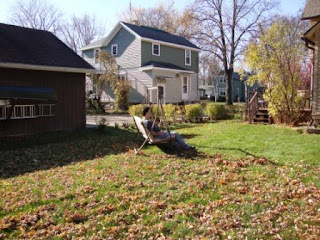
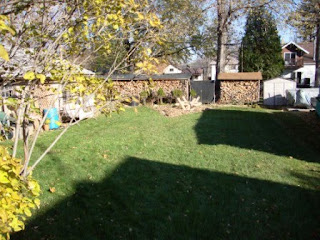
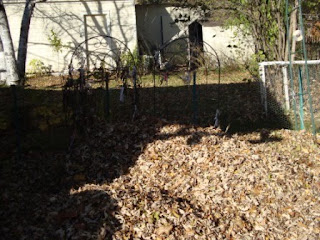
Director: Make a note: when we edit this, show the before and after. Hey, wait a minute. What did you do with the leaves? Burn them?
Chuck and Daisy, to each other: Shake heads.
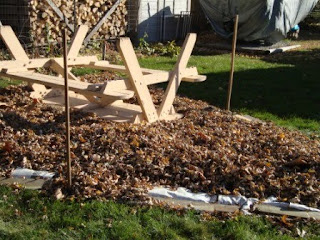
>The killing frost came. I harvested the last beans, tomatoes, peppers, and parsley. I pulled down the bean vines, yanked out the pepper and tomato plants, set aside the wire cages for spring. The second rain barrel is emptied and up-ended; I’ll use the main one for one last soaking, then open its drain and turn it, too.
Meanwhile, it’s fall, when the vegetable gardener’s mind turns to — spring! We’re preparing a new plot for tomatoes. Last year, the tomatoes grew too big for their spot, outgrew the wire tomato cages, leading to broken stems and shading the pepper plants behind. I moved them, and found another not-so-good season. No tomato blight here, thank goodness, but I planted them too close together and they didn’t have enough sun to really flourish. Solution: Prepare a new plot in a sunny location for the tomatoes. Decision: start it now.
This is the layered, no till, often called “lasagna” approach. The lowest layer is either newspaper or cardboard. I had boxes galore, so I flattened them and spread them out. The area is bordered by boards from an old deck; they’ll hold down the boxes for now and designate the sides in the spring. If I decide on a different edging, it’ll be simple; just pick them up!
 Layer two: grass clippings, mulch in progress. I’ll add a little more each weekend until it (gulp) snows. As I carried this organic material from the brush pile, last weekend’s nasty chest cold reared its ugly bronchial head and I had to go inside. The first layer is enough; we can add leaves and more when we get time.

>10. Watch the bean vines grow higher and higher.
9. Sneak a fresh raspberry before the rest of the family sees them.
8. Harvest lettuce and tomato for your BLT while the bacon is cooking.
7. Clip fresh herbs for a sauce or salad, making the kitchen smell great.
6. Freeze spinach and add it to everything.
5. Admire the cute little cauliflower head alongside the blooming broccoli.
4. Have a zucchini give-away contest: the most creative idea wins (Just don’t announce that the winner gets all the zucchini).
3. Make a garden vegetable soup in the crockpot; take the leftovers to work and gloat that you grew your own soup.
2. Bake rhubarb muffins – in January, from your frozen stash of rhubarb.
1. Serve fresh food to the family, nutritious and delicious – whether they like it or not!
>I didn’t want to cook. I was tired of cooking. I was feeling lazy. I didn’t want to shop, either. Therefore, I dubbed it “Let’s see what we already have in the house that will work together” day. I experienced and blogged this in August, but it could work today, too; I’d just be harvesting from the farmers’ market or the freezer instead of the backyard.
If there were a recipe, it might have looked something like this.
First: 2 chicken breasts and about a pint of chicken stock, both frozen. Dump into crockpot as is, without thawing.
Next: Sprinkle herbs (basil, oregano, thyme) over chicken & stock. Let simmer on low.
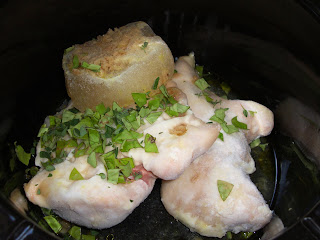
 Meanwhile: harvest zucchini. Find small bag of red potatoes in pantry. Search refrigerator for other potential ingredients: dice and add celery. Harvest a few pea pods and a handful of beans. Discover the one last green onion hiding in a corner of the garden.

Slice vegetables thin, remove peas from pods, and eventually layer veggies on top of chicken (when chicken is suitably thawed and beginning to cook, that is).
La Petite doesn’t like mushrooms, so saute them separately with butter and garlic.
