
>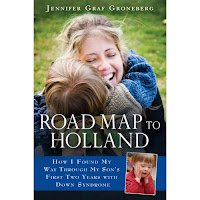
Jennifer Graf Groneberg faces a familiar journey in Road Map to Holland: How I found my way through my son’s first two years with Down Syndrome. I, too, had to suddenly change my perception, modify my hopes and dreams, and dig for information when my infant son’s blindness was diagnosed. Ms. Groneberg and I faced parallels in some of our thinking processes, and one of those was a constant re-interpretation of life metaphors.
The Holland metaphor in her title comes from an essay by Emily Perl Kingsley describing the paradigm shift when a baby is diagnosed with a disability or other life-altering condition. The well-known essay likens the thought process to planning for a vacation to Italy, only to find yourself in Holland instead. The destination is still beautiful, but it’s totally different from the original plan.
I’ve never been a big fan of the Holland essay and metaphor, although I knew at least one mom who posted it on her refrigerator as inspiration. Rather, I likened the challenge to expecting a car with automatic everything and then getting a manual transmission instead. The driver has to learn to shift gears quickly and smoothly, both literally and figuratively.
Groneberg hears and adapts other metaphors to her own experience. “Kids are like sandpaper” didn’t quite make sense at first. Did it mean raising kids is rough? Wears you down? Eventually she takes a more positive angle on this one, seeing her child as the sander who smooths out her own rough edges as he grows.
Groneberg’s journey with Avery paralleled my journey with Amigo in several ways. I kept nodding as I read, thinking, “Oh, I remember going through that.” But I also remembered that the first few years were the easy ones. Babies are babies, even when they’re disabled. Her twins’ story might be more interesting as they grow up, are forced to face their differences, and the biases toward Avery and his Down syndrome become more overt. Going through the IEP process, making transition plans, looking into job training, and more await the family in the years ahead.
The Holland metaphor in her title comes from an essay by Emily Perl Kingsley describing the paradigm shift when a baby is diagnosed with a disability or other life-altering condition. The well-known essay likens the thought process to planning for a vacation to Italy, only to find yourself in Holland instead. The destination is still beautiful, but it’s totally different from the original plan.
I’ve never been a big fan of the Holland essay and metaphor, although I knew at least one mom who posted it on her refrigerator as inspiration. Rather, I likened the challenge to expecting a car with automatic everything and then getting a manual transmission instead. The driver has to learn to shift gears quickly and smoothly, both literally and figuratively.
Groneberg hears and adapts other metaphors to her own experience. “Kids are like sandpaper” didn’t quite make sense at first. Did it mean raising kids is rough? Wears you down? Eventually she takes a more positive angle on this one, seeing her child as the sander who smooths out her own rough edges as he grows.
Groneberg’s journey with Avery paralleled my journey with Amigo in several ways. I kept nodding as I read, thinking, “Oh, I remember going through that.” But I also remembered that the first few years were the easy ones. Babies are babies, even when they’re disabled. Her twins’ story might be more interesting as they grow up, are forced to face their differences, and the biases toward Avery and his Down syndrome become more overt. Going through the IEP process, making transition plans, looking into job training, and more await the family in the years ahead.
My hope for the Groneberg family is that they will love and cherish all three of their children for themselves, their strengths, and their unique individual traits. Despite the difficulty of the first few years, I hope they can see their glass, however fragile, as half full rather than half empty.
For more discussion of this book and others, go to MotherTalk Book Talks and Salon.
MotherTalk provided me with a free copy of this book in order to read it and review it. If you’d like to read it, leave me a note in the comments that includes your email or a link. I’ll mail it out to the first interested commenter.