RIP Nora Ephron

Writer, producer, feminist, director, and all around talented woman, Nora Ephron, 1941 – 2012

 “I have always thought it was a terrible shame that the women’s movement didn’t realise how much easier it was to reach people by making them laugh than by shaking a fist and saying, ‘Don’t you see how oppressed you are’,” she told Newsday in 1976.

Maybe I could apply that to the upcoming elections. Instead of going all heavy duty and gathering serious facts about health care and education et. al., I could find jokes. A good punch line will help voters remember because they were smiling as they heard the facts. The smile helps voters feel positive, and positive motivation – well, anyway, I should look for punch lines. That will help.

“Your education is a dress rehearsal for a life that is yours to lead.”- graduation speech at Wellesley, 1996.

I’m not sure I agree with this one in a literal sense. If I’d followed my undergraduate education stream of consciousness, I’d be – oh, I give in, I wouldn’t be me. Since my graduation day, I’ve built on my liberal arts knowledge base and my experiences to move through a range of jobs and fields of study, some connected to my major and some unheard of under the roof of the ivory tower in which I studied. My current position did not exist when I was in college. In fact, my current job did not exist a mere ten years ago.

On the other hand, my undergraduate experience was an education in survival. I survived being an open-minded person in a closed-minded structure. I survived being a hearing impaired person in a conservatory of music. Some of those who wanted to knock me down back then are no longer in music or education. Dress rehearsal? Perhaps. When the curtain rose, I didn’t follow the script. I improvised. I had a lot of practice in modifying a score to fit the structure of my life rather than modifying myself to fit someone else’s composition.

“Above all,” said Ephron, in the address to the graduates of Wellesley in 1996, “be the heroine of your life, not the victim.”

Wow. That’s harder than it sounds. In the past few years, I’ve been victim of health troubles, including both physical and mental health, a victim of professional bullying (how’s that for an oxymoron?), and if you listen to the insurance company, a victim of my own coping skills. If I read it the other way, I’m a survivor. I cope. I am determined and willing to put a lot on the line to better my life and those around me. Is that heroic? I don’t leap tall buildings in a single bound, but I’ve crawled out of some nasty swamps and bogs.

A victim who recovers and moves on beyond victim status can indeed be a heroine. I think I’ll take a bite of a line from one of of Nora Ephron’s screenplays.

“I’ll have what she’s having.” – from When Harry met Sally.

My world is better for knowing Ephron’s work. She was an amazing woman. May she rest in peace – or better yet, may she spread her wisdom and humor to a new, eternal audience. I can have a taste of what she had by experiencing the collection she left behind.

Thanks, Nora.

Share and Enjoy !

Shares

Non-Consumption – guidelines to make it possible

I enjoy Mother Nature Network. I scan the articles, peruse the photo collections, compare the graphics, and more. Sometimes I see inspiration for changes in my own life. My family and I tend more toward the locavore than the globavore, as illustrated in this graphic. I do buy organic and free trade coffee from outside the local range – it doesn’t grow here – but I like to buy it from small grocers or local delis whenever I can. We grow quite a few vegetables in the backyard, and we buy a lot of produce from the downtown farmers’ markets. All of this improves the quality of our diet and our carbon footprint.

 The piece I saw this week was a list of questions to help make purchasing decisions. Instead of mindless consumerism and buy-buy-buy, asking these questions can point a consumer in a different direction. My friend Green Girl commented that “No one leaves the Farmers’ Market with buyer’s remorse,” and I agree. But regular stores? That kind of remorse is more likely. Check out the list below.

1. Is this purchase something I need? Need, not want. There’s a difference.

2. Do I already own something that will serve the same purpose? Example: clothing. I don’t need a new pair of jeans. I need to wear out the jeans I already own. I’ll let you go on, readers, without my interjections. 

3. Can I borrow one instead of buying new?
4. Can I make something that will serve the same purpose?
5. Can I buy a used one?
6. Would someone be willing to split the cost and share this with me?
7. Can I buy or commission one made locally?
8. Can I buy one that was made with environmentally responsible materials?
9. Can I buy one that serves more than one purpose?
10. Can I get something human powered instead of gas or electric?
11. Can I compost or recycle it when I’m done with it?
12. What is the impact on the environment of the full life cycle of it?
13. Does the manufacture or disposal of it damage the environment?
If the answers to these questions still suggest making a purchase, the buyers will know that their money will go toward valuing our environment rather than spoiling or damaging the natural world. I wonder – if I copied this list into my tiny purse notebook, could I avoid spending money unnecessarily? Probably. Could I make a more positive impact or at least a lesser impact on my home planet? Likely. I tell myself that I limit my consumption in a lot of ways. This list reminds me that I can do better.
Readers, which question is the hardest to answer? For me it’s number 13. I find it difficult to do the research involved in answering questions about the manufacture or disposal of commercial items. How about you?

Share and Enjoy !

Shares

War Imagery in Politics

Readers, remember this conversation?

Daisy: I’m going downtown to volunteer for a few more hours.

Chuck: You know, honey, the recall election is over.

Daisy: Dear, we lost the battle, but not the war. There are primaries in August and the Big Match-up in November. 

I know; Governor Walker won his recall election. He won it by a small margin, despite the millions spent on his campaign. I hope the governor is taking into consideration that he did not win easily. His side may have won one battle, but the troops on the ground are still fighting the war.

Fighting the war. The battle imagery implies fighting, attacking, attempting a take-over or worse, aiming to kill. Collateral damage will occur; people will suffer. Is that really what we want in Wisconsin?

Back in the 1970s and 1980s, the language of war and the language of sports were highly recommended study topics for college graduates going into business. If young men and (especially) women didn’t know the terminology, they were perceived as outsiders and began their careers with a linguistic disadvantage. In today’s world, management language still exists, but it varies more according to workplace climate than a gender or age difference. In a working climate defined by conflict, war words might seem appropriate. Wisconsin’s current political climate is not physically violent, but it is full of pain, aggression, vitriol and rancor. Conflict is the norm and cooperation is the exception. Passing laws becomes a matter of a battle won or lost, with wounded citizens on both sides.

If instead a sports analogy came into play, the teamwork aspect could appear stronger. When team works together, they score. When players go to bat and hit grand slam home runs, their entire team benefits. In this model, legislators can train for marathon sessions or bulk up for raising heavy issues, Unruly managers and players can be removed from the game. Good sportsmanship, playing by the rules, and clean competition all become important.  In a sports metaphor, opposite sides still compete, but they do it within a structure. They compete in public, with an audience watching, cheering, applauding, and respecting the participants. Eventually the game ends with a winner and, unfortunately, a loser. A sportsmanlike competition allows the loser to graciously concede without losing status.

I don’t even want to start thinking about battle fatigue. That’ll be a whole different set of images. Readers, what kind of language do you suggest? The metaphors and analogies we use can set the scene for success or failure.

Share and Enjoy !

Shares

This talent skipped a generation.

I don’t sew. My mother does, and my daughter does, but the best I can hope for with a needle and thread is to anchor a button before it falls off.

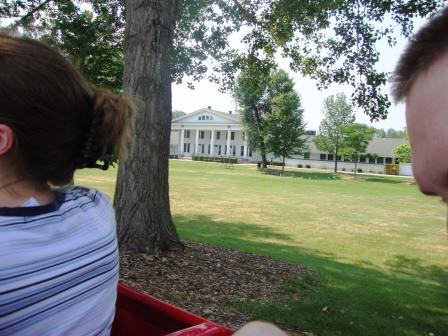
Daughter is starting her career as a professional photographer. I take pictures for my blog. Some are okay, and some are – well, you’ll see. Observe: examples from our recent trip to Bay Beach Amusement Park.

I’ll pretend I meant to frame the pavilion between SIL and Amigo.

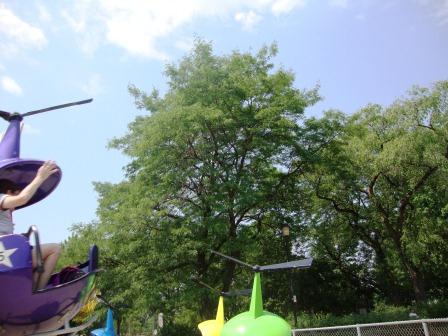
And the day went on, from train ride to helicopters.

The helicopter at left is carrying SIL and adorable 2 year old niece.

Note to self: Don’t even try to make meaningful photos from the Ferris wheel.

Watch that first step – it’s a long way down.


Great view – er, great view after you get past the knees.

Next time I’ll leave the professional photo work to the younger generation.

I’ll just sit back and enjoy the rides.


Share and Enjoy !

Shares

The Daisy Reality Show: why it isn’t really TV worthy

A reality show of my life would have a lot of boring moments for viewers. Consider the following:

Director’s Assistant: Daisy, you snore.

Daisy: What?! (starts coffeemaker and turns her bleary eyes toward the annoying assistant) I thought my bedroom was off limits.

Assistant: Well, we leave the cameras off when you and Chuck are changing clothes or doing anything, um, private.

Daisy: (moans) I have a terrible sinus headache. No wonder – the two go together. If I can’t breathe through my nose, that means I’m sawing wood all night. If I’m rattling the floorboards in my sleep, I probably have sinus troubles. Let me get into the bathroom and see what I can do about it.

Assistant: But we can’t use bathroom video, either!

Now, readers, we move from boredom to TMI – too much information.

Daisy: I took ibuprofen already. It’s not helping. Next: I’ll flush out my nasal passages with my Neti Pot. I’m sure viewers don’t want to watch my saline solution flowing through my sinuses and washing out –

Assistant: Stop! Stop! I get it.

Daisy: Speaking of flushing, my left ear aches. I had the wax flushed out of it yesterday.

Assistant: Doesn’t a Q-Tip work? He had to ask.

Daisy: No, no, no! Q-tips just squash the wax and make it more tightly impacted in the ear canal. Anyone with hearing aids has wax troubles. In most people, the earwax finds its own way out. With a hearing aid in the way, the earwax builds up and needs to be removed by a doctor two or three times a year.

Assistant: Oh. (Looks suspiciously at Daisy) Does that hurt?

Daisy: It’s uncomfortable. Sometimes I get pain after the procedure because my middle ear is tender and sore. Then I function without the hearing aid on that side for a while to reduce the pressure and let the skin heal.

See what I mean, readers, TMI! True, but somewhat icky details, are the daily grit of my life.  But the show must go on.

Director: Sorry I’m late! Daisy, did you sleep all right last night? You look like you have a headache.

Assistant: Don’t. Even. Ask.

Share and Enjoy !

Shares