>Potential: herbs in their new home

>

Hmmm… no green yet. Soon, though. This nice holder and pot are right outside the door to the dining room. We can slip out to harvest herbs while we’re cooking; it’ll take only seconds.

In fact, here’s the long view. The chair in the background has potential of its own. It’s an old one with a couple of spindles missing, not very strong overall. Perfect: for a plant holder. Husband plans to cut a hole in the seat, and then I’ll paint it to match or coordinate with the deck. I’ll do my best to keep it solid colors; polka dots won’t be quite as becoming on this style of furniture.

Share and Enjoy !

Shares

>Salsa: fresh from the garden

>Disclaimer: I haven’t made this yet. I found it in our wellness newsletter and decided to copy it for my collection. I didn’t plan cilantro, but I can buy some at the farm market. I did plant green bell peppers, jalapeno chili peppers, and (of course) tomatoes. We always have onion in the produce drawer.

The best part is the last line: “Modify to your liking!” As always, I welcome your suggestions. Avocado, perhaps? Black beans? Bring it on, bloggy friends!

Fresh Salsa
Ingredients:
2 Ripe Tomatoes (diced)
2 Green Bell Peppers (diced)
1 White Onion (diced)
Fresh Cilantro
1 Tablespoon Lemon Juice
1 Jalapeno Chili Pepper (diced)

Combine all ingredients and chill in the refrigerator. Modify the ingredients to your liking!

Share and Enjoy !

Shares

>Planting a garden: it’s all in the potential

>A few weeks ago, my garden was just a deep brown color, waiting for seeds and seedlings. Now it has little hints of green here and there.

Peas and beans! The peas already look healthier than they did a year ago.

Cauliflower and (maybe) broccoli emerge, seeking sun and water.

But the bunny food section? I must get those maple tree seeds out of this area. It’s a lettuce bed, not a helicopter pad!

Share and Enjoy !

Shares

>Watering Toys, er, tools for the garden

>Ah, gardening geekdom. Simple pleasures, such as getting water to the plants, can be so much fun. The process starts here at the rain barrel, with a short (10′) hose attached.

This hose feeds through the chicken wire fence (that’s the overflow hose in the background).
Feeding it through rather than draping it over the fence allow gravity to help provide pressure and bring the water where it’s needed.

The connection from 10′ hose to soaker hose wasn’t quite secure at first, letting a little too much water leak into the lettuce bed. I fixed it. This might not matter with a standard faucet, but with a barrel, the system can’t afford to lose any of its meager pressure and still expect to get the water where it needs to go.

I connected the two hoses securely, and then the water was ready to reach its goal: the soil around the plants. These tomatoes sure look like they need it.

The soaker hose is a porous hose made partially from recycle rubber. It has tiny holes that allow the water directly into the soil without letting significant amounts evaporate like a sprinkler does. When I’ve gone to the trouble of harvesting rainwater, I don’t want it going into the air as water vapor. Ultimately, I’ll move the soaker hose around until it shares its moisture with all the thirsty plants.
A few strategic tools, a little physics, a little ecology, and the garden is watered. Yes, it’s fun to be a gardener who teaches science!

Share and Enjoy !

Shares

>Teaching Wisdom from the Gardener

>Gardening is a thinking time. It’s a contemplative and meditative frame of mind while I’m digging, pulling, and patting the earth. The acts of planting or weeding take very little conscious concentration, and instead let my mind wander along other paths.

The first year of the garden I struggled. I planted some things that just didn’t work in the space and the soil. The grass and the creeping ivy kept invading. It took several years to get the remnants of grasses out of the garden plot. There’s a reason for the term “grass-roots organizing.” Grass roots are strong, they don’t let go, and they are determined to live on and prosper. I’ll keep that in mind as I write letters to my legislators at the state and federal level and ask for more equitable school funding formulas.

I’ve learned along the way. My first few years of teaching I relied on basics, taking the textbooks as my guides. As I learned more and gained confidence, my teaching methods improved and I began to differentiate for various learning styles and ability levels. Every year I garden I learn something new. Last year the sun just wasn’t reaching the plants the way they needed it, so I re-planned the whole layout this year. Oh, I almost forgot, we cut down a tree, too.

I call myself a lazy gardener. No one dares call me a lazy teacher! It’s okay to limit the amount of extra time I spend on schoolwork by prioritizing, focusing, and organizing. My family needs me, and I need Me Time, too. I’ve already decided to drop off one of the main committees at school when the year is done: the committee that does the test score data analysis, among other tasks. I stuck with it through the grant writing and the introductory collaboration, and now that I look at the summer commitments for this group, it’s going to be too much. The data analysis itself will require a whole new set of training and skills that are just not in my schedule right now. I serve my school well, and this specific committee will achieve its goals without my presence.

Lazy gardener? I plant, weed, and water, and eventually harvest. If the weeds aren’t totally eradicated, I don’t sweat it. But that’s not laziness, really. Compost takes a small amount of time, and it’s well worth the effort. Reading books and browsing web sites on gardening also helps, and those activities take time, too. I find the time investment worthwhile. It pays off later.

That leads to another item: time investments. I’m dropping off a major committee. I did, however, register for a course in teaching students with ADHD. In the past two years I’ve seen more students than ever with difficulty focusing, staying on task, resisting impulses, and more. Some have diagnosed Attention Deficit Disorder, some with and some without the Hyperactivity element. A few kids probably don’t have a medical reason for their difficulties, but can benefit from some of the ideas and knowledge I’ll gain from the course. It’s worth three graduate credits, but more than that, it’s well worth my time. This time investment will pay out later in direct and improved student contact.

I’ll probably do the bulk of the coursework for this graduate class on rainy days, a cup of coffee by my side, while the rain barrel fills and the garden soil soaks up the water. I’ll do the rest on the deck after watering and weeding and turning the compost. Balance? Summer is all about balance. Maybe that’s the best piece of wisdom of all.

Share and Enjoy !

Shares

>Not more with less, but more with the existing garden resources.

>Doing more with less in a school setting can lead to burnout. In the garden, I’m focusing on doing more with what I already have available instead of doing more with less. My goal: feel productive, not overwhelmed.

Compost, of course. I’m adding paper this year, that which can not be recycled due to food residues. Husband puts in the grass clippings, I add some of the soiled bunny litter box contents, and of course any suitable kitchen scraps. The grass clippings keep the temperature hot and help decompose the rest.

The rain barrel is already a success. I use it to rinse the litter boxes, rinse the emptied compost bucket, water the rhubarb, and more. We’ve only used the outside tap when we need the high water pressure for washing the lawnmower.

Tomatoes have new supports, supports that I already owned. The bean trellis is the same one I’ve used for years. I’m using a few old tomato cages for pepper plants and snap peas, and I think I’ll sell the rest at our June rummage sale. I really have too many. Hmmm…if La Petite would wash and paint them, maybe they’d be worth a little more. Maybe?

All this productivity with minimal investment helps my morale. I feel frugal for reusing and repurposing. I feel accomplished for getting the garden in and tending it. I feel thorough for doing my research and nurturing the tomatoes to do so well.

But lock your doors; if my zucchini is too prolific, I’ll have to get creative in giving it away.

Share and Enjoy !

Shares

>Tomatoes in a nutshell, er, in an eggshell.

>

Gardening and teaching. I could make a Venn diagram comparing and contrasting the two. I had a random thought today that teaching and gardening are similar in that we choose and match the techniques that work for our students or for our soil and plant choices. Last year I did a little research on growing tomatoes. I found loads and loads of ideas, many of which were ridiculously difficult. Typical of my style, I chose the pieces that I could easily incorporate into my own routine within the time limits of my own schedule and the budget limits of my own wallet.

Last year I worked with the soil by adding shredded newspaper under each plant to increase drainage. That meant I had to make sure the plants stayed watered well, but it helped prevent swamping when we had a lot of rain. I’ll do it again.

I also added eggshells. All the other fertilizers seemed to cost $$ or be difficult to find. My soil already includes home made compost, and the tomato plants move to a different part of the plot each year. I didn’t feel like I needed Miracle Grow or any other such commercial fertilizer.

Was it the weather? The newspapers? The eggshells? Could have been all or a combination of the three, but my plants outgrew the wire tomato cages so much they collapsed.

I’m going to follow the same plan this season with one exception. I have a different set of trellisses, and I’ll gently tie up the plant stems with old tee-shirt rags. Last year’s plants grew to 5 feet tall, and with support they may do even better.

I always have plenty of shredded papers, and I can feed newspaper through the shredder if I need more.

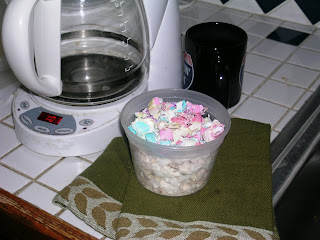
Eggshells? I’ve been collecting since before Easter. Aren’t they pretty?

Share and Enjoy !

Shares

>Square Foot Gardening: The Good, the Bad, and the Dirty

>My gardening goal this season is simple: use the existing space more efficiently for a better yield. No expansion of the space, no new additions, just do more with my current patch of dirt. The timing was right: I ordered the new and updated Square Foot Gardening by Mel Bartholomew. The subtitle is Growing more in Less Space! It sounds like a perfect fit for my goal.

Well, yes, no, and maybe.

The good: Mel’s philosophies are sound.

The introduction should be required reading. In it, Mel explains how he came to develop this small-space, low maintenance method for backyard gardening. Much of the how-to advice that follows is based on this introduction.

His compost advice is great. He makes composting sound simple, which it is, and offers suggestions to improve the quality and the balance in very easy ways.

If you’re looking for low-maintenance, reasonably small time investment, and limited frustration factor, read this book. He’s very realistic about gardeners who have very little time for daily garden maintenance (i.e. weeding).

His methods have been demonstrated successfully over many years and in many different settings. The Square Foot Gardening (SFG) method is applicable in many planting zones and yard sizes: even apartment decks.

The bad: The book reads like an infomercial, and an old-fashioned sexist one, too.
“Without a grid, your garden is not a Square Foot Garden.” Okay, Mr. Bartholomew, what is it? Do you mean that unless I plan to construct the full box/grid plan, I shouldn’t bother? I hope that’s not the case. There are many good ideas in SFG that I can apply without doing the whole enchilada.

On building a compost bin from pallets: “Women tell me they love this because it involves no tools, wire cutting, equipment, or familiarity with construction.” Mel, Mel, Mel. It’s the 21st Century! Would it surprise you to hear that I, Daisy, wife & mother & groundskeeper of Compost Happens, teach science? That I handle wire cutters when I prepare lesson plans in electricity? The All New Edition of SFG really ought to be bias-free.

The dirty (dirt is good, remember): I can integrate many of his concepts into my existing garden.

However, I refuse to feel pressured by the multitude of exclamation points! I will not be intimidated by statements like, “You’re not using authentic SFG if you don’t!” Mel knows gardening, and Mel knows people. If I can ignore his patronizing tone and his high pressure sales writing style, there are good concepts in this book.

Overall opinion? Buy it on sale, buy a used copy, or get one on Paperbackswap.com. I bought it new, and I’ll probably pass it on to a friend or through PBS. It’s worth the read; just don’t let yourself get sucked into the pseudo-hypnotic “You must! You must!” Trust your experience and knowledge, and adopt the SFG ideas that work for your own garden.
Share and Enjoy !

Shares

>Pest Prevention and Plot Preparation: Mission Accomplished

>

It’s a typical spring weekend. We slept in – me until 7, Husband a little later, Amigo up at 8 to listen to his favorite shows on Public Radio. I had the coffee on and newspaper in, but I was still in my pajamas when Husband came downstairs fully dressed and full of philosophy and energy. He focused that energy where it would do the most good, and moved the car to make way for the roto-tiller.
As he put it, he took the long way around the garage. Knowing we live on a small-to-medium city lot, the “long way” can’t be that long, can it? Wrong: it can. He pulled out and kept going all the way to the Moto-Mart for a box of Krispy Kreme donuts.
I followed the special treat with my usual Saturday: sorted laundry, got dressed, got ready to start the first load (jeans and sweats, by my Green Routine). At that moment, Husband came inside. He’d rototilled the entire garden plot, turning the compost into the soil. Laundry could wait while he showered.

The danger of frost is very real in Wisconsin in May, so the best I can do right now is prepare the garden for the seeds. It was a perfect job for a cool and pleasant Saturday morning.

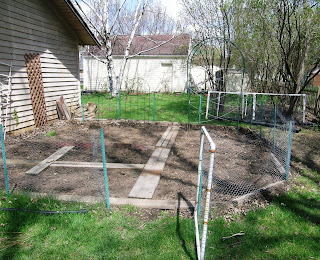
I re-used old fence boards and deck boards to create walkways and block a few square-foot style raised beds. These walkways keep me from over-compacting the soil, prevent weeds from growing in the unplanted areas, and allow me to harvest without changing into my dirt-friendly garden shoes. I “installed” the bean trellis and put up the old rose supports that will help brace the tomato plants this year. They’re taller than the old wire cages, coated so they’re less likely to damage stalks, and I can gently tie up the tomato plants with rags as they grow. I hope this will work well. It has to work better than the wire cages did last season!

Next, I took a few more deck boards, the 4X4 size, and braced them against the chicken wire that keeps the critters out. I love my bunnies, and I don’t mind seeing the wild ones make my yard their habitat, but I don’t want them eating my produce. I buried the big boards slightly and piled up enough dirt to bury the fencing a few inches underground. It’s not perfect, but it’ll keep most of the neighborhood fauna from finding their way into my lettuce and spinach and parsley.
At that point I took a break. Washed up, more laundry, sipped a Diet Coke to rehydrate a bit, and thought about lunch. Instead of making lunch, though, I went back outside to document my progress.
Getting my hands (and shovel) back in the dirt feels so good, so productive.

Share and Enjoy !

Shares

>The neverending saga of the telephone wires

>Husband cut down an ornamental tree that had grown a bit too tall for itself. It was lovely when it was small, and I’m sure the previous owners of the home enjoyed it. But as it grew, it blocked the sun from my garden and its thorns (spikes! ouch!) imperiled anyone walking under the drooping branches. We made the decision, and down it came.

But high up above the ladder, the tree branches were tangled in and around the phone wires. He called the AT&T equivalent of Diggers’ Hotline to let them know about the problem and find out what they wanted to do. When he finally reached a real person (after several minutes of the voice-system maze), he was told to cut the tree down completely. When he was done and the branches were just dangling, they would send a crew out to get the tree out of the wires.

He cut the tree down. When freed of their lower supportive brethren, the tiptop branches wobbled, twisted, and fell free themselves. They left the phone service lines dangling, however. That was just the beginning.

Husband called again to leave an update. We got a phone call later that week from a service technician who wanted to come while we weren’t home. Should have been fine; he didn’t need to get in the house. But no, it wasn’t that simple. Somewhere in the chain of command, the story became garbled. The tech thought we had trouble with U-Verse, our television service. He tested the line going into the home, found no problem, left us a note with his phone number so we could call him back because he couldn’t get into the home, of course.

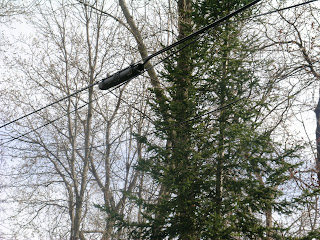
So….husband called again. He explained that it wasn’t a U-Verse problem, a cell phone problem, or a landline problem. All of our services were working well. It was the line outside that might become a problem. He even described it in engineering terms so the technicians could understand. I offered to send them the above pictures if they needed more information….

The next morning, a weekend with all of us at home this time, the technician called. “I understand you want a wire buried?” Husband got off the phone and nearly collapsed with laughter. For a communications giant, the local folks certainly couldn’t get a message straight! The tech showed up twenty minutes later, Hubs showed him the dangling wires, described the recent problem and the fact that the tree and the lightning strike a few years ago had collaborated (okay, maybe not consciously planned) to weaken the wires. The technician, the first one to actually finally see and understand the problem, said he knew who would do this work and he’d call him right away.

Concluding act: The above-mentioned technician showed up at the door on Sunday afternoon. He rang the doorbell greeted Husband with, “Hi, I’m here to replace the wire that runs from the pole to your house.” Imagine further laughter here, but all out of view of the poor guy. He honestly thought that was the message. Husband took him out back, showed him the wire, and he said, “Oh! I can do that. And I’ll record the lightning strike, too. These wires get weak with repeated stresses, so we like to keep records so we know when to replace them.” He got his ladder, did the work, and was gone within half an hour.

And all was well with the wired world.

Share and Enjoy !

Shares