>Compost 3-2-1: Summary and Goals

>We teachers sometimes use a summarizer technique called a 3-2-1 review. It’s like a bulleted list that helps students process what they’ve learned and show that they’ve gained from the activity or unit. For example:

While watching the video, fill in the following.

3 things you already knew
2 new facts
1 fact or concept that surprised you

New Year Goals

3 habits I will keep
2 events I’m looking forward to
1 goal or change for the new year

I can use the same 3-2-1 techique to summarize my composting progress.

3 items that decomposed completely: no sign of them at all!

  • coffee filters with coffee grounds
  • banana peels
  • waxed paper

2 items that did not decompose: I should leave these out from now on.

  • Dental floss. Don’t laugh; it’s waxy, contains food residue, it makes sense that it would decompose! But it didn’t.
  • Pine litter from the bunny box. The small dry pieces partially degraded, while the wet one are gone for good. If I left the bin for another year, just to finish decomposing, I think the used litter would completely fade into the soil. Maybe when I get that second compost bin…

1 goal: another item to add to the compost pile, one more thing to keep out of the garbage can and landfill

  • Non-recyclable paper and cardboard. Examples: the cardboard circles from pizzas, food boxes containing crumbs or soiled with food residue, and the like. I’ve started ripping these into long strips and soaking them (in rain barrel water, of course) before adding the paper to the compost.

There you have it: my 3-2-1 review, a summary of the pile I just spread on the garden soil. The resulting assessment will be a long time coming: to fully evaluate the success of this year’s bin, I’ll need to wait until next spring, when the latest pile of compost (you guessed it) happens.

Share and Enjoy !

Shares

>Climb on the wagon – the spring garden wagon

>

This wagon was in my inlaws’ garden shed when they moved to their senior condo. Mother-in-law (MIL) knew she wouldn’t use it again, but she resisted giving it away or leaving it with the house. Like many of their “heirlooms”, the wagon landed at our humble abode. Husband suggested putting it in the rummage sale. We don’t need it; we have a wheelbarrow. Our yard is so small; we don’t need to transport brush or leaves any distance, really.

But we couldn’t quite bring ourselves to let it go. I considered setting it up as the centerpiece of a flower display, with the pots arranged artfully inside it and various ivies draping over the sides. With La Petite’s flower expertise and artistic asistance, possibilities abound.

Then Husband cut down the ornamental tree that had gotten too big for its branches, blocking the morning sun and poking its higher reaches into the phone lines. He filled the wagon with brush (while I used the wheelbarrow elsewhere in the yard), and then stacked firewood in it.

Perfect. Absolutely perfect.

I won’t hazard a guess as to the value of this wagon, with its metal mesh sides and base and the heavy duty handle and wheelbase. It’s probably old, but not an antique. There’s no damage or rust, even after spending the winter next to the garage in the (recordbreaking) snow. Rust proofing on a garden implement? Maybe. Just lucky? Maybe that, too.

But for now, I like it. We’ll use it for firewood or build a flower-scape around it. Cute, it’s not, but it’s solid. This little green wagon has a history, too. I think we’ll keep it around.

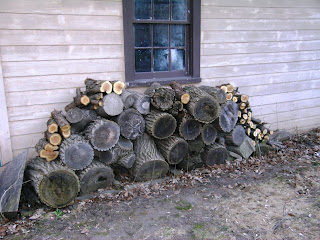
Woodpile: lighter colored branches are the fresh pieces.
They’ll weather and dry for at least a year before they’re fireplace-ready.
The “new” old wagon made this process a little easier.

Share and Enjoy !

Shares

>Greening the Weekend Chores

>Is it easy to become green? Live a more eco-conscious life? It seems like after taking the basic steps – recycle, compost, start a garden – it takes a little more effort to incorporate additional green habits into our lifestyles. Today Husband and I spent more time in the yard getting ready for spring. Here’s the Green Task List from today’s chores.

1. Brush pile. Dear darling Husband cut down a small tree last weekend, and today was the day to get rid of it. We thought (briefly) about renting a chipper and chopping up the entire thing, but decided against it. Why? It’s free to drop off the branches etc. at the brush dump. The brush dump staff will chip this wood and add it to the dump’s mulch pile. Mulch is free to city residents. Why pay to rent a power tool when we’re already paying for the service with our taxes? Decision: take the branches to the brush dump. Pick up mulch when we need it. Cost: $0. Time spent: three minivan-loads to the brush dump about a mile from home. Green factor? Pretty darn good. Rationalizes keeping my (not a guzzler, but not exactly fuel efficient) minivan, too.

2. Basic Maintenance on south side of house. This is the side with the tulips, the mums, the annuals, the Hen & Chix plants, mint, and if I’m lucky, hollyhocks. I raked out the old dry leaves, cut down the old dead mums, lost my clipper, took all the dead and dry goodies to the compost bin, found my clipper, moved a shepherd’s crook with two wind chimes, and pronounced the area ready for spring. Green factor? Typical, which is good.

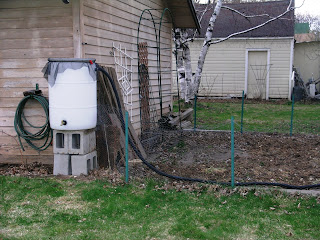
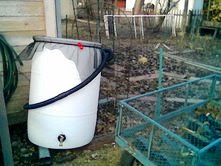
3. Emptied and moved the rain barrel! We planned to set up the new rain barrel under a downspout at the back of the garage between the rhubarb and the garden itself. We dropped it back there, went back to our normal lives, and then it rained. And filled the barrel. I’ve used the water to clean bunny litter boxes and rinse out the compost bucket, but it was still three quarters full and too heavy to move. My solution: hook up a hose to the spigot and water a few bushes. I drained enough of the barrel that it was light enough to move, and then recruited Husband to put a few concrete blocks underneath it. Now it’s propped high enough that gravity can help me use the hose with more success, and Husband will reattach the downspout and aim it toward the barrel itself – hopefully before the next storm arrives. Green factor? Great! The neighbor behind us (a new gardener!) saw it and now wants one for himself.

4. Basic weekend chores: laundry. I bought a pair of anti-static dryer balls to replace fabric softener. So far, I’m seeing – or should I say feeling? – good results. If they work in the long term, it’s another victory for green living and fewer chemicals in our lives. Simple and eco-conscious, just the way I like it.

Share and Enjoy !

Shares

>It’s not spring yet, honey!

>I tried. I really tried to feel like spring, but Mother Nature did not cooperate.

I spread the compost on the garden and started using the bin again. I had to wear a knit hat and warm gloves while I did it. It’s not spring yet; I had to wear gloves to keep warm, not just work gloves for leverage.

I washed all the blankets and comforters at the laundromat (an annual spring cleaning chore) and put a different, thinner comforter on the bed. Husband was too cold and couldn’t sleep. It’s not spring yet: I had to put the fluffy blanket and thick comforter back. (So much for avoiding those elder-mama night sweats, grumble grumble)

We opened windows just a crack to enjoy a little fresh air, but then we forgot to turn the heat back on. In the morning, with 37 degrees F on the outside thermometer, we piled on the blanket throws while we read the Sunday paper and waited until the hardworking furnace worked hard to reheat the house. It’s not spring yet; we still need heat.

Husband won’t put away the snow shovels. He’s superstitious that way. A coworker talked about putting away his snowblower, “…and we had two major snowstorms the next week! It’s not spring yet!” He’ll take care of the snow tools in May — or June, if he’s really uber cautious. If we put the snow removal devices away, we’ll get a blizzard.

But Husband did give in and work in the yard with me. He took out the chain saw to cut down an ornamental tree that had gotten too big. This was an adventure; the uppermost branches were tangled in the telephone wires. He called AT&T, knowing they wouldn’t want him messing with the wires in any way. After going through all the switchboard options (no, we don’t need service; no, we don’t need billing), he finally got a Real Person on the line. That Real Person told him to remove the tree and call them back; they’d take out any remaining branches that hung from the phone lines. Luckily (I think), the branches untangled themselves and came down as he cut out the bigger branches below.

The garden plot is closer to ready. The sun-blocking tree is gone. The compost is spread, waiting for soil-turning. Unfortunately, it’s not spring yet. But when Mother Nature turns that corner, I’ll be ready. Shhh: don’t tell her I’m ready now!

Share and Enjoy !

Shares

>A Victory Garden in the Family History

>Husband took a day trip last weekend to a nearby city in order to photograph gravestones for his family history web site. He invited me along; I declined, preferring to start readying my garden. He invited Amigo; Amigo wanted to stay home and start his spring break by relaxing. Husband then called his mom and dad. They initially said yes, and then his dad backed out in favor of a nap or two.

On the road between here and there, Mother-In-Law talked about her childhood in Milwaukee. She meant the big city itself, not a suburb. MIL spent her formative years on Milwaukee’s north side, around 41st Street between Silver Spring and Capitol Drive. They lived in a small house, and her father bought the two lots on either side when the owners were in arrears on their taxes. “He got them cheap!” as she told Husband. Using the extra lots, the family started what she refers to as their Victory Farm in the sity of Milwaukee.

They grew vegetables, they raised chickens (she remembers somewhere in the range of 500!), and near the back of their lot, they grew the grain to feed the chicks. She, as the only daughter, canned the blueberries and raspberries as they ripened. When they had more than they needed, she would work out trades with the neighbors and/or the small grocers in the neighborhood. She remembers trading berries she’d canned for a box (crate? case?) of peaches. She canned the peaches and started the cycle all over again. She threw a few peach pits in the backyard, and lo and behold, two peach trees came up. As they began to bear fruit, the family didn’t need to buy or trade for peaches any more, either. The peach trees were a hardy variety, a Rocky Mountain type, so they held up well in this cold Wisconsin weather.

I’ve read that at one time Victory Gardens produced 40% of the nation’s food supply. That figure sounded awfully high to me, but if a lot of city families did what my MIL’s family did, 40% becomes more believable. MIL told Husband that the family started their Victory Farmette just before World War II. It must have been fairly well established by the time the Victory Garden became the trendy thing to do.

My backyard plot – call it Kitchen Garden, Recession Garden, or just my patch of dirt – won’t come near Victory Garden quantities. I can only hope it’ll grow stories that I can tell my kids when they have kids of their own. Maybe they’ll talk about how their mother liked to play in the dirt all summer long and added home grown spinach to everything they ate!

Happy Love Thursday, everyone, and keep telling the family tales. That’s the kind of growth our country will always need.

Share and Enjoy !

Shares

>Whether the weather…

>It’s shovel ready. The economic benefits may be localized (okay, merely personal), but it fits the times. As soon as the weather cooperates, I’m on it.

You guessed it: Daisy’s small but wonderful backyard garden.

I’ve never formally defined it as a Kitchen Garden or a Recession Garden. It is what it is: a backyard garden of vegetables for the family, both human and rabbit residents of our fair home. The plot has grown a little each year we’ve planted it, and we’ve added simple environmentally-friendly tricks along the way. This year our goal is to use the space efficiently and get a better yield.

Here’s the to-do list.
Move walkway boards out of the dirt. These are re-used from an old fence. When it started to fall, we knocked it down the rest of the way and used the boards as stepping “stones” between the veggies.
Move trellises and tomato cages. I’m still doing the research to find better and taller supports for the tomatoes now that I’ve discovered some of the techniques for nurturing them well.
Spread the compost. It’s still in the bin, and I’m eager to get out the soil-ready batch and start anew.
Till. Husband does this. He now has his family’s old rototiller, so we don’t need to rent one any more.
Hook up rain barrel. It’s ready to use; we need to set it on its blocks and direct the downspout into it. Painting optional: I would like to paint it, though.
Buy the seedlings. I have the seeds; the tomato, pepper, and broccoli plants will come later.
Sketch the new layout. I know what I want; I just need to make sure I’m putting it all in the right place this year.
Plant!!

Ta-dah! list:
(That’s the “finished” or “outbox,” for new readers to Compost Happens.)
Make rain barrel! It filled with water during a rainstorm earlier this week; it’s “shovel-ready,” too!
Buy seeds!
Get excited and motivated! Okay, that’s always a given. I’ll never be a farmer, but I do enjoy my tiny plot in the backyard. Playing, er, working in the dirt feels good. Feels right.

Share and Enjoy !

Shares

>Saving the rainwater, growing the veggies

>

We’re not used to working together as a team. We’re more accustomed to splitting up the responsibilities, or as Husband put it, we “Divide and Conquer.” So when I signed us up for a rain barrel making workshop at a nearby environmental charter school, we stumbled through the process as an awkward team.

I got out the camera and then left it on the kitchen table, so we ended up without pictures, but that’s fine. Frankly, it wasn’t a very photogenic experience. Just imagine a big plastic barrel, the two of us drilling holes and fitting it with two tubes and a spigot, and there you have it. We covered the top with mesh to keep the bugs out, and now it’s done. We’ll hook it up to the downspout at the back of the garage near the garden, and it’ll be good to go. Er, ready to catch the next storm.

It looks rather blah out there now, so maybe I’ll try to convince La Petite to paint it. Maybe polka dots? It would match the deck chairs!

Here it is, not hooked up yet, with the garden area in the background. It was too cold to even start working outside today. Sigh. If March goes out like a lamb, maybe there’s hope.

Share and Enjoy !

Shares

>Recession garden? Bring it on!

>A few seasons back I waited too long to buy seeds. I didn’t get any pole beans, and my bush beans turned out to be both green and yellow. Surprise, Green Bay Packer colors! But seriously, I prefer stringless pole beans for ease of harvest and preparation.

Last summer compared my small backyard plot to the WWII era Victory gardens. Today’s news is full of a new term: Recession Gardens. Folks across the U.S.A. are figuring out what we backyard gardeners already knew: fresh home grown veggies are inexpensive and delicious, with less risk of contamination in the harvest or shipping process. But with the new found popularity of vegetable gardens comes a drawback: not a run on the bank as in the Great Depression, but a run on the seed companies!

I can’t get out to buy seeds right away. Despite the thick piles of snow still on the ground, I have Spring Conferences at school this week and next. I won’t have the time or energy to shop around. I could order online, but I’d really rather buy locally and stimulate my neighborhood economy. For what it’s worth, whenever I get it together, here comes the plan! Step one in any major shopping endeavour: make a list! So far, here’s what I own.


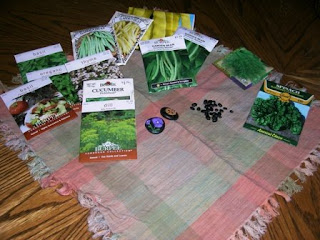
I think the beans are covered now: I have both pole and bush styles, green and yellow. Herbs are good: see the thyme, oregano, basil, dill, and more on the left. Only one package of spinach, and that’s about it. The black beans came from a plant I put in by mistake last year; I didn’t have my reading glasses on for the fine print. Oops! I like black beans in soups and chili, so I’m going to try them again. The painted rocks were a student gift a few years ago; I still love them.

Here’s the seed shopping list for now:
Peas, squash (zucchini, green), parsley, lettuces, a little more spinach.
Plants:
Tomatoes (cherry, Roma, and big juicy ones), peppers, broccoli.
Asparagus! I’ve done the research, and I think I’m ready.

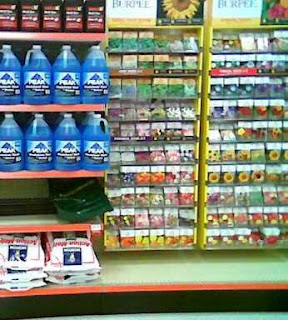
The chives and green onions will come back, as will the rhubarb and the raspberries. It’s time to go back to the store and see if they still have a good supply next to the snow shovels, anti-freeze and ice melt!

Parent Bloggers Network is talking about green living this week. What can be greener than a backyard garden, complete with home-grown compost? They’re also featuring green cleaning supplies from the Nature’s Choice line by SC Johnson. Great idea, but I’d still rather play in the dirt, er, I’d rather weed the garden than clean my house.

Share and Enjoy !

Shares

>Inch by inch, Green is a cinch.

>BlogHer asked members to comment on ways they’ve been “greening” their lifestyles. The post has a sponsor, of course. Doesn’t everybody? I started to comment, realized I’d forgotten my password, and vowed to come back. As time passed and life went on, I couldn’t help but think that my recent Green Growth couldn’t possibly fit in a comment box.

You can tell from my blogs’ names that I’m an environmentalist at heart. Compost Happens, A Mother’s Garden of Verses… no doubt about this blogger’s philosophies. Not at all. Then look through the archives: start with Mom’s Playing in the Dirt Again! and then check out others under the labeles of garden and It’s not easy being green. Green isn’t just a color; it’s a way of life.

I’m not “crunchy” green in the hippy sense, though. I gave in to Husband’s desire to hire a lawn service. We use a clothes dryer, not a clothesline. Our home is air conditioned, although in our part of Wisconsin we are fortunate not to need it often. I drive a minivan, too. Hey, I’m a mom of a teen and college student. We’re always filling the back of the minivan with someone or something.

The pale olive comparison (see above) is here so readers will know that green, like any lifestyle, has limits and levels. Seriously, it’s easier than many people think. Teacher friends like to say “Inch by inch, learning’s a cinch. Yard by yard, learning’s hard.” Incorporating environmental actions step by step, inch by inch, can be easy.

I garden. This section of lawn doesn’t grow grass, doesn’t need mowing, doesn’t need any chemicals. It provides delicious and fresh vegetables for much of the summer.
We compost. Composting is easy, it cuts down on our family garbage, and it produces a nice soil additive each spring for the garden.
We conserve energy by using a programmable thermostat, minimizing the use of the clothes dryer, washing clothes in warm or cold water, and more.
There are more, many more, environmentally friendly practices in my home and family. Really, it’s quite easy to bring green living practices into everyday use.

Back to the top. It would be cheating to simply list the above practices in the comment box on BlogHer’s question. These are not new; they’re habits we’ve built into our lives for years. New and recent additions in my family’s eco-conscious behaviors do exist. For example:

We stopped buying paper napkins last fall. I keep them on hand (well, we haven’t used up the package that was in the pantry when I set this goal!), but we have switched almost 100% to cloth napkins. This was a frugal choice: I bought the first set from a store’s going out of business sale, and picked up a set of holiday napkins in new condition from a thrift store before Christmas. I wash them with the rest of the dirty clothes and towels each weekend – no extra laundry, no additional water/ heat energy used. This decision was so easy I wonder why I didn’t start years ago!

I set a goal last fall of buying No New Wrapping Paper. My family resisted a little, so I didn’t push it on them, but I predict they’ll come around. I reuse gift bags, make tags from last year’s cards, and collect rather than recycle packing material. It worked; I bought no new wrapping paper, and (don’t tell them I noticed), my family didn’t come home with any new paper, either.

My husband and I make a conscious effort to pay attention to buying local, especially in foods. That’s tough in a cold climate like ours, and we’re hoping to freeze more of our garden produce in order to avoid buying produce imported from out of the country. This is a nutrition decision as well as a commitment to minimizing our carbon footprint, as well as noting that local and fresh simply tastes better.

So, BlogHers, are you satisfied with my contribution? I almost hope not. I’m committed to living lightly on the earth, and there are many easy ways to lighten my footprint. In my future I predict a second compost bin, a rain barrel or two for the garden, and possibly a food dehydrater to make the most of my garden yield. Spinning the rabbits’ shedded fur into yarn might not be possible, but I know that inch by inch, my family and I will weave the green consciousness into action.

And action, after all, is what environmentalism is about.
Share and Enjoy !

Shares

>Mom’s playing — in the kitchen?

>Gardening and baking. Two seemingly dissimilar activities, both serve a similar place and purpose for me.

I tried to blend butter and sugars the other day and the butter wasn’t ready. It reminded me to plan ahead, get the butter out ahead of time, and let it sit. I stopped, waited, and got back at it with better results and a more peaceful, easy feeling. The cookies were delicious.

Gardening is also a slower process, a contrast to my high pressure teaching job. When I put the garden to bed for the winter, it’s a melancholy feeling not only for the yield, but because I truly miss working with my hands in the dirt.

Both gardening and baking let me incorporate a few more healthy ingredients into our menus. Spinach, fresh tomatoes, and crisp green beans make their way onto the family table in late summer and fall. When I bake from scratch, I can control the ingredients that make their way onto my family’s plates, not to mention using up foodstuffs that might otherwise go to waste. I recently used up two very ripe bananas in a banana bread. Husband helped; he peeled the bananas.

Gardening gets me out of the house and away from distractions like the telephone. Baking doesn’t do exactly that, but it does take me out of the whirlwind that is my life. Putting the ingredients together, measuring properly, following a recipe (well, to some extent) all take just enough concentration. Just enough, that is, to take my mind off the many day to day stressors.

We’re steadily working our way through the Christmas cookies, so I’m looking at a few other ideas to plant in the kitchen. Cranberry muffins, anyone?

Share and Enjoy !

Shares