>Depression hurts and confuses.

>

Yesterday, my back hurt and my head hurt. My back hurt because I have no energy to stand or walk for any length of time. Making lunch or supper meant pushing my limits, which caused pain. My head hurt from exhaustion; I slept much of the morning, despite sleeping well the previous night.
Rest is hard to come by in this Midwestern work ethic. I feel like I should be constantly accomplishing something. During the playoffs and the Super Bowl, I could allow myself to watch a game or two – but there was usually laundry in the washer and dryer while I was watching. I’m taking an online class right now, and getting that work done helps rationalize another nap.
Depression hurts emotionally. Dredging out the energy to make small talk, even with family, is tough sometimes. I’ve always been a peacemaker – at work and at home. Right now, I just want to walk away. I don’t have the energy to converse, much less mediate.
Some days I have more questions than answers. I’ve had flashback dreams of that November night in the ER, the night with the chest pains that scared the heck out of me. Why the flashbacks? I don’t know. It doesn’t mean I want to be sicker or go to the hospital. This dream may just mean I’m doing too much, too soon, too fast. Maybe it’s a warning that I need to slow down, no matter what my Midwestern work ethic might say.
Lately, recovery consists of two steps forward, one step back. Days exist when I have the energy to cook, but not clean the kitchen. I need to slow down and put myself first. Slow down, rest, and heal.
Now if only our state politics would let up, and I could stop watching news….

Share and Enjoy !

Shares

>Concussion: more than a headache

>There they were, my Green Bay Packers, getting close to the end zone and scaring the New England Patriots because a touchdown would have put the Packers in the lead. Then Matt Flynn’s pass was tipped…

Readers, I hear your questions. “Matt Flynn? Daisy, what are you talking about? Aaron Rodgers was the starting quarterback for the fantastic Green Bay Packers. Rodgers, not Flynn, was the MVP in that incredible Super Bowl win!”
Yes, readers. Aaron Rodgers, starting quarterback, had been hit hard in the helmet the previous week – hard enough to suffer a concussion. He hadn’t recovered sufficiently to be cleared to play, so Matt Flynn, his back-up, started in his place.
Concussion is the term for an injury: an injury to the brain. When the brain is shaken, spun, or suffers a blow (such as a blow to the football helmet), it moves rapidly – too rapidly – inside the skull. Symptoms of concussion vary, but some key signs of a concussion are:
  • appears dazed or confused
  • can’t remember events immediately after or prior to the hit or fall
  • double or blurry vision
  • concentration or memory problems
  • any change in the athlete’s thinking, behavior, or physical functioning
I didn’t list loss of consciousness, although even a momentary loss of consciousness is one of the most common clues that a concussion has occurred, because a concussion doesn’t always result in blacking out. It’s not safe to assume that a young athlete is “fine” because he or she didn’t see stars or pass out. Even a “bell-ringer” or a “ding” to the brain can be serious.
In fact, my caution list is woefully short. Since many young children play under inexperienced or untrained coaches, parents shoulder the burden of watching over their children’s safety.
Aaron Rodgers had the entire Packers’ training staff examining and treating him, including doctors and physical therapists and professionally trained coaches. Young athletes don’t have that advantage. The CDC has several resources aimed at coaches, teachers & school personnel, and parents.
If the Super Bowl MVP can miss a game in order to recover from a concussion, anyone can. It’s better to miss one game than the whole season.
This is not a paid post. The Center for Disease Control (CDC) asked me to help publicize this important topic. If you’d like more information, the CDC’s home page for Concussion is here.

Share and Enjoy !

Shares

>Family Travel Tips

>

Ten Tips from Daisy for Family Travel
Tip: Know your limits. Budget and plan accordingly.
These tips change as families get older. Chuck and I have traveled by train across the country from East to West, and along the East coast from Miami to Washington, D.C. Had we done this twenty years ago, we could have gone in coach the entire way. Now that we’re both 50 and, well, mature travelers, we prefer beds at night, so we paid a bit more for the Amtrak roomette. It was worth it.
Tip: Acknowledge that each family member has different taste, and respect each other’s tunes.
When our kids were younger, we’d bring our own music and take turns choosing what to play in the vehicle’s CD player. Now each person brings their own headphones, earbuds, and music player – MP3, mainly. Well, that is, each person except the driver.
Tip: Have enough cup holders. Seriously.
Cup holders are awesome. Each traveler should have his/her own. Mine, of course, will hold my morning coffee. Chuck, La Petite, and Amigo? Most likely Mountain Dew. We all have our chosen vices.
Tip: Travel eco-responsibly as much as possible.
Whenever we hit the road, I feel some guilt for not being as green as we are at home. Instead of cloth napkins, we’ll use paper. We’ll pull out disposable wet wipes for convenience. There is room for compromise, though. I often bring my own water bottle or travel coffee mug. Many places make it easy to recycle; go ahead, do it. And when all is said and done, don’t beat yourself up for not being perfect.

Tip: Pack light.
Somehow, dirty clothes seem to take up more space than clean clothes do. Pack with room to spare. And then there are the souvenirs; leave room if you plan to buy anything at your destination or along the way.
Tip: Choose souvenirs wisely.
Did I mention souvenirs? My favorites are those that are useful and fun reminders of the trip. Coffee mugs make great purchases; so do t-shirts and sweatshirts if you wear them. On our last trip, we picked up a lovely hand-made wicker basket. It became an additional carry-on for the trip home, and now it lives next to my recliner with my lumbar pillow and recent magazines in it. This lovely yet simple basket will always remind me of the trip.
Moving on a bit more quickly, here are a few tips for traveling families:
Tip: Bring pillows or blankets. My best travel-related purchase ever was a horseshoe pillow. I use it in the car, on trains, and on airplanes. These supplies are almost always cheaper at home than on the road.
Tip: Bring reading material. Last trip I packed two books, read them both, and left them in the Bed & Breakfast’s bookshelf for future travelers. One of my favorite reading tips? Buy a local paper.
Tip: Plan for the best, but prepare for the worst. If your plane is delayed, what will you do? If the car gets a flat tire, do you know how to change to the spare? If you’re stuck in a traffic jam at lunch time, do you have snacks to prevent starvation and (worse) crabbiness?
Tip: Look for simple pleasures. Scenery. Sounds. Plants. Animals. Regional foods. Time together to talk and simply enjoy each other. The best memories of the trip aren’t always those that cost a lot of money. After all, the key word in Family Vacation is Family.
I wrote this blog post while participating in the SocialMoms and Alamo blogging program, with the possibility of earning a gift card worth $25. For more information on how you can participate, click here.

Share and Enjoy !

Shares

>Pan Fried Cod with Peppers

>

Chuck created this recipe based on something he found in the book Dining on the Pacific. He changed the recipe enough to be called his own. He’s a great cook; I’d love to see him take over the kitchen, but then who would make sure all the Packers specialty shows were on the air? Never mind.


Here it is!


Pan Fried Cod with Peppers

Topping:

2 tablespoons of Crisco Extra Virgin olive oil

1 clove of garlic minced

1 small can of minced clams, drain out and reserve the liquid

1 small yellow onion chopped

1 tablespoon sugar

1 green pepper chopped

1 red pepper chopped

1 can Rotel diced tomatoes with lime juice & cilantro

Pepper to taste

Preheat oil in a 3 qt saucepan. Add onion and begin to sauté. Sprinkle in sugar and garlic when onion begins to turn opaque. Sauté for another 2 minutes or until onions just begin to carmelize, being careful not to burn garlic. Add peppers and tomatoes. When peppers begin to soften, add clams without the liquor. Stir, reduce heat and let simmer for 20 minutes. Just before serving, stir in 2 tablespoons of the clam liquor. (This helps prevent the liquor from curdling and will begin to add some saltiness to the topping.) Add pepper to taste.

Fish

1 ½ to 2 pounds of Cod fillets, washed and dried. (About 6-8 pieces.)

2/3 cup all purpose flour

½ teaspoon McCormick’s ground paprika

1/8 teaspoon McCormick’s ground cinnamon

2 tablespoons butter

2 tablespoons Crisco vegetable oil

Thoroughly combine all dry ingredients in a storage sized Ziploc bag.

Preheat oil and butter in a skillet.

Place two fillets at a time into bag and shake them until well coated.

Place the fillets into the hot skillet and pan fry until golden brown, turning once to do other side.

Continue until all fillets are done.

When removing from skillet, place fillets onto a plate with a paper towel to drain any excess oil.

Serve fish on a bed of rice with a generous portion of topping spooned over it. Serves 4.

Share and Enjoy !

Shares

>Mrs. Lerner’s Afterlife

>Let’s call her Mrs. Lerner, the teacher in this story. Mrs. Lerner passed away, and continued on her peaceful way toward the pearly gates. St. Peter met her with, “Welcome, Mrs. Lerner. Here in Heaven, we all make contributions. What would you like to do?” Mrs. Lerner responded, “I’m a teacher, so I’ll teach.”

Peter called over St. John-Baptiste de la Salle, the patron saint of teachers, and had him escort Mrs. Lerner to her new classroom. When she got there, she was was shocked to see the conditions. 40 desks. 35 textbooks, all outdated. Pencils, pens, and paper were sufficient to supply the class for perhaps one day, no computers existed, and a cracked chalkboard hung on the front wall.
“Oh, my God!” she exclaimed, “this is horrible!”
Boom! Suddenly, Mrs. Lerner was in an entirely different locale, escorted by a devilishly handsome young man. With a fiendish smile, he brought her to a very different classroom. 15 desks, well-equipped with supplies, books of all reading levels and interests, an interactive whiteboard, and behind each student, supportive parents. On her desk lay a contract offering the opportunity to bargain for decent working conditions as long as she continued to teach.
“I don’t understand,” she murmured, shaking her head. “Why the advantages here, of all places?”
The devilishly handsome escort slyly reminded the dedicated educator, “Mrs. Lerner, when you asked the governor for this, where did he tell you to go?”

Share and Enjoy !

Shares

>What does healthy feel like?

>Chuck and I went out for dinner last weekend. I mentioned that it had been two weeks since my last appointment and a change in medications. I thought there was some progress. He asked “How can you tell? How will you know when you’re better? What are the signs?” And then we realized together that I hadn’t been healthy in months. I might not know what healthy feels like.

I spent the summer with peri-menopausal issues, ending with surgery that seemed to quiet the hormonal changes. I was still weak, tired, and anemic.
In September I taught on crutches for a while until the good family doctor figured out that despite the negative blood tests, I did, indeed, have gout in one foot. Reaching a diagnosis meant we could treat that, and I could regain strength and walk around school again.
Then there was the Virus That Was Not Influenza.
The following months were full of one thing after another, including clinical depression, eventually leading to the decision to take a long term medical leave of absence and recover from any and all of these problems.
So once more: how will I know what healthy feels like?
On an average day, I’m here (imagine me holding hand up to chest level). A healthy person would be at this level (holding hand above head). On a Good Day I might feel like I’m here (hand at chin), but too many days I still slip to here (waist level). That’s an improvement. Before I began resting seriously and pursuing formal treatment, low days were (knee level) and average days barely made it to (waist high).
I’m smiling more often. I sleep a little better, but family doctor is still working with me to improve the quality and quantity of shut-eye. My dreams are still tense, but they’re not all school-related. I’ve decided to set up La Petite’s aquarium and put a few fish in it. It’ll be relaxing to watch easy to care for. So – is this what healthy feels like? No, not really, but I do feel improvement.
I guess I’ll keep reveling in each small improvement, taking care of myself, and moving those levels gradually higher and higher. Some day in the future, I’ll look in the mirror and realize “This is what healthy looks and feels like.” Readers, trust me; I’ll let you know when that day arrives!

Share and Enjoy !

Shares

>An Oldie,but Goodie: A Tribute to Dr. Seuss

>originally posted in March 2007; originally published in WSRA Journal in 1997

When we were young
And could pick up a book,
A man with a gift
Made us all take a look

At a cat with a mission,
A feline with style,
Dressed up in a hat
With a hint of beguile.

The cat made us smile,
The Grinch brought a tear.
While the Whos down in Whoville
Inspired a cheer.

Those red fish and blue fish
Or green eggs and ham
The Star Bellied Sneetches
And that Sam-I-Am

The poor little boy
Wearing five hundred hats
Got caught in the oobleck
That fell and went splat.

His stories had morals,
Were strong with conviction,
Even though written
As young readers’ fiction.

A clear point of view,
The compassion he saw,
Like”…a person’s a person,
No matter how small.”

The elephant Horton
Who said what he meant,
That he could be faithful,
One hundred percent.

And think of the Lorax,
The one who said, “Please,
Oh, Please stop destroying
The Truffula Trees!”

His creatures were special,
Both comic and tragic,
Some small and some large,
With an aura of magic.

Think of the characters,
Ageless and timeless,
And how he could make
Something rhyme that seemed rhymeless!

The point of my story,
I’m sure you have reckoned,
Someone quite special
Was born on March second.

Creator of Yertle,
And Thidwick the Moose,
A talent unequaled:
The dear Dr. Seuss.

Share and Enjoy !

Shares

>Potluck with the Geeks

>

Chuck was at a model train show recently. While he was gone, I realized I had a draft in my queue that I hadn’t posted yet. What does that have to do with trains? Read on.
It was the annual gathering of the model train club: a cookout-slash-potluck of the guys. They requested that Chuck bring his famous German potato salad. He did, but he did even better. Remember, these guys are geeks who identify totally with the main characters on the show Big Bang Theory.

From the left: Fizzbin Fruit Salad, Pickles Set on Stun, Photon Tomatoes, and the aforementioned potato salad.


Fruit salad:

fresh pineapple, raisins, gooseberries,

Photon tomatoes:
spicy deviled egg mix (yolks only) in plum tomatoes: use the yolks of hardboiled eggs for a traditional deviled egg mix, with the addition of smokey red pepper sauce. Scoop the seeds and pulp out of the cherry tomatoes; fill with the egg mixture and top with the tops of the cherry tomatoes.

Pickles set on Stun:
pickles marinaded in brine from Marzetti’s hot pickled yellow peppers.
Next year I think he’ll bring something that requires a pizza cutter so he can bring his new one.
Thanks, ThinkGeek. You’re awesome.

Share and Enjoy !

Shares

>Sound Bites and Protest Signs

>

The first time I heard the term “sound bite” was during the presidential election between Bill Clinton and George H.W. Bush. Journalists, especially those on TV and radio, found ways to pull out a small snippet of a candidate’s speech and use it to form the basis of a news story. Remember these?
Read my lips: no new taxes!
It’s the economy.
…a kinder, gentler nation.
Save Social Security!

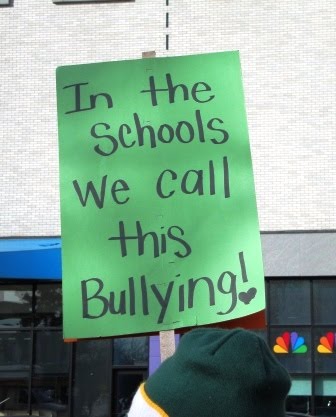
Protest signs have a similar challenge: not much space, the need for a quick message, one that a driver can read at a glance and continue driving safely. Amigo told me he was rallying for his teachers: those who had taught him in the past and those who were his teachers now. We talked over simple slogans, and he decided to include a little Braille to remind people that all students, no matter what their needs, must be educated. He used his Perkins Brailler to show me how to write SOS correctly, and we were ready. He knew which side of the sign to face out because he could feel the stick & duct tape on the back.

There’s a classic saying, “If you think education is expensive, try ignorance.” The signmaker below has a variation on that theme – a variation that also points to new governor’s insistence that Wisconsin is “Open for Business.” How he thinks a strong business economy can exist without educated workers is beyond me. But that’s another post…
Anti-bullying programs and zero-tolerance policies for physical, verbal, and cyber bullying are common across the country. In many states, such policies are mandated by the Department of Public Instruction. Gov. Walker’s method for dashing off a divisive and devastating bill that guts the rights of many is just that – bullying. Questions? See below.

Sound bites or protest signs, they work in a similar fashion: quick to make a point, easy to understand, easy to remember, and the potential to provoke a more in-depth discussion. Let’s hope the bully decides to mediate soon so that Wisconsin workers don’t need many more signs.

Share and Enjoy !

Shares

>Workplace Safety close to home

>After last week’s post with union history, I heard from relatives who reminded me of my grandfather’s union past. He worked for a paper mill in the 1940s before workers were union members.

The mills were extremely dangerous places to work back then. If not for unions, the mills could and did treat people as though they were expendable. A mill manager could arbitrarily fire a long time paper machine operator and replace him with an incompetent relative or neighbor. This kind of grossly unfair management was only stopped when the unions came in.
He saw great injuries caused by the paper machines. Safety wasn’t mandatory; making money was.
He saw people lose their hearing before ear protection became mandatory. One of those so disabled was my great uncle.
He was there when people died gruesome deaths. Two men from his little town went into a giant digester machine for maintenance and suffered gruesome deaths from a steam explosion.
Later, three local men died from inhaling toxic chemicals (Hydrogen Sulfite) in a sewer. Grandpa talked about this at length, blaming a combination of incompetent management and poorly trained, unprepared workers.
Readers, go back into your family history. You may have someone who remembers life before unions, life before OSHA, and life before management was forced to be fair. Ask your grandparents; you may find surprising stories.

Share and Enjoy !

Shares