On a hot, hot day at the market

Today's Market Goodies

Today’s Market Goodies

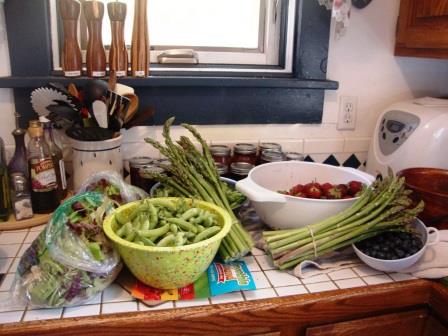
From left to right: lettuce, peas, asparagus, strawberries, more asparagus, blueberries. My tasks today: cut up and freeze asparagus, remove peas from pod (there’s a snappier way to say that, I’m sure), freeze peas, hull strawberries, clean lettuce – oh, you get the drift. The brightly colored menu under the green bowl is the new menu for the smoothie place downtown. It’s going into my schoolbag so I can order from my desk in a cubicle just a few blocks away.

Meanwhile, I’ll sip on today’s smoothie (Groovy Grape) and start chopping asparagus spears.

Life is good.

Share and Enjoy !

Shares

Every mug has a back story.

Coffee, tea, hot cocoa – no matter what your hot beverage of choice, the mug it’s in is very likely to carry a story. This came up in a thread on Facebook, and I realized I had a number of posts featuring my coffee mug collection. Most of the posts are from my first or second year of blogging. Let’s start with yesterday’s mug, Where’s Waldo, and today’s mug of choice, Ducks in a row.

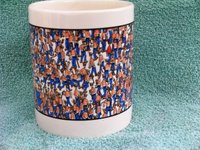
Where’s Waldo? Well, if you can’t find him now, just fill the mug with hot liquid (preferably Folgers) and all of the faux Waldos’ shirts will fade away. This mug has been in my collection for a long time — at least 13 years (Daisy’s update: at least 20 years, now). I ordered it free with a few labels from cans of Spaghetti-os and a miniscule shipping and handling fee. It has served up tea, hot cocoa, and of course, coffee. I’ve had a lot of fun with this mug over the years, including watching people stare at it in the teachers’ lounge. It was worth the shipping and the stamp. And now, Ducks in a Row. Continue reading

Share and Enjoy !

Shares

Cooking from Scratch

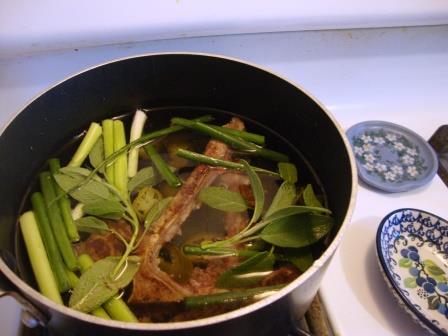
Another reason to grow herbs, among other pretty plants: soup stock. Chuck had beef bones left after grilling supper. He knows to save them for me. I dropped them in a pan of water and added, fresh from the backyard:

Beef Broth in Progress

Beef Broth in Progress

Beef Bones, sage, green onion, and garlic scapes. Did I forget to add basil? Dang it. The basil is growing like wildfire. Must make a pesto or something similar soon.

Share and Enjoy !

Shares

Farmers’ Market Starts Again!

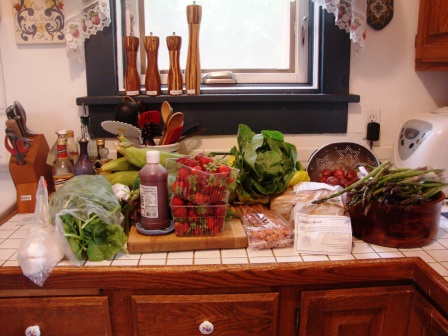
I’ve been waiting and waiting for this day. The Downtown Farmers’ Market has returned to my fair city! The weather was muggy, but tolerable. No rain, just the threat of it. And people? The street was mobbed. We bought — wait. I can make this easier.

Market Bounty, Week I

Market Bounty, Week I

You can probably recognize the spinach, the asparagus, and strawberries, and lettuce, too. I also picked up whole wheat bread with flaxseed (from my favorite Amish baker) and a small loaf of cheddar cheese bread. For my sweet husband who loves to cook, we picked up scallops (not local, I know), red potatoes (much more local), and a great local barbecue sauce. He chatted with the sauce maker for a while and got some tips on how to grill really tender ribs. There’s more, but I must get to work prepping the strawberries and the peas. The peas are in the picture, sort of. They’re hiding under the asparagus.

Ah, the Downtown Farmers’ Market. Now it really feels like summer.

Share and Enjoy !

Shares

From Animal, Vegetable, Miracle to No Impact Man

I read Barbara Kingsolver’s Animal, Vegetable, Miracle about five years ago. I was wowed by the project of eating locally for a full year. Her experiment was impressive, starting in spring with rhubarb from the local farmers’ market and asparagus from her own yard and then moving through the seasons.

I still use some of the recipes from Animal, Vegetable, Miracle. I do lean toward local foods, in particular local produce. I’m nowhere near the level of Kingsolver’s experiment, but putting the locavore philosophy into practice is now a natural part of our food shopping and preparation.

Another year long experiment was No Impact Man by Colin Beavan. I’d had No Impact Man on my wish list for a while. When a copy became available on Paperback Swap dot com, I grabbed it.

Beavan’s project was impressive, too. He decided to create a carbon footprint as light as possible for a full year. His project started in stages, starting with walking or biking to and from work and resisting the urge to buy food or drinks on or in disposable containers. Every few weeks he would add in a new challenge such as limited electricity or water. His project was as urban as Kingsolver’s was rural; Beavan and his wife and daughter lived in a ninth floor apartment in New York City.

One trait both books share is the experimental nature of each project. The authors were both skilled writers before their environmental projects began; and their reflections throughout their respective projects reflect both facts and subjective responses. Difficulties, roadblocks, support, positive and negative attention, and real-life reflections make both experiments less clinical and more enjoyable. Colin Beavan’s toddler decided she preferred her new cloth diapers to the disposables they’d used previously. Barbara Kingsolver’s daughter went to college mid-project and relished her home visits for the good quality local food.

Animal, Vegetable, Miracle and No Impact Man remain active on the web and in the green scene. That’s what impressed me. They didn’t dump their experiments the minute the calendar flipped to the next year. They left the extremes behind, but the core of each project remained. Kingsolver continued to buy and serve local food, growing what she can and raising her flock of heirloom turkeys. Beavan turned on his electricity and uses public transportation now, but he turns off the lights when he leaves a room and rarely uses an elevator.

Why a book review in June, years after these two were published? Well, folks, I realized that our family already makes a fairly decent low carbon footprint, and courtesy of our freezer and a hot water bath canner, we enjoy local fruits and vegetables year round. I’m not writing a book (well, not about that), but I’m using the space in my semi-urban backyard quite well.

Readers, what are your green habits of choice?
Share and Enjoy !

Shares

It’s a crazy, amazing world.

Officially, I was out of school on Friday, June 6, as soon as I had my progress reports handed in and my cubicle cleaned. It didn’t feel that way, though.

I turned in my progress reports, cleaned my cubicle, and then took off to pick up Amigo at his sister’s apartment in Lake Geneva. We were on the road home when Amigo realized he’d forgotten his wallet. La Petite met us midway, and we were on track again.

Saturday was a busy day and a napping day. Amigo left for camp Sunday, so he spent Saturday doing his laundry and I helped – a little.

Sunday we took him to camp.

Monday could have been  my first day of Summer Break, but I signed up for a training session that lasted four days. as Thursday ended, I gave a deep sigh of relief.

Then, Friday, we drove to camp to pick him up and bring him home. Still busy, not feeling the break yet.

Saturday and Sunday I did relax a little, but I did it with La Petite. She needed a little moral support for a few days, and I was available.

Well, folks, now it’s Monday, and it’s not going to be a manic Monday. I’m done traveling (for now), and I plan to stay at home, do my own laundry, and weed parts of the garden. I might even sleep in and/or take a nap.  If you’re expecting a lot out of me, you’ll have to wait.


Share and Enjoy !

Shares

Portion Sizes

Readers, I know that Blog Basics state “Nobody cares what you had for lunch!” but I’m going to chance it. Due to a rude awakening (99% blocked carotid artery, et. al.), I’m getting serious about keeping my blood pressure down. Task one: monitor the aforementioned blood pressure.

Petunia bought me a home monitor, and I’ve been faithfully using it since I came home from the hospital. Now that I have the numbers and I’ve learned a little about what those numbers mean, I want to move to the next step: do something to keep those numbers low.

In the meantime, I’m paying attention to my eating habits. By using the USDA’s DASH diet, I hope to keep the BP numbers below that mystical threshold. So far, I’m meeting my goal of eating 6-8 servings of fruits and vegetables a day. The tough part: what makes a serving? Well, I did find some guidelines. I think I can handle this.

Fruits and veggies will be easy for the foreseeable future: it’s Farmers’ Market season! My favorite market, the one that spans the entire downtown of my small city, is starting soon. Time to get out the cloth bags! Vegetable vendors, here I come!

Share and Enjoy !

Shares

Weeding is Therapeutic

Weeding is productive and therapeutic and even enjoyable. I searched through old posts and found out that I’ve discussed the positives of weeding in the past. I mentioned this yesterday, too, in the context of the hay masquerading as straw.

Here’s one from June, 2007.

I enjoy weeding because I can see progress. My garden is divided into small sections, set apart by my stepping “stones” made from old deck and fence pieces. I set a goal of weeding one section at a time. When that’s done, I can quit weeding or choose to finish another section. This is a managable goal; I feel productive when I can see the results in one part of the plot. It spares me the frustration of not “finishing” the whole thing, which is of course an impossible goal. Today I chose one triangular section of the garden and weeded out the many mini maples that flew in from the lot behind ours. If I ever abandon this small plot of ground behind my garage, I predict the mini maples will take over, leaving room for a blanket of clover underneath. But for now, look out maples! I have garden gloves and I know how to use them.

Here’s an even older post from July, 2006.

Weeding feels good because:
  • I can’t hear the telephone.
  • Digging in the dirt is fun.
  • It doesn’t matter if I’m all sweaty and grimy.
  • I can appreciate the growth of my vegetables by comparing them to the weeds I’m pulling out.
  • I see the little flowers that mean the plants will bear fruit — some day.
  • I can laugh at the tiny “volunteer” tomato plants that grew where the rotten fruit dropped last fall.
  • The science teacher in me looks at all the clover and thinks, “Wow! There’s a lot of nitrogen in this soil! Who needs fertilizer?”
  • I notice the little grubs and worms that aerate the rich soil; and they’re almost (I said ALMOST) cute.
  • I notice how dark and rich the soil is, thanks to our home-grown compost.
  • The weeds (well, most of them) will become part of the cycle of life by decomposing in the compost bin.
  • Progress is noticeable. Every little bit of weeding shows results.
I heard a garden expert on the radio recommend that serious gardeners spend about 30 minutes a day weeding and maintaining. I don’t come near that, so I guess I’m not “serious” by his standards. I do keep it up, though, and get my hands dirty and produce good things to eat. My garden makes me happy. Isn’t that enough?

Share and Enjoy !

Shares

The Truth about Straw Bales

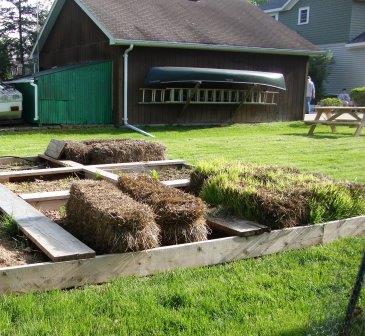
I mentioned my dilemma about the straw bales. Did I have the right fertilizer? For that matter, did I have the right bales? We bought them from two different places last fall, and it seemed like one might have labeled the bales Straw when they were really Hay.

Hay? Straw? I’m a city girl, despite my green thumb and green attitude. I didn’t know straw from hay. So I did what a good virtual teacher does; I asked a student and her family for advice.

My students live all over Wisconsin, and several live on farms. I asked about the bales, describing the one set as looking straw-like and the other growing like a Chia Pet.

One of these things is not like the other.

One of these things is not like the other.

I learned that straw is what’s left over after the wheat is harvested and removed from the stalk, and hay is a grass. Yep, that’s it. I can extend this to say I learned not to buy a bale of “straw” at a grocery store. Uh-huh. This batch was left over from a fall display, so the store sold them off for a few bucks each. The rest are from a garden center. I know where I’ll go if I need a set of straw bales again.

Meanwhile, I took time to yank most of the growth from the hay bales. They’ll still work for planting; I just might have to weed them more often than not. And that’s alright. Weeding, after all, is therapeutic, too.

Share and Enjoy !

Shares