The Second in the series: Awareness Encores

This post originally aired about one year ago. Since then, the magic number of prevalence has become 1 in 67, up from 1 in 88.

It’s April, again. Autism Awareness Month. Now that autism numbers are estimated at 1 in 88, shouldn’t we already be aware? Shouldn’t we as a society be moving on?

Moving on beyond awareness means learning about each other, neurotypical or on the autism spectrum. Even under the old numbers of 1 in 166, the estimates indicated so many children and adults with autism that “normal” needed redefinition.

Awareness, people, is not enough. Awareness is a low form of knowledge, and knowledge itself sits down low at the base of the learning pyramid. Awareness means knowing that the student sitting next to your child in class might have autism. Knowledge and understanding come around when that child responds to gestures of friendship, perhaps awkwardly, yet making a step toward joining the social peer group in some way.

Awareness? Awareness means slapping a multi-colored puzzle-design ribbon magnet on the back of the family minivan. Understanding means that when the minivan next to yours at the red light is moving back and forth propelled by the rocking of the teenager in the front seat, you notice but don’t judge. You might offer an understanding smile to the driver if the opportunity comes up. By refraining from negative comments, a parent provides a role model for the rest of the minivan passengers.

The “R” word is also still active, unfortunately. The word Retarded hasn’t been in active use for educational professionals in decades, but it still turns up in verbal put-downs. Awareness means knowing the label Retarded is unacceptable. Knowledge and comprehension would show that anyone with limitations in learning faces enough challenges without getting their diagnosis tossed around as a playground insult.

I wore my “R” Word t-shirt on the appropriate day. That’s my awareness activity. To bring it to a higher level, I vow to stop and comment when I hear the word used: stop and educate those who would otherwise redefine a person in narrow boxes.

Now it’s time to take Autism Awareness to a higher level, too.
 

Share and Enjoy !

Shares

The Awareness Series: let’s move on, already.

From fall of 2012 — I still feel this way. The first in a three- day series, Awareness Encores.

Breast Cancer Awareness is all over the networks – at least it’s all over ESPN, NFL Network, NBC, CBS, and Fox Sports. Guess it yet? The NFL is blowing the horn to the tune of Pink – massive pinkness in the most macho of arenas.

Pink Gatorade towels. Pink shoe covers. Pink wristbands. Pink cleats, chin straps, and ribbon decals. Pink whistles for the (real) referees, for heaven’s sake. And why?

The purpose of all this pink on the turf is supposed to make all NFL football fans think about breast cancer. Be Aware. Know it’s there.

I can’t help it. My inner cynic is screaming “Enough with the pinky dances already!” My inner cynic, for those who don’t know, is very tuned in to breast cancer in the realm of early detection through mammograms. I’m more than aware of radiation studies, chemo, reconstruction – you name it, friends and family in real life have lived it. Yes, Mom, my latest mammogram was once again normal.

Before readers denounce me as a Bah Humbug, my inner cynic must look into its own wardrobe for two (at least two) pink t-shirts designed by an art teacher who was raising money for the Avon Walk in Chicago. I also own a pink polo shirt with the Green Bay Packers logo on it and the famous pink Packers baseball cap pioneered by Deanna Favre. Both of these items sold out quickly, and not just for Deanna. We still liked Brett back then, but we who bought pink knew a significant portion of our purchase money would go toward breast cancer research.

Well, readers, you might recognize my tone already. I have contributed to breast cancer research through purchases of t-shirts, baseball caps, and just simply by donating to sponsor my amazing friends who walked the walks. So why, why would I complain about the wealthy NFL putting its pink on parade to bring attention to breast cancer for Breast Cancer Awareness?

I complain because awareness is the lowest form of knowledge. Awareness means we know it exists. Awareness means, hey, look at that guy, he’s man enough to put on pink wristbands. This pink thing must be important. What does the pink stand for again?

Awareness doesn’t mean understanding, public support, private support, or personal support. The biggest anticlimax is that all that pink doesn’t mean financial support.

I’ll pose a few questions.

The NFL plans to auction off pink gear to raise money. How much will they raise? How much do they hope to sell? What percentage of the proceeds will actually become donations? And to whom will those donations go?

How much did Gatorade spend on those towels? I’d venture a guess that it could have funded many mammograms for women who don’t have medical coverage. Those dollars might have made up for some of the bucks that Susan B. Komen foundation tried to pull from Planned Parenthood – money that funded just that.

How about those pink whistles? Cute, huh? Cute, however, doesn’t pay the bills when a woman is recuperating from reconstructive surgery. Putting the bucks directly into a fund for follow-up care would go much further than the whistle-stop campaign.

The hot pink shoes, wow, they really show up well on TV hoofin’ their way toward the end zone or during a dramatic kickoff or punt return. But again, at what cost? How much good could that money do if it were used for research toward saving lives?

Okay, NFL, you know I’m a fan. I’m a true blue green and gold cheesehead shareholder type. I’ll keep watching games, pink or no pink. The token pink, though, still irritates me.

Let’s see the teams and their officials and their coaching staff wear the regular colors and have the organization instead make a more-than-token donation to breast cancer research. Maybe when public groups like football teams move beyond the pink ribbons and towels we as a society can admit that research and treatment will gain more from a sizable infusion of cash than from muscular young men sporting hot pink shoelaces.

Until then, maybe I’ll stick to listening to my beloved Packers on the radio for the rest of October.

Share and Enjoy !

Shares

Intellectually Vulnerable

Intellectually Vulnerable — I saw the term on Facebook, of all places. The complete phrase read, “…trying to sell his snake oil to the intellectually vulnerable.” Intellectual snake oil — that’s another interesting term, combining the two in the sentence.

Snake oil, according to Merriam-Webster, is “any of various substances or mixtures sold as medicine usually without regard to their medical worth or properties.” A vulnerable buyer might pay for this snake oil and get stuck with a worthless product.

The snake oil on the market today doesn’t come in a bottle. Today’s snake oil is more a collection of misinformation, often talk with no action or talk that has no basis in fact.

Back to Merriam-Webster. Intellectual snake oil, ideas without merit, sound wonderful because they sound simple. The vulnerable might think, “Yeah! I like this! It’ll solve all the world’s ills in one shot!” But no. Nothing is ever that simple. And those that are vulnerable might also be those that are hurt by the simplistic faux solution.

Where is this heading? Tuesday, it’s headed to the polls – at least I am. We have a school board to elect and a new City Council member for our ward, too. I can’t quite bring myself to use the term “alderperson.” It sounds so impersonal.

I think I’ll make a bumper sticker that says, “I’m NOT intellectually vulnerable; and I vote!”

Share and Enjoy !

Shares

One Child A Year

This post and the philosophy it describes came to mind recently. It came up in the context of a team meeting, and then it came to mind again when I was choosing writing samples for my Amtrak Residency application. I settled on two posts: Death and Drama, the day the sirens stopped outside our office windows, and a post with a more positive outlook, One Child a Year. Here’s the post, updated slightly to have the correct number of years teaching. Enjoy.

Beginning teachers want to change the world, put their hearts into their work, matter to someone, somehow. I have come to realize that there are limits, big limits, to the good I do through my teaching. And when it comes down to changing a life, having an impact on a child’s future, a wise co-worker told me to expect to make a difference once a year. One child a year.
At first it sounds callous, minimizing. Realize, however, that we’re not talking about everyday teaching. I teach the entire class to read, to write, to handle long division. But a life-changing impact? An impact that changes the route students will take, puts them on a path to success — or not — doesn’t happen nearly as often as idealists think.
Now, in my nineteenth year of teaching, I wonder who those children are and were. I may never know. A few may touch base with me again. Most won’t or can’t. Many don’t even realize that a teacher, any teacher, turned them around and set them in the right direction.
The victim of bullying who learned to take control might join the list. Then there’s the slacker with a high IQ who earned his first D or F and finally learned study skills. The late bloomer who discovered her favorite book ever on my shelves and realized she loved to read may feel that connection as well. But those are the easy ones.
The child whose family was evicted from their apartment, the family I helped find services for the homeless, won’t ever know that I made a difference. Her parents are too busy keeping a roof over their heads and feeding the kids to think about teachers, and that’s exactly where their priorities belong. The depressed tweens that I referred for help? The counselor made a bigger difference than I did, and again that’s just as it should be. The student who struggled with math and finally, finally “got” fractions under my watch, may be the one child for that year. Or not. It might have been the quiet student, the one who sat in the back and listened intently, absorbing everything he heard, but never saying a word.
So I keep on plugging, planning for class, differentiating for those who need it, and hoping. I hope as well that maybe, just maybe, I made a difference for someone, somehow, each year.

Share and Enjoy !

Shares

Read Across America

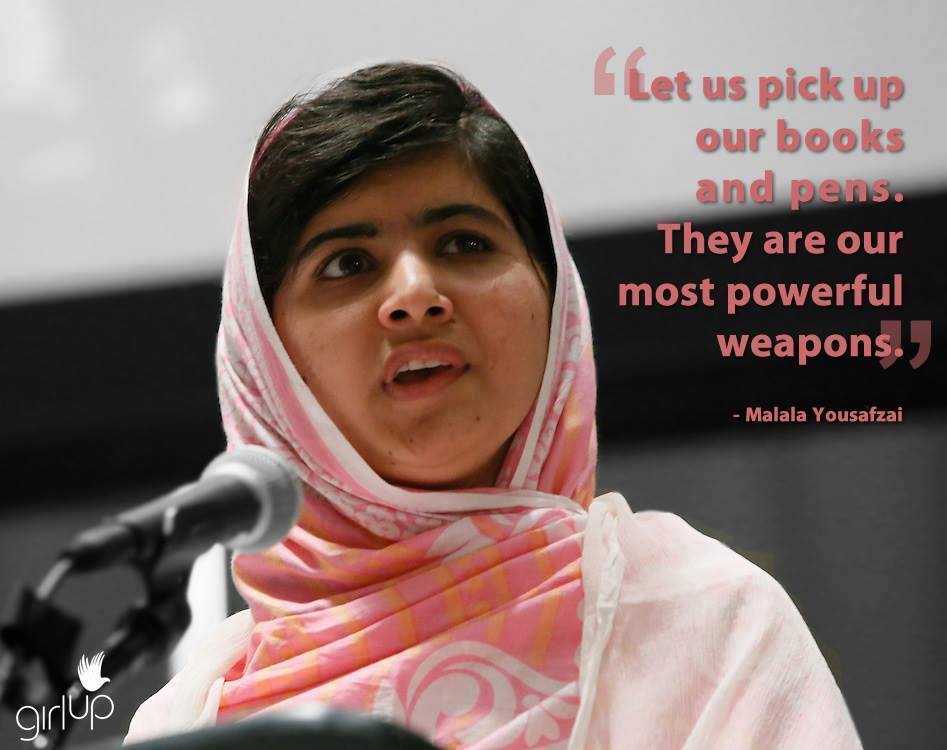
Malala books are powerful

(as seen on Facebook)

In my life, I’d use a different turn of phrase. I’d most likely substitute tools for weapons. But in Malala’s life, the act of seeking an education was radical and law breaking. She saw books and learning as tools, but also as weapons: weapons to fight the good fight, tools to achieve great things.

The pen is mightier than the sword- and so is the desktop publisher. What remains is the reader. If the reader is taught to think and analyze, to seek understanding, then the book itself can be powerful.


Share and Enjoy !

Shares

Political Parties – an encore post, mostly

My students have been learning about the Articles of Confederation and the events and debates and compromises leading up to the writing and ratification of the United States Constitution. I’ve been correcting their tests lately, and the essay questions and their thoughtful or not-so-much answers have kept me thinking. I share with you an encore post, and I promise I plan to collect this year’s responses and form a new post.

I can’t post the specific question, but I’ll just tell you that they were discussing the creation of the Constitution and interpreting George Washington’s warning against the destructive nature of political parties.

Actual student answers:
-“I think Washington wanted people to be happy and to work as a team.”
Can this student run for office some day? Please?
 
-“They would disagree on things because they would have different opinions and they would argue a lot.”
Run-on sentence aside, she was predicting the future with amazing accuracy.
 
-“It creates tensions and the good that could be done is lost in the arguments of each party’s plans.”
Another candidate for office someday – governor, perhaps.
“Washington knew that if the country split into political parties, then the country would be more split up and there would be too many disagreements.”
Politicians, stand warned. This student and others like him will be voting before you know it.
 
It’s time, it’s well past time, to start cooperating. Bipartisan collaboration would be a good start, but in all honesty, nonpartisan cooperation would be even better.
I’m sure George would agree.
Now back to the gradebook to grade the section on Shay’s Rebellion.

Share and Enjoy !

Shares

And on we go, into 2014

Yesterday I described a few highlights and lowlights to what I’m now calling the Year of Survival, 2013. To follow up, I’ll address the other part of the challenge: What word reflects my intentions for 2014?

Many of my ongoing projects got set aside in the mess that was 2013. The manuscript for the book Educating Amigo is still in limbo, and sending out submission packages became less of a goal than learning to walk well and handle stairs without a cane. The book project is back on a front burner now, and I hope to reach out to a another potential writer/editor for guidance.

I wrote a few short grants at work, none successful. I don’t mind losing the grants; I learn a little every time I do the research involved in any project funding request. Looking ahead, my grant applications will still focus on our goals of increasing family involvement and improving reading skills. I might reach out to more grantors who have the same mission, rather than more general resources.

In a post on my employer’s national blog, I suggested setting goals in the form of a 3-2-1 summary. 3 good habits to keep in place; 2 bad habits to break or leave behind; and finally, 1 positive change. Let’s see how that looks in my own life.

3 good habits:

  1. Put my health first. Reach out to health professionals as necessary.
  2. Eat local, cook from scratch, and preserve (can and freeze) to keep the family’s menu healthy and delicious. 
  3. Rest. Make sleep a priority.  

2 bad habits to leave behind:

  1. Stop putting my health at risk by putting off routine care – this is a dangerous route to follow.
  2. Don’t sweat the small stuff; keep the big priorities on top of the to-do list. 

And in conclusion, 1 positive change to put into place:

Get my home office in shape and use it – for book work, possibly for summer school, and also for privacy, peace, and quiet.

Back to the first question: What word reflects my intentions for 2014?

Reach. Reach out to those who can help keep me healthy and keep my brain and body functioning properly; reach for resources that can help with grants for my work and help with the publishing process; reach for the sky, but keep at least one foot on the ground for balance.

Readers, how about you?

Share and Enjoy !

Shares

Flu and How Daisy Cleaned out the Medicine Cabinet

We were all sick, almost one at a time, but overlapping slightly. It was an upper respiratory virus, but not the full blown flu, thank goodness. My dear sweet husband “Chuck” got hit first. His immune system was down as he recovered from the agony of kidney stones, and he was knocked for a loop with this cough and fever. Amigo came next, and they left me for last.

While the chicken soup was simmering, we reached for our stock of over the counter medicines to treat the symptoms. In doing so, we had an unpleasant surprise. Many bottles were expired.

Let’s take off on a tangent, and then we’ll get back to the outdated medicines. Amigo and I have had our flu shots. I hope La Petite found a way to get vaccinated, too. Chuck prefers not to get one; he seems to do well without it. We are ready, we hope, to avoid the worst that the influenza has in store.

National Influenza Vaccination Week (NIVW) is December 8-14 this year. Vaccination is the first and most important step in protecting your family against flu. Outreach people from the CDC asked several bloggers to spread the word, and of course I said Compost Happens would be happy to help.

Flu can be very serious, readers. I’ll never forget the year my fourth grade class was decimated by H1N1. Influenza of any kind can hit hard, without warning. One way to distinguish influenza from other similar illnesses is that most illnesses come on gradually – a little fever, then a headache and a cough, and then all get worse. Most people who get influenza know the day and hour that it hit.

Influenza isn’t just a cold or a stomach ache. During last year’s flu season, over 150 flu-related pediatric deaths were reported. Some young children may require two shots to establish immunity. Ask your physician.

Since I’ve been teaching online, I feel less of the germ phobia that hovers over classroom teachers. However, we virtual teachers work in a cubicle-filled office. We all breathe the same air. If someone is coughing, the airborne virus will spread. We’re still very faithful flu shot customers, whether we see our students daily or not.

So back to the beginning, dear readers. If flu does hit the O.K. Chorale, which it could, will we be ready? I cleared out any and all outdated medicines from the cupboard and replaced the basics. When I’m sick, the last thing I want to do is stand in line at the pharmacy to get anti-inflammatory drugs and cough drops. We keep ibuprofen, acetaminophen, and a few others on hand at all times. I keep the making of chicken soup in the pantry, too.

The next question: what to do with old medications? Are any biodegradable? Compostable? What about the rest? That, readers, is another post in itself.

Have you gone to the doctor or pharmacy for a flu shot? How do you prepare your family for flu season? Leave a comment and let me know.

Share and Enjoy !

Shares

Act 10 Craziness continues

Remember Wisconsin Act 10? It started as a budget “repair” bill, and when our governor’s followers couldn’t pull together a quorum, they changed the bill enough to pass it — oh, I’m sorry, I can’t summarize this quickly. It’s the law commonly known as the Union Buster. It’s featured along with a few other political topics on my Voter’s Voice page. That’s Voter, as in singular, as in me. One voter’s voice. Recently, a different sort of vote surfaced, one that requires voters, plural, to raise their voices.

According to Good Ole Act Ten, public sector unions like the one to which I belong must vote to recertify their associations in order to bargain what little they still can. Our local met last night to vote on whether or not to pursue the recertification process. Why not? Well, the whole process is still tied up in court and may be unnecessary if the related part of the law is found to be unconstitutional. Get it? Uh-huh. I hear you.

Meanwhile, all potential eligible possible members must be part of the recertification. To keep on as a bargaining entity, my local needs to get 51% of all the actual members AND the call-me-maybes. We set goals last night at our meeting; each member present at the meeting was to recruit and be personally responsible for three votes in addition to our own. If that happens, we will successfully get at least the 51% that we need.

The phone call vote is not easy, though. The Powers That Be designed the automated call process to make callers jump through a few hoops. If a caller hangs up one hoop shy of completion, the vote gets recorded as NO.

The Powers That Be underestimated us. Seriously, most definitely underestimated us. We are teachers! Giving complete directions is what we do! The leaders of our local made up a handout with two sides: One with written directions for the verbal linguistic word-person types, and one with a flow chart for the more visual learners.

Wait! I forgot a detail about the automated voting system. Anyone who doesn’t call at all is recorded as a NO. That’s right, folks, no vote at all counts as a vote towards the Governor’s union busters. All potential members who fail to call are counted in the negative column just as though they had thumbed their collective noses at collective bargaining.

Well, readers, I recruited two on my own and checked on a third potential voter. I do plan to quietly chat with a couple of my nonmember colleagues and ask them to do the democratic thing and be counted. Yes or no, pro or con, our nonmembers need to make their preferences known.

When it’s over, maybe I’ll jump back into the future and ask Grandma Daisy to reminisce a little. I’ll get back to you, folks.

Share and Enjoy !

Shares

Waiting Area or Lobby?

Our offices are rather cramped. I may have mentioned the Coffee Closet, a.k.a. the Clounge. We have no room to sit down together, and there is no lounge or meeting area. The coffee maker and the microwaves are in a storage closet, on a table opposite shelves loaded with books, manuals, bags full of math manipulatives and science materials, and boxes of pencils and pens. And more, I’m sure, but there are boxes I’m afraid to open, they’ve been there so long.

Anyway, we have no place for families to sit down and wait, either. Teachers are creative, even when they work in cubicles, so of course someone came up with a solution.

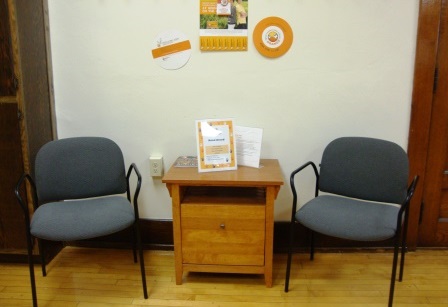
The Official Waiting Area

The Official Waiting Area

It’s just two chairs and a small table. To the right is our main door; to the left, storage lockers. This little spot is in a huge hallway — huge in the way that it’s a school hallway, wide enough for large groups of students to comfortably pass from one class to another. Nowadays, on our top floor at least, only teachers and administrators wander this hallway, and usually just to get from their own offices to the bathroom and back again.

But as it happens, I had another brainstorm. Parents often sit here while they are waiting for their children to take a placement test or get a benchmark reading assessment done. Many parents have youngsters along, and then have nothing to do while they wait. Here’s our chance. We’ll give them something to do, something valuable, something that will be good for both parent and child.

We’ll create a read-aloud station in our new Hallway-Lobby.

It’s fairly simple in concept. A set of books, a batch of informational brochures, and a sign explaining it all.

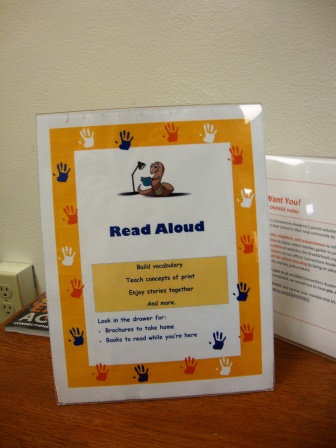
Read Aloud!

Read Aloud!

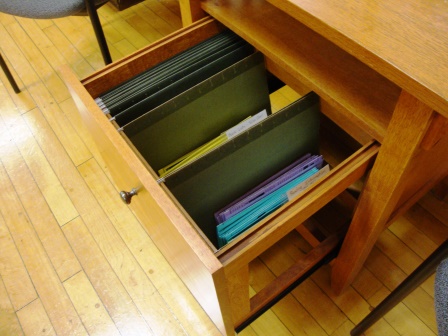
And below, the drawer, previously containing only empty file folders, now filled with learning materials.

I copied them in color, just for fun.

I copied them in color, just for fun.

Books are on the way. I ordered ten different picture books from Paperback Swap dot com, and six are already in the mail headed my way. I’ll beg and plead I mean I’ll write for a grant or two and see if we can beef up the collection, and then we’ll have it: the reading area.

I’ll let you know how it works. The boss likes it, so it must be worth something.

Share and Enjoy !

Shares