>
Tag Archives: teachers live at school
>Nonconformity and Being Remarkable
>
I teach. I’m not an award winner, I’m one of many, but I’m one of many who make a difference. I know that I might make a small difference to some, an average difference to others, and if I’m lucky, a big difference to a few. Yes, I enjoy my work. There are times, though, that I don’t enjoy my job. To this statement, I answer yes, but a qualified yes.
You complete your education (high school, college, university, graduate school, whatever) because you want to, not because you feel like you should.
This one is a little more difficult to address. I completed my degree and then went back to school to add the specific classes that I needed to earn an elementary teaching license. Yes, I did it because I wanted to do it. However, in a field with stringent licensing requirements, there wasn’t much – really, there wasn’t any choice in the matter. To earn my license, this was the road I had to travel.
Helping others is not something you do as an afterthought. It is a central part of who you are, just as doing what you want is.
I took these statements in the order they came, which was also in order from easiest to hardest. No one goes into teaching for the “summers off.” In my field, work doesn’t end when the bell rings. We spend extra time planning, assessing, evaluating, and more. My schoolbag is heavy on weeknights and heavier on weekends – unless I plan to spend part of the weekend in my classroom. Filling out referrals, getting services for kids who need more help than I can give, and working with counselors and social workers are all tasks that come outside my workday. Helping others is ingrained in all educators, all the time.
When it comes down to the crunch, though, choosing my own path is rarely an option. My disability doesn’t fully block my personal journey, but it creates side trips. Hearing impairment is both costly and mentally challenging. Hearing aids and their related testing and services are not covered by health insurance. Learning to lipread and educating those around me are ongoing responsibilities. I can only hope that as hearing impairments become more common in the mainstream, people I’ve taught will use those adaptive skills as they work with others like me.
Family needs affect the route, too. We’re truly the sandwich generation, responsible for our children and our parents. Paying college tuition for one child, working out IEPs for another, helping parents move out of homes and into condos or apartments, the list goes on and on.
These are important tasks, all of them. If I rephrase the last statement, it maintains its meaning while being more realistic for my life:
Helping others is a central part of who you are, part of your daily life. The choices you make reflect that outlook and philosophy.
Remarkable? Maybe, maybe not, but I’m on the right track. Let’s get that high speed rail installed so I can make more progress!
Thanks to Chris Guillebeau at AONC for the thoughtful inspiration behind this post.
>That pile? I faced it; it’s gone!
>Cleaning the classroom
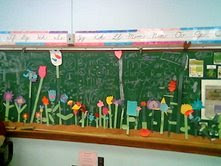
>Last year my class decorated the chalkboard with flowers during the last few weeks of school. I liked it so much that this year, I assigned them the task. We were gearing up for a field trip to see a play based on the book Seedfolks by Paul Fleischman. I helped prepare them for the story by reading about urban gardens, learning about plants, planting their own tomato plants in little pots made from toilet paper rolls, and more. One day I presented them with several shades and lengths of green construction paper, told them these were their stems, and challenged them to create flowers using our bin of paper scraps.
They outdid themselves.
The flowers were lovely, each as original as its creator. My young students (ages 9-10) decided to write their names on the board to claim their work. They wrote and drew and made more flowers, and I was glad to say Yes to saving their work from the cleaning staff. I knew Di, the cleaner who keeps my room spotless, would love the classroom flower garden as much as I did and would be glad to leave it untouched by rag or vinegar cleaning spray.

When a student moved the week before school let out, she made sure to pick her flower from the board. On the last full day of school, plucking the flowers was a high priority for the young paper gardeners. By then the chalk was getting dusty, but the paper work was as unique as ever. High art? Nope. Just right? Absolutely.
>Common Courtesy — isn’t.
>Monday morning I walked into my classroom with the uneasy feeling that someone had been there during the weekend. The door was unlocked, the shades were drawn, and the chairs were not up on the desks as they are at the end of each day.
“Did I leave it like this?” was my first thought. I’ve been very stressed lately, and stress can overload my brain to the point of forgetfulness.
I asked my next door neighbor-teacher, and she suggested it might have been the cleaning staff. “You know Dinah often closes the shades when it gets hot, and she’s in here when the sun’s shining in.” But would she leave it unlocked? Well, yes, occasionally she has done that.
But all the chairs down? That’s a routine I wouldn’t forget. The students are so in the groove that if I ask them to stack chairs instead, they get confused. Most of the chairs, at least, would have been put up.
So began the search for a solution. I asked Robin, the After School Care coordinator, if the homework and tutoring group has used my room. She said no, they never use mine, and they didn’t have tutoring on Friday. I thanked her and decided it must have been Dinah, even though the chair thing didn’t make sense.
The week went on, crazy as the last week of school usually is. We had fun, we had rising energy levels, and I finished and sent home report cards. On the last day of school, my kiddos were well represented in the school slide show and enjoyed their autograph books. I finished cleaning my room and preparing for its summer school inhabitants before heading downtown to the annual staff luncheon.
One of our lovely professionals, a teacher who taught in my room a few years ago, had recently announced her retirement. As part of the farewell festivities, our building’s equivalent to the Not Ready for Prime Time Players had made a memory video. Her current and former coworkers starred in scenes she remembered (and some she might rather forget) from her many years of teaching.
Their stage? My room. Obviously, the previous weekend.
My reaction? I didn’t say a word. I couldn’t. It was her day, her moment, and there was no way on earth I was going to put a damper on it. Not. A. Chance.
I was embarrassed, too. If the Film Crew had let me know, I could have straightened the room or at least cleared the desk and file cabinet to make a better background.
I also felt uncomfortable. I’d assumed the room condition and the unlocked door were due to the after school program or Dinah, the cleaning woman. I hadn’t talked to Dinah, but I had questioned Robin, the After School Care coordinator. She wasn’t at the luncheon, so my first item of business afterward needed to be an apology phone call or email.
Most of all, I felt hurt. Left out. Unimportant. I teach in a public school; my workspace carries no illusions of privacy or ownership. Common courtesy, though, is always a welcome touch. A simple “Hey, Daisy, we’ll be using your room this weekend for the retirement flick” would have been nice. An after-the-fact “By the way, we think we left your room in good shape, but if anything’s out of order it’s because…” would have eased my mind, too. An actual request like “Daisy, we’d like to film in your room because it was hers. Would that be okay?” was obviously too much to expect.
My coworkers must not have been Girl Scouts when they were younger. Girl Scouts learn to always leave a place better than they found it.
My wannabe Oscar-winning teacher pals aren’t environmentalists, either. “Take only pictures; leave only footprints” was beyond them.
The truth is worse, though. This is the last in a long series of communication errors, small and large. Emails with my name left off. Major decisions made regarding my students – but not including or informing me. Getting invited to assist with a major writing project, but then being dumped unceremoniously with no notice, wondering what I’d done wrong. This small event, the lack of Room Service, wouldn’t even register on the radar by itself. But as part of the whole — it speaks loudly and clearly.
In the pecking order at this school, I’m Chicken poop.
Well, at least chicken poop makes good compost.
>Fun in the park with kids
>Toward the end of the school year, students want nothing to do with book learning. ‘Don’t know much’ seems to be their trademark phrase. ‘Do I have to?’ is the second. If it involves getting up and out and moving, though, no one is short volunteers! With the craziness in mind, we planned a simple end-of-year outing in a neighboring park.
First: the Dinosaur Egg Hunt. Enter Mr. Fifth Grade Teacher.
“Did you hear the news? Our park is all over the newspapers and television reports! Did you hear why? Dinosaur eggs have been found here! We divided you into groups to help search for them. Each egg has a group number on it. Your group must find the one with your number on it. Oh, and by the way – they look a lot like watermelon.”
When the “eggs” were found and kids had eaten all the watermelon they wanted, we let them play freely. Bocci, ladderball, lawn golf (croquet), football, basketball, or the playground provided plenty of choices. If the dinosaur eggs were not enough, my partner-in-crime, er, teaching had brought a cereal mix that we served in ice cream cones to minimize garbage. No one went hungry, there was a bathroom nearby, plenty of shade trees and sun to satisfy any taste in weather or in games.
Of course, one of the Gifted and Talented students provided his own entertainment.
Me: “Jorge, what are you doing?” He was squatted on the ground, looking into the bottom of a hollow pole that held up a stage railing in the park pavilion.
Jorge: “I just found (pulls out tiny item) a geocache!”
Classmates: “What’s a geocache?”
Jorge explained it and they were hooked. I predict a few kids will beg their parents to buy a GPS and link to local geocaching web sites this summer.
Me: “If I had a pen, you could sign in!”
Jorge: “That’s okay, Mrs. Teacher. I’ve already found this one. See, my name is right there.”
He pointed out his signature, which was followed by several others who had found the geocache after he did.
Jorge put the tiny cylinder back together, hung it inside the iron post again (it was magnetic), and walked with me and the others to get lined up to walk back to school.
Dinosaur eggs, cones of trail mix, games and a surprise geocaching. I think I can call it a successful day. Successful year? I’ll reserve judgment. Today, I’ll settle for a fun day at the park.
>To Do, Ta-Dah! and the pile I don’t want to face
>Teaching Wisdom from the Gardener
>Gardening is a thinking time. It’s a contemplative and meditative frame of mind while I’m digging, pulling, and patting the earth. The acts of planting or weeding take very little conscious concentration, and instead let my mind wander along other paths.
The first year of the garden I struggled. I planted some things that just didn’t work in the space and the soil. The grass and the creeping ivy kept invading. It took several years to get the remnants of grasses out of the garden plot. There’s a reason for the term “grass-roots organizing.” Grass roots are strong, they don’t let go, and they are determined to live on and prosper. I’ll keep that in mind as I write letters to my legislators at the state and federal level and ask for more equitable school funding formulas.
I’ve learned along the way. My first few years of teaching I relied on basics, taking the textbooks as my guides. As I learned more and gained confidence, my teaching methods improved and I began to differentiate for various learning styles and ability levels. Every year I garden I learn something new. Last year the sun just wasn’t reaching the plants the way they needed it, so I re-planned the whole layout this year. Oh, I almost forgot, we cut down a tree, too.
I call myself a lazy gardener. No one dares call me a lazy teacher! It’s okay to limit the amount of extra time I spend on schoolwork by prioritizing, focusing, and organizing. My family needs me, and I need Me Time, too. I’ve already decided to drop off one of the main committees at school when the year is done: the committee that does the test score data analysis, among other tasks. I stuck with it through the grant writing and the introductory collaboration, and now that I look at the summer commitments for this group, it’s going to be too much. The data analysis itself will require a whole new set of training and skills that are just not in my schedule right now. I serve my school well, and this specific committee will achieve its goals without my presence.
Lazy gardener? I plant, weed, and water, and eventually harvest. If the weeds aren’t totally eradicated, I don’t sweat it. But that’s not laziness, really. Compost takes a small amount of time, and it’s well worth the effort. Reading books and browsing web sites on gardening also helps, and those activities take time, too. I find the time investment worthwhile. It pays off later.
That leads to another item: time investments. I’m dropping off a major committee. I did, however, register for a course in teaching students with ADHD. In the past two years I’ve seen more students than ever with difficulty focusing, staying on task, resisting impulses, and more. Some have diagnosed Attention Deficit Disorder, some with and some without the Hyperactivity element. A few kids probably don’t have a medical reason for their difficulties, but can benefit from some of the ideas and knowledge I’ll gain from the course. It’s worth three graduate credits, but more than that, it’s well worth my time. This time investment will pay out later in direct and improved student contact.
I’ll probably do the bulk of the coursework for this graduate class on rainy days, a cup of coffee by my side, while the rain barrel fills and the garden soil soaks up the water. I’ll do the rest on the deck after watering and weeding and turning the compost. Balance? Summer is all about balance. Maybe that’s the best piece of wisdom of all.
>A teacher reviews Obama: the Historic Journey, Young Readers Edition
>When Mothertalk offered the opportunity to read and review the young reader’s edition of Obama: The Historic Journey produced by The New York Times, I jumped at the chance. To help convince the people who choose the reviewers, I reminded them that 1. I teach fourth grade. 2. My students were very interested in the campaign and the election.
Obama: the Historic Journey is illustrated with vivid and varied photos, most taken by New York Times photographers. The text is by Jill Abramson, who collaborated with colleagues, browsed the NYT archives, and included her own knowledge of the lengthy presidential campaign. Abramson opens the book with election night and ends with the inauguration. The chapters between chronicle young Barack’s life and the many unique circumstances and people that contributed to make him the amazing man he is today.
The narrative is what we teachers call “ordinary language used well.” It’s readable: my school’s reading specialist leveled it at late third grade reading level. The style is direct and factual, yet captures the excitement of the campaign and the passion of the people involved in Obama’s long journey to the White House. Students looking for detail will find it; students looking for familiar events such as the election night speech at Chicago’s Grant Park will find those as well. Readers searching for an understanding of how voters came to elect the first African-American president of the U.S.A. will find it. Reading as a teacher and reviewer, I found myself drawn into the dramatic story, even though I knew it well, having followed it as events unfolded in real life.
All in all, Obama: the Historic Journey (young reader’s edition) is a wonderful book. It’s big (about 9 by 12 inches), hardcover, and sturdy enough to withstand the fingers of many eager readers. The text is simple and straightforward enough that an average fourth grader can read it, and detailed enough that older readers will be taken in by the story itself. The photos include the predictable (Obama being sworn in, family at his side) and the uniquely fascinating (toddler Barack playing in the Hawaiian surf). All are clear and excellent quality, as I would expect from the NYT.
I predict I will have a hard time keeping this book on the shelf in my classroom. Students will be lining up to grab it, eager to read the details of this Historic Journey. Maybe our library media specialist will order a copy; this one is for me and my class. I’m not giving it up.
>Books on my table and my TBR list
>I finished reading and browsing Square Foot Gardening, and my review stands. There are good points, and I’ll apply them. I especially like the appendices with planting charts and at-a-glance references.
Next, I’m looking through Edward Smith’s Vegetable Gardener’s Bible. Smith balances his advice better than Bartholomew’s text; he shows how wide rows can work without insisting on a perfectly “authentic” square grid. So far, and I’ve only read a little, the advice is solid and his enthusiasm is contagious. I liked the section , “The Joy of Tools.” I have several trowels, at least two purchased with gift cards from students who recognized my gardening interests.
I’m catching up on several weeks of Time magazine. I’m old-fashioned in this way; I like getting the print version. Sure, I go online for more, but there’s nothing quite like getting the new issue in the mail and browsing the headlines, then reading the details from cover to cover.
I just finished Hope McIntyre’s How to Seduce a Ghost and How to Marry a Ghost. Nothing supernatural here; the “ghost” in question is a ghostwriter. These books were purely pleasure: not professional journals, not garden related (although those are a pleasure, too), not news. I read light chick lit and more intense novels to let me forget the world around me. I read them to relax. Thank goodness for paperbackswap.com and my local bookstore; my busy schedule makes library deadlines difficult to meet sometimes. I like my library better in the summer when I have more time to read.
Awaiting my opinion (for review) is a young readers’ edition of Obama: the Historic Journey published by The New York Times. This looks fascinating already. I know my students will love it – when I’m done, that is!
Another resident of my chairside table is The Lone Ranger and Tonto Fistfight in Heaven. It’s short stories, so I’ll read one or two and then set it aside. It’s fascinating; some humorous, some serious, but all well-written and interesting.
What’s on your To Be Read pile or table? Books, journals, magazines? Make a suggestion: I might pick up the titles and read them in June when I (finally) have more time!