>Sound Bites and Protest Signs

>

The first time I heard the term “sound bite” was during the presidential election between Bill Clinton and George H.W. Bush. Journalists, especially those on TV and radio, found ways to pull out a small snippet of a candidate’s speech and use it to form the basis of a news story. Remember these?
Read my lips: no new taxes!
It’s the economy.
…a kinder, gentler nation.
Save Social Security!

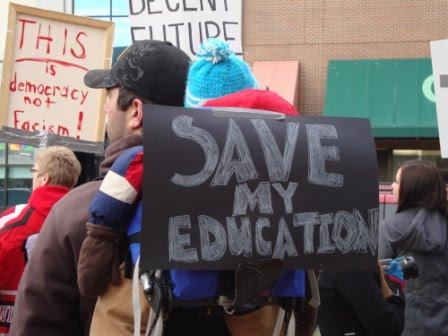
Protest signs have a similar challenge: not much space, the need for a quick message, one that a driver can read at a glance and continue driving safely. Amigo told me he was rallying for his teachers: those who had taught him in the past and those who were his teachers now. We talked over simple slogans, and he decided to include a little Braille to remind people that all students, no matter what their needs, must be educated. He used his Perkins Brailler to show me how to write SOS correctly, and we were ready. He knew which side of the sign to face out because he could feel the stick & duct tape on the back.

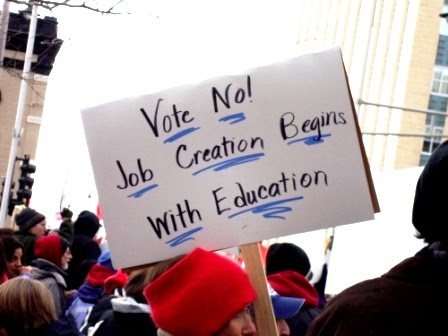
There’s a classic saying, “If you think education is expensive, try ignorance.” The signmaker below has a variation on that theme – a variation that also points to new governor’s insistence that Wisconsin is “Open for Business.” How he thinks a strong business economy can exist without educated workers is beyond me. But that’s another post…
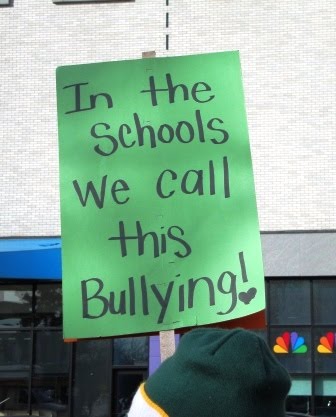
Anti-bullying programs and zero-tolerance policies for physical, verbal, and cyber bullying are common across the country. In many states, such policies are mandated by the Department of Public Instruction. Gov. Walker’s method for dashing off a divisive and devastating bill that guts the rights of many is just that – bullying. Questions? See below.

Sound bites or protest signs, they work in a similar fashion: quick to make a point, easy to understand, easy to remember, and the potential to provoke a more in-depth discussion. Let’s hope the bully decides to mediate soon so that Wisconsin workers don’t need many more signs.

Share and Enjoy !

Shares

>Workplace Safety close to home

>After last week’s post with union history, I heard from relatives who reminded me of my grandfather’s union past. He worked for a paper mill in the 1940s before workers were union members.

The mills were extremely dangerous places to work back then. If not for unions, the mills could and did treat people as though they were expendable. A mill manager could arbitrarily fire a long time paper machine operator and replace him with an incompetent relative or neighbor. This kind of grossly unfair management was only stopped when the unions came in.
He saw great injuries caused by the paper machines. Safety wasn’t mandatory; making money was.
He saw people lose their hearing before ear protection became mandatory. One of those so disabled was my great uncle.
He was there when people died gruesome deaths. Two men from his little town went into a giant digester machine for maintenance and suffered gruesome deaths from a steam explosion.
Later, three local men died from inhaling toxic chemicals (Hydrogen Sulfite) in a sewer. Grandpa talked about this at length, blaming a combination of incompetent management and poorly trained, unprepared workers.
Readers, go back into your family history. You may have someone who remembers life before unions, life before OSHA, and life before management was forced to be fair. Ask your grandparents; you may find surprising stories.

Share and Enjoy !

Shares

>What’s the middle class – does it still exist?

>

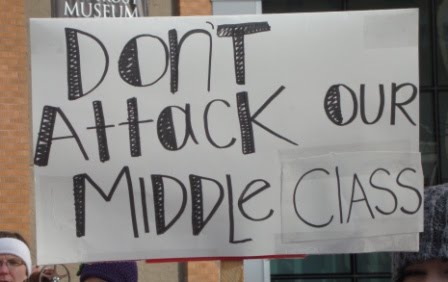
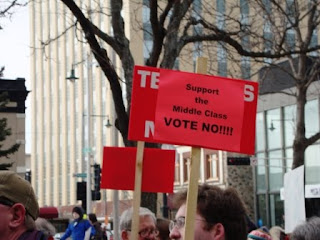
A few years ago, a colleague told me that we teachers were part of a dying breed; the American middle class. Teachers, police officers, firefighters were a few of the socio-economic level in the middle – not rich, not poor. Not overburdened with too much money, not stretched to the breaking point with too little. Owning a house, a very very very fine house, with two cats in the yard — you get the picture. Not wealthy, but secure enough to buy bicycles for the kids and eventually send them to college without too many loans.

No matter what the outcome of the so-called “Budget Repair Bill” that guts bargaining rights, we’ll remember those who took action and those who listened when we expressed our concerns. We’re willing to invest more in our insurance and our pensions; we know that the state deficit is very large and everyone must contribute. If the right to bargain is lost, however, we also face the loss of the security that allows us to buy bicycles and still buy groceries, send the kids to college and still pay the mortgage. Is that too much to ask?

Share and Enjoy !

Shares

>Amigo gets political

>It was a typical Friday night. I pulled up to the store parking lot to meet the bus from the school for blind, gather Amigo and his bags, and head home.

As he got in the car, he was full of excitement. “Mom, did you hear what’s happening in Madison?” He continued talking, telling how he’d been learning about how the legislature works, what a quorum is and why it’s important, and a lot about the process of writing and passing a law.
Then he dropped the bombshell.
“Mom, I wish I could go to Madison tomorrow for the demonstration.”
I offered, “How about downtown on the plaza tomorrow afternoon?”
Amigo responded with an enthusiastic “Yeah!!”
So we made a sign for Amigo, I wore red to support my colleagues, and La Petite charged her camera to document the event. Here’s the rest of the story. The top photo shows my neighbors, both retired high school teachers, great people and great teachers. No, they’re not wearing Bear colors; those are the colors of my alma mater, West High School.

This was perhaps the youngest participant at the rally.

I don’t usually show full face shots of my offspring, but they were so great together I couldn’t resist.

I’ll have more background on Saturday’s post: personal experiences passed down through the family the old fashioned way, by the oral tradition. Well, the updated oral tradition: my relatives emailed me the stories they’d heard from my grandfather.

Share and Enjoy !

Shares

>Yet another Basic Bread Recipe

>I feel like I can never have too many options for baking bread. Lately I’ve made at least one loaf a week, sometimes two. Home made bread makes my toast and sandwiches so much better than factory-produced loaves. Since I use a bread machine, I can accomplish this task even when I’m having a difficult day with fatigue or headaches. Just throw in the wet ingredients, then the dry, topped by the yeast. Here’s my new one that (sort of, you know me) came with the new bread maker.

Daisy’s Basic Everyday Delicious Bread
adapted from the recipe that came with my Sunbeam 5891

For a 1.5 pound loaf, add ingredients to bread machine in this order.
1 cup + 2 Tablespoons water, 75-85 degrees F. (1 minute in the microwave does the trick)
1 Tablespoon butter or margarine or olive oil (I’ve tried all three; they work exactly the same)
2 Tablespoons sugar
1 Tablespoon non-fat dry milk powder
1 1/2 teaspoon salt
2 1/2 cups bread flour
1/2 cup wheat flour
1 Tablespoon whole wheat gluten
2 1/2 bread machine yeast
Set bread machine for white course, light crust, and 1 1/2 lb. loaf. Enjoy! Your house will smell wonderful.

Share and Enjoy !

Shares

>Thinking ahead for this year’s garden

>Thinking ahead – gardeners do this a lot. I’m stuck inside with a major headache, but I can look out the windows and see sunshine in a late-winter thaw. Sunshine lifts my spirits and raises thoughts and plans for spring’s eventual arrival. I don’t have a drawing yet; yes, I often sketch the garden plan so I buy the right number of plants and seeds. Most of the winter I’m in brainstorming and dreaming mode.

Random gardening thoughts:
  • I’d like to incorporate shallots and leeks. They can go in the smallest corner of the triangular garden.
  • We’ll have the fence up this year with a supporting border of marigolds, so I’ll put in broccoli. Maybe our own bunnies will actually get to eat it! Last year only the wild backyard cottontails had the joy of fresh broccoli.
  • I’m letting the raspberries expand. I moved the chives and asparagus out of the general area of the raspberries, so nothing is in the way of their spreading. Not that anything stops raspberry plants!
  • Peas will go in front of the beans on a new trellis. They didn’t get enough sun last year, so the move will help. Peas mature before beans, so they’ll be harvested and gone before the beans need the bulk of the sunshine.
  • Squash! Where should the squash go? I’m putting in butternut squash and my usual zucchini. If I plant the seeds near the beans or peas, they’ll grow toward the sun. They also mature later. This should work.
  • Bunny food! The usual lettuces and spinach and parsley will have a space. They might go in the area that will be taken over later by squash.
  • Tomatoes; oh, I love my tomatoes. I had success canning stewed tomatoes and salsa, so I’m going to put in more heirloom pulp tomato varieties. I’ll still put in the standard eating tomatoes and the cherries; they’re delicious and they freeze well.
  • Freezing: now that’s another post.
You can get a sense of my garden plans for the coming season. I’m planning on using the space well, using the sunshine efficiently, and preserving more of the harvest. Oh, winter sunshine, you taunt me! I want to get started now.

Share and Enjoy !

Shares

I teach, and I pay taxes.

Or should I say “I pay taxes and I teach”?

Folks who’ve seen the Wisconsin budget drama on CNN or Fox News or CSNBC probably wonder. “Daisy, you’re a teacher! You live in Wisconsin! You’re a progressive thinker and active in politics! Why have you said nothing about the demonstrations? Or the disappearance of the Senate Democrats? Or Governor Walker’s bad hair and desire for make-up any time a camera is near? Never mind that last one.
I haven’t posted yet because it’s so upsetting. Today I’m checking in periodically, but I’m minimizing my TV news time. My news junkie self is not compatible with the depressive self, and I’m in a pretty bad state right now – pun intended.
Instead, I’d like to share a few facts about union history. Consider it a history lesson featuring the American worker.
Early railroad worker unions were primarily insurance providers. The workers could not get standard insurance because their work was considered too hazardous, the workers too risky to insure. From Railroad Labor and its History
The first organization of working women to organize was the Lowell Female Labor Reform Association, a group of young women working in textile mills. For a descriptive piece on the Lowell Mills Girls, look to this piece, an overview of women’s labor rights at the time. From Women and Unions, early efforts
Unions helped outlaw child labor and protect worker safety. The horrible Triangle Shirtwaist Factory fire spurred further movements to keep workers safe at work. Work also means outdoor work. Heard of Cesar Chavez? The United Farm Workers are glad he took the lead to improve their treatment.
Unions are about people: working people. Unions help regulate working conditions, wages, and employee rights. Benefits in union contracts include paid sick days, working conditions, grievance procedures, opportunities for advancement or changing positions, length of workday, and more. My current contract has 182 pages, single spaced. It’s a complex, thoughtful agreement between the school board and the association that represents the district’s teachers.
Every paycheck I receive has taxes taken out. Yes, I teach. Yes, I pay taxes. Yes, I’m a union member. I’m proud of all three.

Share and Enjoy !

Shares

>Comfort Foods: Winter Warm-ups

>The saying goes “If you don’t like Wisconsin weather, wait a day.” Last week we were dressing in several layers and wearing our boots for the warmth, not the snow. This week temperatures rose above freezing, and I joined the line at the car wash. I walked to the polls on Tuesday with an umbrella, thinking “It’s warm enough for rain, wow!” Comfort foods are still on the table, though. Mother Nature is just teasing. I know we could still get another blizzard or two.

When the weather outside is frightful, I go with the standards: chili and homemade bread. This is chili Wisconsin style, with beans and noodles. Trust me; it warms physically and emotionally.
Daisy’s Wisconsin Chili (slow cooker style)
1 can dark red kidney beans
1 can light red kidney beans
1 can diced tomatoes
1 lb. browned ground beef
1/4 cup diced onion
1/4 cup diced peppers (green & red bell peppers are my favorites)
1 jalepeno pepper, seeded and diced
1 Tablespoon chili powder
1 can tomato sauce
1 cup noodles; elbow mac or shells are my favorites.
Directions:
Brown ground beef in a skillet with the onion and peppers. Drain and rinse.
Add ingredients to slow cooker in this order:
  1. beans
  2. tomatoes
  3. ground beef & onion & pepper mix
  4. chili powder
  5. tomato sauce
Simmer on low for 6-8 hours or high for 4-5 hours. An hour before serving, add noodles and turn to high. Stir.
Serve with with glorious toppings from America’s Dairyland:
  • a teaspoon of sour cream with diced green onions or chives
  • grated cheese: basic cheddar or for the adventurous, pepper jack
Notes:
I’ve had good luck with dried beans as well. Measure out 1 cup of each kind, soak overnight, and rinse before adding to slow cooker. Black beans also work well; they add a different flavor and color to the mix.
I’ve also used home-canned tomatoes and home grown peppers. If you can tomatoes from your own garden, it’s such a great flavor! The home grown peppers may be smaller, but the taste will be strong and you’ll dispense with the waxy covering on many store tomatoes.
As for the beef, no, I don’t raise my own cattle. Sorry.
As for bread, I use my bread machine. You can find my basic bread recipes in these posts.

Share and Enjoy !

Shares

>As heard on Social Networking

>

“Has anyone seen my ambition? I’ve lost it.”

“It eloped with my patience. They’ll make a lovely couple.”
“I think it kidnapped my get-up-and-go. They’re living it up in a warm climate somewhere.”
“I like to suck the guts out of kiwis. Just thought you’d li
ke to know.”
“Kiwanis?”
“No, fuzzy fruit, not fuzzy-hatted drunken men.”
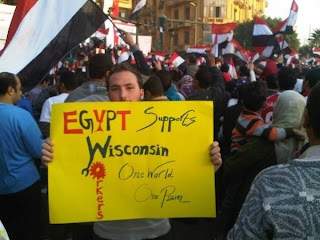
Lately Twitter has been full of comments on the action in Madison, pictures of the protests, links to articles and news videos with more information. This picture was shared by an American school administrator currently working at a school in the Middle East.

This one gave me a lump in my throat. Thanks, @scarter. Win or lose this battle, we Wisconsin teachers feel supported.

Share and Enjoy !

Shares

>Super Bowl – victory to the underdog?

>The Green Bay Packers were not expected to even make it into the playoffs this year. Early in the season they stumbled, and mid-season they fell. Then they picked themselves up, dusted themselves off, and started all over again.

It wasn’t a true do-over; they still stood with a record of 9 wins and 6 losses going into the last game of the season against the dreaded Chicago Bears. The Bears had already clinched the division title and playoff eligibility. The Packers? They had to win if they wanted to play post-season games.
They did it that cool Sunday. They beat Da Bears 10-3 in a defensive battle. The underdog, the one not expected to win, pulled it off and won themselves the right to keep playing in a Wild Card slot.
The team headed to Philadelphia to play the Eagles. We served Philly pepper steak with cheese; delicious. Aaron Rodgers and company ate up the field and pulled out a win and the privilege to travel to another away game, this time in Atlanta. The Falcons had beaten the Packers early in the season in a heartbreaker of a game. Both teams had played their hearts out, but the Falcons scored a field goal in the last minute of the game to win 20-17. Heartbreaker? It hurt to watch, and it hurt to remember.
The Packers had lost the last meeting with the Falcons; that’s the main focus. Would they lose again? Or would they turn the tables and win a close one? Coming in as the underdog, what would the results be?
They beat the heck out of the Falcons. Underdog? They outplayed the birds 48-21. No doubt about it; this was not the same Packers team that had barely lost the previous contest in November.
This was the game that had me re-thinking the term Underdog. An underdog, according to various dictionaries, is one who is not expected to win or one at a significant disadvantage. With a final score of 48-21, I had a hard time considering Rodgers et. al. to be at a significant disadvantage. They had the ability, the motivation, and the advantage that day. Underdog? The only disadvantage they had in Atlanta was that as a Wild Card team, they didn’t get home field advantage. In the end, it didn’t seem to matter.
After eating peach cobbler and drinking Coke products during the Packers-Falcons game, we prepared for the big one: the NFC Conference Champions, a re-match with Da Bears at Soldier Field in Chicago. We decorated the house in green and gold, served bear claws for breakfast, pizza for lunch, and ribs for supper. The Packers had won the last meet-up; were they an underdog this time?
Nope. No underdogs this week; the only disadvantage was the condition of the field, a problem for both teams. Green Bay played another strong game, winning the Halas trophy and the right to play in the Big Game: Super Bowl XLV!!!
Sometimes the opponent underestimates an underdog, one not expected to win, leading to an upset or unexpected dramatic score. The Pittsburgh Steelers organization sported five Lombardi trophies to Green Bay’s three, not counting championships won before the Super Bowl began. Terry Bradshaw, while admittedly biased toward his old team, waved a Terrible Towel and predicted the Steelers to win handily. Steelers starting quarterback Big Ben Roethlisberger had been playing longer than Aaron Rodgers and had a Tough Guy image to go with the experience. We almost expected Ben in a black cowboy hat and Aaron in a white one coming out for a duel at the 50 yard lines instead of a coin toss.
Chuck served up kielbasa and pierogies with Klondike bars for dessert as we awaited the kick-off time. Commercials? We were here to watch the game!
Ultimately, the “underdog” didn’t play like one. Green Bay had one weak quarter (the third, after injuries to two major players hurt their momentum and concentration), but otherwise controlled the game. They forced three turnovers and scored from each one. The defense refused to allow Pittsburgh to move downfield one last time, knocking down a pass on a critical fourth down.
Underdog? Not this Green Bay Packers team. Led by a talented and classy MVP quarterback, the boys in green and yellow were more like late bloomers. They started the season with some inconsistency, lost many important starters to injuries, but then they pulled together and became the team that wouldn’t lose any more.
A week later, the city of Green Bay and the state of Wisconsin are still basking in the glory of our Green Bay Packers. XLV was no underdog accident; it was a well-deserved and well-earned achievement.

Share and Enjoy !

Shares