>Top Ten Ways to Enjoy a Backyard Kitchen Garden

>10. Watch the bean vines grow higher and higher.

9. Sneak a fresh raspberry before the rest of the family sees them.

8. Harvest lettuce and tomato for your BLT while the bacon is cooking.

7. Clip fresh herbs for a sauce or salad, making the kitchen smell great.

6. Freeze spinach and add it to everything.

5. Admire the cute little cauliflower head alongside the blooming broccoli.

4. Have a zucchini give-away contest: the most creative idea wins (Just don’t announce that the winner gets all the zucchini).

3. Make a garden vegetable soup in the crockpot; take the leftovers to work and gloat that you grew your own soup.

2. Bake rhubarb muffins – in January, from your frozen stash of rhubarb.

1. Serve fresh food to the family, nutritious and delicious – whether they like it or not!

Share and Enjoy !

Shares

>More tips for flu prevention!

>Fears of pandemic, both legit and overdone, are all over the emails and the newsletters. The latest came from our healthy living advice source: the Lifestyle Enhancement newsletter. Here’s the advice, along with my serious and not-so-much responses, of course.

Yogurt for probiotics
We went through a lot of yogurt when Amigo had his tummy troubles. He was eating it every day, sometimes twice a day. He then graduated to chewable acidophilus tablets, or yogurt culture without the yogurt, as the nurse practitioner told him. Now that he’s healthy, he eats yogurt a few times a week to regulate his tummy chemistry. I’m eating a little yogurt; that’s an area I could increase.

Citrus for Vitamin C
Amigo and I both take daily vitamin C supplements, and I pack fresh fruits in my lunch bag. When winter comes and along with it the music department fruit sale, we order oranges and grapefruit galore. Lately I’ve been cooking and baking with fruits, and I hope that will increase our vitamin C intake a little bit.

Mushrooms for Beta-glucan
What the heck is beta-glucan? Is it like the Betazoid race on Star Trek? Or is it more like glue in a can? Didn’t they call that stuff paste long ago? Mushroom paste. Now there’s a concept.

Seafood for selenium.
This category is a little tougher for us Midwesterners. Locavores have to go for Great Lakes fish, not ocean harvests. Freshwater, not saltwater. Do they still provide selenium? And why am I humming Tom Lehrer’s “Periodic Table of the Elements” song?

Green Tea for — what was that? Oh, she said Catechins.
Cat-a whatsits? I find green tea relaxing on a cold and stressful school day, catechins or no catechins. It doesn’t add to my doublechins, either.

Nuts to, er, for Vitamin E
I’m putting nuts in more of my baking. Does that count? It might not be enough. How about Nutella?

Our locavore effort has been helpful in encouraging us to cook from scratch, use fresh ingredients, and feed the family more vegetables and fruit. I think I’ll just keep it up and use my neti pot regularly. Oops, TMI. Sorry for that image. Go back to Tom Lehrer. He’ll make you laugh, germs or viruses or perfect health.

P.S. Spellcheck didn’t like this post. Catechins? Beta-glucan? Acidophilus? Yikes.

Share and Enjoy !

Shares

>One change a Month

>I saw the idea on Over Coffee: the Green Edition. She suggested twelve recommendations, one per month, for a person who wanted to become more eco-conscious but could only handle one change a month.

Imitation being the most sincere form of flattery, I stole the idea. Here’s my list: one action per month, meant to be additive so that after a year’s time green behavior feels natural.

January: Read and learn. Join Paperbackswap.com for trading books. You don’t have to stop buying books, but instead of hoarding them, pass them on to another reader through the swap network.

February: Switch to cloth napkins. This was so easy I wondered what took me so long to try it. I buy them on sale, so the investment is minimal. They go in with the rest of the wash, so there’s no additional expense for laundry.

March: Dig a garden plot. If you live in the north country like I do, this might be too early. If your ground is still frozen, plant and nurture a few seeds. Herbs grow quickly; try basil and oregano.

April: Start backyard composting. Really. It’s simple. Buy an inexpensive compost bin or build one yourself. There’s no need for the fancy ones – unless you want something really cute like my new bin!

May: Plant a garden. Vegetables for eating, flowers for pleasure, but keep them local. No imports, please. Vegetables can be so satisfying. There’s not much on Earth that can compare to a fresh tomato right off the vine.

June: Shop at a Farm Market or join a CSA. When you pass by the street musicians, drop some spare change in their cases. They offer so much enjoyment when they share their talents.

July: Use your own shopping bag. Keep a small one in your purse or the car’s glove box. It’s an easy change if you keep the bags handy. As the habit grows, you’ll collect fewer and fewer plastic bags. It’s worth the (small) effort.

August: Before hitting the school supply sales, check your home. Buy only what you need. This is both economical and eco-conscious.

September: Use a reusable lunch box, including containers and flatware. Build this habit early, and the brown bag will never feel the same.

October: Rake your leaves into a pile over the garden or compost them.

November: Cook local or regional specialties for Thanksgiving. That’s easy for me to say: cranberries grow in my state!

December: Give up wrapping paper. It’s not recyclable, it’s rarely reusable, it contains too many chemicals to be burned in a fireplace. Re-use gift bags or get creative with your wrapping.

Share and Enjoy !

Shares

>Taco Meat: variation on a theme

>I bought the book Eating Well for a Healthy Heart with a goal toward finding more healthy recipes for our family. With my overweightness (is that a word? it is now) and Chuck’s (a.k.a. Husband’s) high cholesterol, we needed to take action. I take action by buying books and doing research online. So far, so good.

This recipe also had toppings and crispy taco shells. I served it instead as a Make-Your-Own on soft tortilla shells. Here’s the meat recipe.

Lean and Spicy Taco Meat from Eating Well, adapted slightly by Daisy

1 lb. lean ground beef
1/2 lb. ground chicken or ground turkey
1/2 cup chopped onion
1/2 cup chopped peppers: green, yellow, red, or all three
1 10-ounce can diced tomatoes (replace with fresh when in season, of course)
1/2 teaspoon cumin
1 teaspoon chili powder
1/2 teaspoon dried oregano or 2 teaspoons fresh oregano

Brown ground meats with onion and peppers. Drain and rinse in colander. Return to pan; heat with tomatoes, cumin, chili powder, and oregano.

Serve as desired on soft or crispy taco shells with shredded lettuce and shredded cheese. If you prefer a spicier taco, like Chuck & La Petite do, add a few drops of green chili tabasco sauce.

Share and Enjoy !

Shares

>Are your favorite books on the Banned lists?

>I recently dropped out of several committee assignments at school. One committee slot I preserved is the Book Challenge Committee. I get to read and review and defend any book that is challenged by a parent at school. After reading this guest post, I think Josh would be right at home on that committee with me and my colleagues. I’m excited to introduce his guest post on Compost Happens.

Three Books I Couldn’t Put Down And What They Have In Common (or not)
by Josh Hanagarne, World’s Strongest Librarian

I’m constantly getting asked for lists of my favorite books. When I give them, people are often surprised by how scattered the lists are. There’s very little apparent rhyme or reason—it can be hard to draw connections between the books I love.

Let’s try to connect some dots. Here are three books I could not put down.

1. Lord Of The Flies by William Golding

You probably know the story. A large group of children are stranded on an island after a plane crash. They try to govern themselves for a while but it doesn’t go too well. Eventually they splinter into two groups—you could call them the “savages” and the “civilized.”

By the end of the book one group is actually trying to kill the other. Now remember, we’re talking about children here. This is why someone is always trying to remove Lord Of The Flies from library shelves. And I get it, to a point: this is nasty stuff.

And yet, I read this book every year. I’m not interested in the Cold War parallels or the lofty commentary on violence, our primitive instincts, the failure of governments, etc.

So…why? Why do I love it? I just do. I read it every year because I can’t figure out how not to.

2. Alice’s Adventures In Wonderland by Lewis Carroll

Again, this is one I read every single year. If there is a book with more hidden meaning out there, I haven’t found it. Lewis Carroll was a mathematician, a lover of riddles, a playful wordsmith, and a genius. It’s that simple.

It’s fun.

I can flip to any page of this book at any time and find something new. Something that makes me say, “Hmm…” Or that makes me laugh out loud.

I love the art. I love the images. The characters are, for me, the most unforgettable and striking in all of literature.

The Caterpillar with the hookah. The White Rabbit. The Queen of Hearts. The Cheshire Cat. Just thinking about it again makes me smile and also makes my hair stand on end.

Oh, and this book was banned as well, in China. Seems they didn’t take kindly to talking animals. Representing animals as having human traits is a big no-no.

3. Catch-22 by Joseph Heller

Catch-22 sort of has a story, but that’s not the point at all. The experience of reading it is all that matters. I’ve never been so constantly surprised on every page. Or even in every paragraph. This book took a long time for Heller to write, and it shows in the craftsmanship.

I read it at least once a year because, again—I can’t figure out how not to. Catch-22 makes me feel good. It’s that simple.

It also happens to be the funniest thing I’ve ever read, with the possible exception of A Confederacy Of Dunces. But this is so hard to talk about coherently—I know as many people hate Catch-22 as those who love it. There are people who think it is the least funny thing they’ve ever read.

The story, as it were, is about a group of people during World War II. Seriously, that’s about it. But what a group of people! Catch-22 is satire personified. Every single character is an indictment of some ludicrous aspect of humanity, war, bureaucracy, and language.

The book is occasionally challenged on the grounds of inappropriate language or anti-war sentiment.

What We’ve Learned (or not)

The books I can’t figure out how to put down are usually:

  • Banned or challenged
  • More revealing the more I read them
  • Like a drug. If a book makes me feel good, I want it. I’m a sick man.

Good luck making sense of all this! But seriously, go read these books, for the first time, or just one more time.

Josh Hanagarne

Get Stronger, Get Smarter, Live Better…Every Day

About the Author: Josh Hanagarne is the twitchy giant behind World’s Strongest Librarian, a blog with advice about living with Tourette’s Syndrome, kettlebells, book recommendations, buying pants when you’re 6’8”, old-time strongman training, and much more. Please subscribe to Josh’s RSS Updates to stay in touch. He’s bookmarked on my laptop; it’s worth your time to visit his blog.

Share and Enjoy !

Shares

>Farm Markets, fundraising, and putting the garden to bed

>What’s that white stuff? Snow flurries? Already?

The Farmers’ Market, two weeks away from closing, was like a ghost town. Only the most dedicated vendors and the die-hard customers (like me) were there. All were decked out in warm outerwear, gloves, hats, the keep-warm collection. It was windy, too. Brrrr. I bought honey crisp apples for lunches, a little sweet corn, peppers in green and (mostly) red. The peppers we’ve bought from this stand lately are delicious. I’ll cook some and freeze a few.

I’m a sucker for a good cause. A polite young Boy Scout asked if I was interested in buying popcorn. Chuck and I are not supposed to eat much popcorn, so we’ll probably bring the box to La Petite next time we visit. I’ll call it her fall midterms Care Package. Of course I bought it! Did you need to ask? After I finished buying lettuce and carrots (with greens) for the bunny, I passed a local nonprofit cafe and their coffee of the day dragged me by the taste buds through the door and to the counter. White chocolate strawberry, if you must know. That kept me warm while standing in a much-too-long line at the post office.

Actual conversation while tearing down and uprooting dead and dying garden plants:
Me: “I’m getting the last few beans.”
Chuck: “Give them to my parents. They love beans, and they just pulled in the driveway.”
Me: “I don’t have many.”
Chuck: “They don’t need many.”
Me: “I have, like, five beans.”
Silence.
We sent them home with fundraiser cookie dough instead.

One anti-static dryer ball is lost. One. They work in a pair, and this pair has last me 6 months already and is still going strong. Now one is lost. One. I felt a twinge of guilt adding fabric softener to the washer. Only a twinge pulled at my eco-heartstrings, however, because after all, I’ve done largely without fabric softener for six months.

The garden is nearly ready to hibernate, the last harvest is in the sink to be cleaned, laundry is in, Chuck is painting scenery for his model trains, and Amigo is watching college football. Life is good. I think I’ll make some cappuccino or hot cocoa and have a cookie from my own stash of fundraiser cookie dough. Shhhhh.

Share and Enjoy !

Shares

>In which Chuck’s take-out dinner is greener than mine

>It was not a dark and stormy night, but it did rain. I was tired and arrived home late (field trips will do that) and I didn’t have the energy or inclination to cook. Amigo likes days like this; we call for pizza. It doesn’t happen often.

Chuck, on the other hand, had to work late as well. He stopped on his way home to pick up Chinese food — Dragon Phoenix, if you’re wondering, which is one of my favorite dishes as well.

Here’s the trash breakdown for the pizza:
Pizza box: recycled clean portions, soaked and composted soiled part
Bag from breadsticks: soaked and composted
Tiny container from dipping sauce – garbage. Sorry. I just couldn’t think of a way to repurpose this weak little item. The sauce, however, joined a tomato sauce I made from garden tomatoes.
Leftovers in refrigerator for Saturday’s Leftover Lunch

Throwaway totals for Chinese dinner:
Cardboard containers (waxy style, containing food residue): compost
Soup container: reused. These are perfect for freezing soup stocks.
Leftovers in refrigerator, as above, for Saturday.
Paper bag for carryout: recycled. It was a little too big to be handy for reuse.
Plastic bag that covers paper bag for carryout: reused
Fortunes recycled
The only parts of this meal that ended up in the garbage: the tiny wrappers from the fortune cookies and the soy sauce packages. Next time Chuck should say “no thanks” to those; we have a bottle of soy sauce at home.

At a glance, the two look fairly equal in waste impact. However, the Chinese food wins in an important way. The pizza order gets delivered on request, costing gas and spewing carbon into the air every time a customer calls. The other restaurant is on the way home; Chuck doesn’t have to go out of his way at all to pick it up. As for carbon footprint, he wins.

As for taste? It depends on your cravings. Both were delicious.

Share and Enjoy !

Shares

>Good fiction featuring characters with autism

>Parents and teachers of children with autism, friends of people with Asperger’s, people who know the ropes and recognize the characteristics will appreciate these books. Some intentionally include characters with autism as major or important supporting characters. Others feature characters that fit so precisely on the spectrum I have to say it.

The Curious Incident of the Dog in the Night-time
Imagine a novel with chapters numbered in prime numbers. That’s just one unique twist in British author Mark Haddon’s Curious Incidentof the Dog in the Night-time.

The Truth Out There
I read this book aloud to my sixth grade class a few years ago. The computer game element, the potential for alien sightings, skateboarding and other age-appropriate elements all make this mystery a page-turner. Asperger’s Syndrome is an important piece of the puzzle.


Al Capone Does my Shirts
This Newbery honor book reveals the impact of autism on the entire family and the challenge in seeking appropriate educational placements and services. The historical element of the story lends an interesting perspective because autism wasn’t a known diagnosis at the time. The parents just know their daughter needs help; a lot of specialized help.


Rules is another Newbery honor book that depicts the impact of autism on a family. By noted author Cynthia Lord, Rules is written in first person from the perspective of the disabled child’s older sister. An interesting character in this story is another disabled young person, and the plot twists tightly as he find his place socially with the neurotypical and non-disabled students.

The Art of Keeping Cool
Set on the east coast of the U.S. during WWII, The Art of Keeping Cool involves two high school boys, an authoritarian grandfather, and a German refugee artist. The main character’s cousin Elliot shows so many autistic-like traits that I’m certain a real-life Elliot would be on the spectrum. An “aha” moment for Elliot is the day he realizes his actions have an effect on others. Until then, he thinks only of his own small circle, his own perspective on life.


Silent to the Bone
Elaine “E. L.” Konigsburg wrote a thriller in this one. Older brother Branwell loses the power of speech when his baby sister is seriously injured and blame falls on him. This isn’t the part that suggestions autism, however. Branwell’s character traits before the tragedy and his inability to cope suggest Asperger’s. It takes a close friend to see through the silence and find a way for Branwell to communicate and help himself.

The Silent Boy by Lois Lowry features a non-verbal boy as the title character. An asylum for the insane looms in the background as a young girl learns to accept and reach out to the boy in the field, the one who despite his disability loves animals and takes care of babies of all breeds – or tries.

Share and Enjoy !

Shares

>Good readings in autism

>If you bring up Asperger’s Syndrome, someone will probably ask if you’ve read The Curious Incident of the Dog in the Nighttime. Read it; it’s good. However, it’s fiction. I’m focusing more on nonfiction today.

Chuck and I were traveling to pick up Amigo at camp when we heard Lianne Holliday Willey on NPR talking about her book Pretending to be Normal. We knew we had to have it. The subtitle is “Living with Asperger’s Syndrome,” and that’s exactly what the book is. Lianne was a resilient child, but a unique and quirky one. She didn’t realize exactly why she was different until her daughter was diagnosed with Asperger’s and she realized she was on the spectrum herself. Pretending to be Normal is insightful and articulate, a peek inside the experiences and feelings of an adult with Asperger’s Syndrome.

Look me in the Eye by John Elder Robison is another memoir that lets people get a glimpse of how someone who appears different can also be highly intelligent and successful professionally. John Elder, as he was nicknamed in his youth, describes living the high life with the band KISS (he was a creative engineer with the band) and living in near poverty in between tours. He marries, divorces, but stays on good terms with his ex-wife and children. His memoir shows how a strikingly creative and intelligent person can run afoul of a rigid school system, develop unique relationships despite social awkwardness, and eventually recognize and seek treatment to come to grips with his autism. Look me in the Eye is fascinating, and not only for the backstage tales of rock and roll special effects.

Unstrange Minds is a tougher read, but well worth the time. Part clinical explanation and part personal story, this book explains the skyrocketing numbers of autism diagnoses better than anyone else I’ve read.

Send in the Idiots, another memoir by an adult with high functioning autism, initially turned me off because of its title. I was glad I read it, though. As Kamran Nazeer sought out his former classmates and described their successes and failures, he also faced his own uniqueness. Some parts were hard to read not because of any weakness in the book, but because being mom to a teen with Asperger’s, the situations made me worry. The title doesn’t actually refer to the students by the term “idiot,” but quotes an echolalic phrase spoken by a classmate.

Each book is worth the time and effort. I bought all four over a span of several years because I wanted to take my time reading each one thoroughly without the constraints of library due dates. Owning books like this also allows me to go back and read portions at my leisure, rereading as needed.

Readers, I focused on autism. Can you recommend other books from the perspective of people with disabilities or people with disabled family members? Blindness, hearing impairment, otehrs…list them in the comments, please! I eagerly await your suggestions.

Share and Enjoy !

Shares

>Chicken and Herbs + Vegetables in the Crockpot

>I didn’t want to cook. I was tired of cooking. I was feeling lazy. I didn’t want to shop, either. Therefore, I dubbed it “Let’s see what we already have in the house that will work together” day. I experienced and blogged this in August, but it could work today, too; I’d just be harvesting from the farmers’ market or the freezer instead of the backyard.
If there were a recipe, it might have looked something like this.

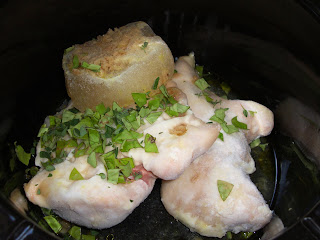
First: 2 chicken breasts and about a pint of chicken stock, both frozen. Dump into crockpot as is, without thawing.
Next: Sprinkle herbs (basil, oregano, thyme) over chicken & stock. Let simmer on low.

(from left: oregano, thyme, basil)

Meanwhile: harvest zucchini. Find small bag of red potatoes in pantry. Search refrigerator for other potential ingredients: dice and add celery. Harvest a few pea pods and a handful of beans. Discover the one last green onion hiding in a corner of the garden.


Slice vegetables thin, remove peas from pods, and eventually layer veggies on top of chicken (when chicken is suitably thawed and beginning to cook, that is).
La Petite doesn’t like mushrooms, so saute them separately with butter and garlic.


Let the whole thing simmer all day.

An hour before serving, add a handful of parsley. Take out chicken breasts; Shred and replace them in crockpot. Stir, then simmer. Turn to warm if fully cooked through.

Serve with long grain brown rice (and mushrooms) and a salad.
Salad: green salad with lettuces and pea pods and shredded carrots.

Amazing. I made a decent supper using lots of garden vegetables and still had the entire afternoon to work on my graduate course’s project. The rough draft of my paper (The Impact of ADHD on the Family) is done. What would I do without my crockpot? No, don’t answer that. I’m sure the answer is unpleasant.

Share and Enjoy !

Shares