>Fireplace brick style wrapping paper

>La Petite showed me this technique a few years ago. I wanted to make a poster, and the brick wall motif worked well for the project. Since I’m avoiding buying wrapping paper this season, I thought I’d try it again.
The tools: iron, ironing board, spray bottle for water, marker (black or brown work well), and plain brown paper bag(s).

Step one: Crinkle the paper. Crunch it up. Crumple it.

Step two: Spritz it with water, smooth it out, press it. The water softens the paper and keeps it from scorching. Caution: it also weakens the paper, making it likely to tear.

After the pressing, draw brick shapes on the paper with the marker. I’m not an artist; mine are rough, very rough. It’s okay; wrapping paper gets torn apart and thrown out right away anyway. This batch will go in the recycling bin.

But until then, I have two pieces of “fireplace brick” with which to wrap a present or two. One bag survived the process; one didn’t. Both will look fine under the tree.

Share and Enjoy !

Shares

>Midwinter Chili for the CrockPot

>In the bleak midwinter, Frosty wind made moan,
Earth stood hard as iron, water like a stone;
Snow had fallen, snow on snow on snow,
In the bleak midwinter, long ago.

Ingredients:
1 can chili beans, spiced
1 can black beans
1 lb. ground beef, browned and drained
1/4 cup diced green pepper
1/4 cup diced red pepper
1/2 small white or yellow onion, diced
1 tablespoon chili powder
optional: 1/4 cup spinach
1 quart tomato soup from the freezer!
(okay, you can substitute canned tomato sauce and/or tomato paste along with a can of tomatoes)

Add ingredients to crockpot in that order. Let simmer 4-6 hours on high or 6-8 on low. One hour before serving, add 1 cup noodles, stir, and turn heat to high.

Serve with your favorite sides for a hearty midwinter meal!
I like grated cheese on the top. Husband likes crackers. Kids both add ketchup, and I don’t object.
My favorite sides are fresh bread, cheese, or a side salad. Mmm.

Share and Enjoy !

Shares

>Big Words for the season

>Dear Santa;

Every year you get letter upon letter saying, “I want this. I want that.” Some are more polite, saying Please and asking how you are. This year may be no different… or will it?

There are some Big Words out there in the world that strike fear into a lot of adults. Economy. Recession. Layoffs. Unemployment. Debt. Kids don’t always understand meanings of these words, but they feel the stress that comes from the situations. The younger the children, the more likely they’ll feel the emotional turmoil and the less likely they’ll understand it.

Santa, I know it doesn’t feel right to stuff a stocking with soap and shampoo. Those are supposed to be necessities, not gifts. But this year, the little gifts might be even more important. Crayons. Pencils. Markers. Paper.
I’m giving my students a little cup of goodies. They’ll each get a pack of tissues, a new pencil, a candy cane. If I can swing it, they’ll each get a white-board marker, too. The candy cane is the only frivolous item, but I know they’ll enjoy the others, too.
You see, Santa, the little ones in my class get colds whether they’re rich or poor. Germs don’t discriminate. And the tissues in my classroom are running out, with the generic scratchy products left to take us through the winter. If a kiddo has his or her own little package of something soft, maybe that will be a small pleasure for those noses that rival Rudoph’s in redness.
There’s a big gap between the haves and the have-nots in my school. Some families bought their kids big packages of white board markers. Some couldn’t afford to even buy one. When I’m working with white boards as a check for understanding, you can guess which kids need to beg or borrow markers. Santa, if you and I can help these kids out, they won’t have to feel depressed every time we get out the white boards. The students from less-well off families can reach into their own desks to get supplies of their own.
The other day I heard a teacher complain, “Flash cards? Who gets flash cards in their stocking at Christmas?!” I understand. It’s kind of like getting underwear for a holiday gift; what fun is that? So along with the marker and the tissues, I’ll give a holiday pencil. Plain yellow #2 just wouldn’t have the same impact as something in red or green or another festive design. It’ll let the kids get their schoolwork done and still make the season bright.

Money, Santa, is not a children’s problem. It’s a grown-up problem. But the problems inherent in today’s economic crisis trickle down to children’s everyday lives. When parents have to choose between buying shoes for their kids or paying the rent, kids feel the pain. When parents can’t afford healthy snacks for mid-morning, kids get hungry. When the car doesn’t start and the parents don’t have the discretionary bucks to fix it, the young ones have to walk to school in the bitter cold. It takes time for those little ones to physically warm up enough to focus on learning.

Santa, I’d love to ask you to deliver safety and warmth and some basics to each and every child in need. But I know that you and your elves can’t solve these economic problems any more than I can. All of us will just have to tighten our belts, give where we can, and most of all, understand. Let’s understand that when parents lose their jobs, kids suffer. And let’s take care of the small things, like markers and pencils and candy canes, so that their suffering is limited even a little bit.

Thanks Santa. Have a Happy Holiday. Hug the elves and reindeer for me.

Lots of love,
Daisy

Share and Enjoy !

Shares

>ridiculous/ hilarious/ terrible/ cool

>Ridiculous/ Hilarious/ Terrible/ Cool; A Year in an American High School

Elisha Cooper spent a year tagging along with students at Walter Payton High School in Chicago, experiencing their senior year along with them. Grades, classes, sports, arts, and college applications are high on the list of most seniors, and these teens were no exception. Theirs was a typical high school in some ways, atypical in others. But these teenagers experienced the same academic challenges, emotional dilemmas and relationship woes as teens in other American secondary schools.

Cooper didn’t go for the standard cliques — the jocks, the cheerleaders, the geeks, the gangsters. Instead, he followed eight individual students through their everyday lives. Cooper’s book paints a picture of personalities against a backdrop of classes, sports, proms, sports, college applications, and more. The diversity in the eight students profiled reflects the diversity of Payton High School as a whole.

Daniel, the class president. Emily, the star athlete. Maya, the actress. Anais, the dancer. Diana, with family obligations that put enormous stress on her. Aisha, caught between two cultures. Anthony, who holds court in the cafeteria to the detriment of his classes. Zef, whose sleep disorder puts him at risk of failing. Each of these teens has his/her own strengths, weaknesses, plans, and outlook on life.

I enjoyed getting insight into each teen not just as a student, but as a unique individual. Emily, the star athlete, had a fear of failure that prevented her from scoring even though she was the best ball handler on the team. In her role as team captain, however, she guided her teammates to improve their game and led them to many victories. In a very different family, Diana found herself in tricky situations where she had to translate in court for her parents and her older brother while her other sisters sit back and refuse to help. She used this motivation to set personal goals, apply for colleges, and look for financial assistance to make her dream of attending college a reality.

Following these eight teens on their way to young adulthood was a fascinating journey. I enjoyed getting to know them and seeing high school life through their eyes. I questioned, however, why Cooper chose to write in such a choppy style, with short sentences that bordered on fragments. This style made the reading rough going at first. Even as I adjusted, I found myself wanting to revise some of the paragraphs to flow more smoothly. High school students, at least the ones that have spent time living and hanging out at my home, don’t speak in short sentences like this. Text or IM maybe, but that’s another genre altogether.

Dreams are a big part of high school. Those students with dreams and goals are more likely to succeed. I see that in the elementary school in which I teach, a diverse neighborhood not unlike that of Payton High. I wish for my students some of the same hopes and dreams and successes of these Chicago students. Fortunately, Cooper added an epilogue to let readers know what these kids were doing six months after graduation so we could follow their progress toward their dreams, too.

Mothertalk sent me a free copy of the book in order to review it. My teen, Amigo, loved the title; he hopes it will become available in audio book or in Braille so he can read it. I hope so, too; I think he’ll enjoy and identify with the stories. He might prefer a high school named Ray Nitschke or Don Hutson, though. Think about it.

Share and Enjoy !

Shares

>Green, green, green…the sequel

>Here’s the latest in my quest for eco-friendly wrapping this holiday season. These are picture frames for my grad school friends. Don’t worry; they’re all with me today on a major shopping and social outing. They won’t read this until they get home, if they read Compost Happens at all.

I didn’t want to give the frames empty or with the usual tacky fake filler fotograf. I mean, photograph. To fill the frames, I went to Wordle. At the wordle site, I copied and pasted a blog post about the five of us and our friendship, turned it into a word cloud, and then printed. I had a hard time getting the size right, making sure it had all the names, and looking for key words, so there were a few extra copies printed. Those extras became the wrapping.

The result: a unique and personalized gift and recyclable wrapping to (almost) match.

I hope they like them. Aw, heck, they’ll love ’em.

Share and Enjoy !

Shares

>Paper-wise and Paper-foolish

>We’re under pressure at school to save paper. It’s a major expense, one we can’t avoid, but one we can adjust and minimize. Maybe.

  • I save extra copies or “oops” papers: the kind where the answer shows through on the page or I have two too many because kids moved yesterday. Those papers get re-used as scratch paper.
  • I copy back to back.
  • My colleagues and I use overhead projectors, small white boards and chalkboards, and other devices for keeping kids involved without requiring paper.
  • I copy straight from the blackline master book without making a new master copy.

But we’re stuck on other paper uses. Penmanship practice needs paper. Attendance is still on paper in our school, as is lunch count. Bathroom sign-out sheets are an unfortunate necessity.

Our district-mandated reading comprehension tests have bubble sheets to run off. My class’ bubble sheets took (are you sitting down?) 150 page. That’s 150 sheets of copy paper, more than one fifth of a ream. Multiply that by the five intermediate classes of similar sizes, and imagine the amount of paper and toner we’re forced to use. It’s like an unfunded mandate with the orders coming from downtown, but all the supplies coming from the existing site budget.

Running scores for the district-ordered Measure of Academic Progress test uses one page per child, three times a year. Multiply that times the number of kiddos in grades two through six and you get — a lot of paper.

If I run grade reports for conferences, there’s one page per student for Reading, for Math, for Science, for Social Studies…you get the picture. Multiply that number by five intermediate classes…we’re starting to look at red ink in the budget line for copy paper.

I haven’t even mentioned IEPs and other special education documentation, much less the daily behavior sheets for kids who need them.

So what do we do? I keep on looking for ways to be pennywise. My colleagues do, too. But there’s only so much we can do when the major paper usage comes not from us, but from record keeping and mandated testing that’s all ordered downtown at the district offices.

Share and Enjoy !

Shares

>How Green can I be?

>I don’t like wrapping paper. It gets used once and then thrown away. It’s not recyclable, we can’t burn it in the fireplace, and re-using it is difficult if not nearly impossible. So what’s an environmentally friendly mama to do? I re-use paper when I can, I keep gift bags until they fall apart, and set up a box for the cut-up cards that become our tags every year.
It still seems wasteful.

I’ve set myself a goal. Goals need to be realistic, so I set this one high enough to make a difference, but not so high I’ll be sure to fail.

I’m determined to use no new wrapping paper this holiday season.

I can use scraps that are already on our wrapping shelves. I can re-use bags and tissue, bows and curling ribbon. But I won’t buy new wrapping paper, no matter how cute or special.

I’ve salvaged packing materials, especially the large pieces of butcher paper that cushion the smaller boxes within the big ones. Flattened, that paper makes a great base for wrapping. I can decorate it with cards or ribbons or other small pieces of wrapping material, and it’ll look reasonably festive.

My family won’t buy into my project. I know that already. They fuss when I take care to open presents so I can reuse the paper. But I set this goal for me alone, and I don’t plan to force it on the rest of the crew.

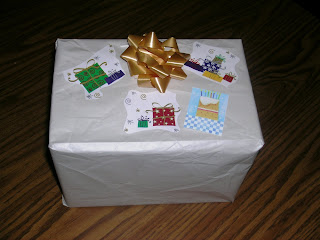
Here’s the first. We have a couple of birthdays to celebrate over Thanksgiving holiday. This one is wrapped in off-white packaging, decorated with pieces from one of last year’s holiday newsletters and a bow, and then one of my own specialized gift tags.

Off we go; for a Christmas that’ll be at least greener, if not green.

Share and Enjoy !

Shares

>In the eye of the beholder

>Loveliest of trees… or at least one of them. It’s a beautiful day in the neighborhood when the trees look like this.

It’s not so lovely when the road signs look like this. And this sign was quite readable, compared to the other road signs that we needed to read to reach our destination on Monday morning.

It was the kind of weather that made us decide to take a detour into a Farm and Fleet store and buy Amigo a new pair of boots. These were not inexpensive boots, either. They fit, they’re warm, and he can handle them himself. I call it an investment. I hope his feet are done growing for now….
You can see the evidence in the parking lot. The roads were that sloppy, too. My vehicle is so grungy that even my visually impaired teenager remarked, “Mom, your van is a mess.”
A snow- and road salt-covered minivan is just not as pretty as a snow-covered tree.

Share and Enjoy !

Shares

>Mush!

>It’s not what you think. It’s really the story of a kitchen near-disaster that spawned not a doorstop, but a colorful end product.
I bought fresh peppers from the farmers’ market in september and planned to dice and freeze them for fresh pepper flavor and color in the middle of winter. I thought, “Oh, I’ll use my new food processor! It’ll go so quickly.”
Famous last words.
I chose a blade that was much too fine, and the yellow pepper quickly became pureed instead of diced. Oops. I switched to a blade that allowed a larger cut for the red pepper, and my lovely kitchen gadget still blended it to a smooth consistency. I was left with colorful but slushy red and yellow pepper mush.
I froze them both anyway. I knew the flavor would still be good, and I was certain there would be a way to use this accidental concoction.
Last week I spread the yellow pepper mush on tilapia under the broiler along with the usual butter and lemon. It was delicious and looked lovely.
The red pepper mush ended up in several places. Tacos, superburgers, meatloaf, and eventually quesadillas.
I won’t make the same mistake a second, er, third time. But if this happens by accident, well, I know there are lots of ways to use pepper mush!

Share and Enjoy !

Shares